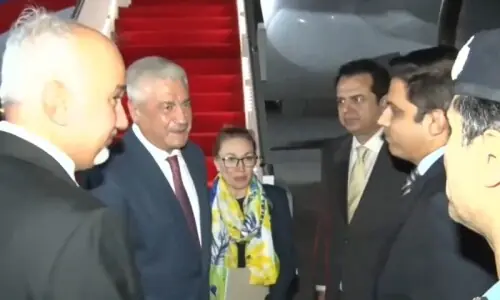
TRUST deficit was the underlying theme of Afghan President Hamid Karzai’s visit to Islamabad and it appears that while little of substance was immediately agreed to, there may have been some movement towards lessening the distrust. Mr Karzai may have boosted the speculation surrounding his visit when he agreed to stay overnight, but yesterday did not bring any significant news. Perhaps the public tone of the meeting was set by Prime Minister Nawaz Sharif when he claimed on Monday that the “central focus of [the Pak-Afghan] relationship has to be a strong trade and economic partnership”. That anodyne characterisation is almost as meaningless as the other familiar Pak-Afghan relationship clichés: an ‘Afghan-led and Afghan-owned’ peace process and seeking a ‘peaceful and stable’ Afghanistan.
As ever, the hard issues will have been addressed behind closed doors. And, as ever, little will be said publicly about what transpired until well after the event. Interesting to note, however, is that the Sharif government is still allowing such a visible and public role to the military high command in foreign relations. Both the army chief and the DG ISI sat in on meetings with Mr Karzai despite their Afghan counterparts not being in attendance. Perhaps this is because Mr Sharif wants to present a united front when it comes to dealing with the thorny Afghan problem. Or perhaps it is because the prime minister and his team have no real idea of how to proceed and are relying on the army’s greater experience to provide guidance. The former is a welcome possibility; the latter not so much.
Ultimately, though, the clock is winding down on the Karzai presidency and the already tiny window of opportunity for resetting ties between Pakistan and Afghanistan is becoming ever tinier. The slow grind of diplomacy may help in improving the atmospherics of the relationship — a reciprocal visit by Mr Sharif to Kabul is on the cards according to the Foreign Office — but it still leaves the critical triangle of Pakistan, Afghanistan and the US out of shape. Pakistan and the US may have edged closer on an acceptable post-2014 outcome in Afghanistan, but the Karzai government is still acutely suspicious of both Pakistan and the US — while the US and Pakistan try hard to hide their exasperation and frustration with Mr Karzai. How a puzzle that hasn’t been solved in over a decade will quickly fall into place in the next six months to a year and a half is difficult to imagine. Perhaps it will come down to there being no choice.