



 0
0

A corny tale
 Karachi seldom turns its back on those who seek its help. The city is as munificent as Mother Nature. No other metropolis in Pakistan boasts of such a vibrant, occasionally confounding, mélange of cultures and people, and accepts them as its own sans any xenophobic streak. This makes the ‘outsider’ – not as in Alber Camus’s character – assimilate into the delectable potpourri with not too much of a hassle, and adapt to the city’s culture of magnanimity like duck to water.
He hails from a remote area of the NWFP. Illiterate but conscientious and unskilled but punctilious, he always wanted to do something that could earn him a decent living, but never had enough to make ends meet. Somebody wise in his community advised him to go to Karachi. And so he did.
Once here, he decided to stand outside the premises of a Kindergarten school in PECHS society and sell corn on a pushcart. It didn’t take him long to gain popularity among toddlers and their parents. His corn on the cob and yellow grains were an instant hit.
He would reach the school half an hour prior to children’s home-time and stay there till each one of them left for home with their parents or whoever came to pick them up.
Apart from earning a decent amount, with the passage of time he developed a certain affinity with the institution and its students. He knew many students by name.
The children affectionately called him makaee wallah or corn wallah. This carried on for quite a few years, till the unforeseen happened: the school administration decided to shift its premises to another area, a bit upscale, for administrative reasons, quite far from the existing one.
This put the makaee wallah in a quandary. He could still sell his corn in the same vicinity, but now he had become emotionally attached to the children, their parents, their drivers, the janitorial staff of the school etc.
The very thought of losing their sight made him sad.
After mulling over the issue for some time he made up his mind: when the school’s furniture were being loaded onto a truck to be driven to the new campus, he hurled his pushcart into the truck and himself hopped onto it like a child looking for a free ride. The loaders looked at each other and smiled.
Now the makaee wallah sells his corn outside the new campus with the same fondness, and has found a shed nearby to rest up or doze off when he’s finished selling his corn to his favourite students.
And the corny tale continues.
—Peerzada Salman
Of coconuts
Life in Karachi never ceases to shock or surprise you. And it is the things that people do rather than the things they don’t do that shocks you the most.
Yesterday I saw this coconut seller at the intersection of University Road and Shaheed-i-Millat Road. Now you might be wondering what is so unusual about a coconut seller.
They are seen all over the city – the ones who sell coconut pieces cut into long strips laid out in a circle all around a metal tray.
They sell them at bus-stops and on minibuses, selling them for Rs5 or Rs10 a piece depending upon its size.
What got me transfixed was the way this one was cleaning them. He was holding the tray with his left hand; then tilted it towards one side to let the water inside flow into his cupped right hand, acting like a receptacle. Then he sprinkled this water all over the coconuts. He repeated the entire process at least six or seven times.
Remember that he uses his right hand for taking money from his customers. He also uses it for holding minibus rods so as not to lose his balance while holding his tray with his left hand.
Most people know that the rods are usually rusted and often our finger tips are soiled reddish-brown or yellowish-brown with the ferric oxide and ferric hydroxide that is contained in rust. Just imagine these same chemicals mixing with the water which he then sprinkles over the coconuts.
Besides, there is the pollution and dust from moving vehicles that keeps settling on the wet coconut pieces from time to time. And to make things worse, flies have a feast when cool and fresh coconut is laid out for them on a platter.
However, there are few among the citizens who seem to care that the fly is often a carrier of diseases, such as typhoid fever, cholera, dysentery, and anthrax.
The dipterous insect transmits diseases by carrying disease organisms onto food. It picks up disease organisms on its leg hairs or eats them and then regurgitates them on food in the process of liquefying solid food.
The next time you eat a piece of the palm-tree fruit think twice as it might prove to be a fly in the ointment.
Until now I had somehow been under the illusion that cleanliness was next to Godliness. But I had never realised that it could be this innovative!
—Mohsin Maqbool Elahi
Commercialised learning
The summer vacations in schools in Karachi usually start in June and end by the mid of August, but private schools do not leave things to chance and in the beginning of January insist that parents deposit the school fees for the holiday period in advance, i.e. the fee for June along with the fee for January and the fee for July along with the fee for February.
These are bad times and almost everyone is going through a crunch period, yet for the sake of children parents go to all means necessary and ensure the fees is paid as per requirement of the schools despite knowing that it’s unjustified.
Most private schools in the city are minting money in the name of education. In addition to admission and tuition fee, parents are asked to pay registration fees, annual charges, extracurricular fees, security deposit, enrolment fees, library charges, voluntary donations, sports fees, computer fees, lab fees and examination fees.
Education is one of the foremost needs of a child and it is really regrettable that we live in an age and society where the quality of education is less significant to the quantity of cash flowing into the coffers of these schools.
Many private schools, which do not demand as much as few other private institutions ask for, do not have education standard better than that of government schools. While the only few private schools that offer quality education demand sums that only the affluent class may afford.
Commercialisation of education is reaching alarming proportions compounded by the growing disparity between private and government schools in terms of standard of education.
The situation deprives children of one segment of society of a proper education, causing major setbacks in their future lives, while allows the affluent class to reap the benefits of quality education and have a greater opportunity in life.
Unfortunately, we do not have any uniform system of education. While parents are asked to pay more and more, teachers are employed at minimum wages, private educational institutions directorate seems lacking the will to change the norm of things.
Will someone take heed and set things right in the education sector? I fear not.
—Syed Ali Anwer
Compiled by Syed Hassan Ali
karachian@dawn.com
Another life lost
Sir,
 Another precious life was lost on the evening of Jan 24, thanks to yet another over-speeding truck. I was one of the many unfortunate eyewitnesses waiting for their ride back home from Karachi University when an over-speeding truck took the life of Anum Zehra, a student of third year economics.
It is not the question of ‘murdering’ (in my eyes) just one KU student. This taking of precious human lives has become a common practice. Following of traffic rules is the least priority of every citizen of Pakistan (myself included).
The traffic police are just a mere burden on state finances. They have absolutely no authority, and whatever they have is compromised for a few bucks of bribe.
The authorities concerned in this matter are hugely ignorant.
They move around in their cosy air-conditioned cars and have no concern for fulfilling their duties to improve the ever deteriorating state of traffic. Over-speeding heavy vehicles (especially dumpers and water tankers) keep on moving around the city like rampaging beasts, killing innocent people every other day.
Ironically, in most such cases the drivers somehow manage to escape from being punished.
They are able to run away from the spot, or they bribe themselves out of the situation. Very few are brought to justice.
Much has been written about the traffic situation of Karachi, but the government has done very little to curb the loss of life in this manner.
I hope that the murderer of Anum Zehra is brought to justice.
YASSER ALI SHAH
KU student
North Nazimabad
Load-shedding
Sir,
Raja Pervez Ashraf announced on Jan 9, 2009 that load-shedding in all the major cities of Pakistan has been discontinued with immediate effect. I am rather confused as more than an hour’s load-shedding continues in Karachi.
Does this city fall within the definition of a big city? Is it considered a part of Pakistan? Will someone in the corridors of power clarify?
SHAHID RAZA
Gulistan-i-Jauhar
Sir,
The City of Lights has become a place without power. We are the ill-fated residents of Works Co-operative Housing Society, Block 4, Gulistan-i-Jauhar, where power is available everywhere except the society.
We have already paid a huge amount in the form of ‘share money’ and we are still running on the kunda system. Would the authority concerned please kindly pay attention to this matter and solve the problem.
A RESIDENT
Block 4
Gulistan-i-Jauhar
Marriage firings
Sir,
It has long been experienced by the majority of Karachians that although a number of good laws exist, their effective implementation is almost lacking. A glaring example of this could easily be provided by the custom of firing at late night marriages.
Apparently, this situation is a result of apathy and lack of seriousness in the implementation of the concerned laws. The centuries old tribal practices also contribute to the problem. Total control of this menace requires necessary cooperation on part of the city administration, police force as well as the citizens.
The very purpose of lawand the time spent on it is wasted if the implementation is ineffective or partially applied.
Since marriage firings have recently become more frequent, causing a lot of inconvenience and insecurity late at night, the issue has to be dealt with immediately and effectively around the marriage halls and lawns.
DR S. IFTIKHAR AHMED
PECHS
Fire tragedy
Sir,
This is with reference to the recent tragedy of a fire that erupted in North Karachi, which claimed 40 innocent lives. According to the media, most of the dead were children and women belonging to the poor, labour class and came from Punjab in search of bread and butter.
The thing which amazed me was the news scrolling on TV that our prime minister has ordered an inquiry into the matter. Like any other incident in the country, whether it is suicide bombing or cases of fires or train accidents or anything else like that, why do the rulers have to order a probe or inquiry? Can’t the departments concerned take action as per the law?
What impact will the PM’s order have on the normal course of the investigation?
TARIQ
Via e-mail
city@dawn.com
‘Aids vaccine already exists’
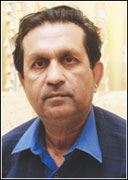 KARACHI: In view of the difficulties and high costs involved in different drug treatments, preventing the HIV infection has been the major focus of research in combating Aids.
A vaccine, it has been assumed, would probably cost less, thus being affordable by developing countries, bearing a major burden of the deadly disease.
Though many claims have been made, a vaccine for Aids still seems to be a distant dream even after decades of research.
One of the few Pakistani scientists working on this difficult task is Dr Omar Bagasra, an eminent immunologist, molecular biologist and retro-virologist working in the US.
A recipient of numerous awards, Dr Bagasra is currently the director of Claflin University’s South Carolina Centre for Biotechnology and a diplomat of the American Board of Medical Laboratory Immunology and the American boards of Forensic Examiners and Forensic Medicine. In 1995, he was also nominated for the King Faisal Award for Medicine.
One of his major contributions is the invention of in-situ PCR (Polymerase Chain Reaction) technique, enabling single copies of a gene to be amplified inside a cell.
Dr Bagasra’s research interests have long been associated with the study of HIV and Aids. In fact, he has been on the trail of the virus since 1981.
Recently, he was in the city and gave presentations at a few universities.
Talking to Dawn about his work on the development of a vaccine for HIV/Aids, he said that it was a brand new concept in vaccination. “We think we have a way to stop HIV. In my laboratory we have discovered some genes, which, if injected into a human body, immunises a person against HIV. That means an Aids vaccine already exists.”
Elaborating upon this, he said that as part of his work he experimented with different blood samples.
“I tested the blood samples of 120 people; infecting the same amount of virus in a sequence. But, there was no development of HIV in some blood samples no matter what you do. This made us realise that there are some people who are naturally immune to HIV.”
These findings led him to write the book, HIV and Molecular Immunity: Prospects for the Aids vaccine, in the 1990s.
He further says that a virus similar to HIV called the Simian immunodeficiency virus (SIV) is present among 40 species of primates, but they do not develop HIV. “They must have these genes. A fraction of the human population also has this RNA-based protected mechanism against HIV/Aids. Nobody has ever immunised with the RNA in history. So it would be the next big thing. The RNA-based vaccine would also help treat those infected with HIV.”
When asked about the time for the availability of the vaccine, he said: “The US has very stringent laws for testing drugs and vaccines. The process can take another 10 years in this case, but I plan to seek help from my friend, Dr Luc Montagnier, a French virologist who won the 2008 Nobel Prize in physiology for his discovery of human immunodeficiency virus (HIV) in this regard. I feel that the vaccine does not need to be tested on animals and can directly be used on humans.
“However, this has to be pre-approved by the US Food and Drug Administration and the Institutional Review Board before we can take such a step. Even then it will take 5-6 years to confirm that the protective micro-RNA can be useful,” he was quick to add.
Referring to the difficulties scientists have been facing in the development of an Aids vaccine, he said that the process was complicated. Earlier, people used protein-based vaccines for HIV/Aids. But, the results had been very discouraging, as it was observed that people who were vaccinated died first. “This was because people get Aids faster if the immune system has been stimulated.”
Dr Bagasra is also working on an oral vaccine for malaria using transgenic tomatoes to carry different antigens. “After resolving some technical issues, the tomatoes will be tested on humans. Since antigens have to be in the seeds, so initially it will be a costly affair. However, poor countries won’t have to bear the cost, as we plan to seek the World Health Organisation’s help in this regard.”
Giving some insights into crime scene investigation, Dr Bagasra said DNA profiling had revolutionised forensic science.
“Every human being sheds 10 per cent of his or her skin every day. If a crime scene is not disturbed and investigators reach the site quickly, the identity of the individuals at the time of the crime can be ascertained by a filter that collects the skin particles left there. But, for that you need to get a DNA reference sample to match the evidence taken from the scene,” he said.
However, this helpful gadget did not undermine the significance of conducting a proper investigation and collecting other evidences from the crime scene. And, in fact, 90 per cent of crime cases were resolved without resorting to DNA testing in the US, he added.



























