



 0
0

Fish out of water
 However, this by no means is an indication that good seafood is not available in Karachi. Rather, it seems people like to enjoy seafood as an exotic alternative to the regular line-up of kebabs, tikkas, so on and so forth. As a matter of fact, crabbing – that is going out on a boat into the open sea to catch, cook and then devour crabs – has caught on, especially with the yuppies of Karachi, like wildfire.
But if crabs are not your thing for any particular reason, there are plenty of fish in the sea off Karachi to please your palate. Indeed there are five-star restaurants which feature seafood specialities, while some of the multinational joints offer fillets of fish in between burger buns. But in case you’re in the mood for something more proletarian, there are numerous joints located all over the city which offer different kinds of fried fish at reasonable prices.
In my search for the great Karachi fish fry, I and a fellow landlubber ended up in the noisy, gastronomically blessed strip of Karachi known as Burnes Road. Now Burnes Road offers a variety of cuisines and is touted by some as a ‘food street.’ Whatever the merits of that nomenclature, sure enough seafood also has a presence here and our party of two ambled over to a makeshift set-up that was displaying a variety of fish in various states of marinade, with a giant vat of boiling oil placed by the side. Both of us being novices when it comes to seafood, we decided this was a place as good as any and decided to down anchor.
A price list displayed various types of fish sold by the pao, or 250 grams, including dandia, mashka and surmey, which, I am told by those in the know, is the local name for mackerel. Settling on what looked like the most delicious of the whole lot, we settled on a whole dandia, as well a quarter kilo of fish sticks covered in besan, or gram flour.
After a brief wait, it turned out to be quite a decent choice for a total shot in the dark. Guided by a very helpful waiter – a rule of thumb: the humbler the joint, the chummier the waiter – we soon dug into our marine feast. Sure enough, the dandia was deep fried and the marinade provided a crispy prelude before reaching the fluffy flesh of the fish. Though no experts, it seemed to us that the catch was fresh.
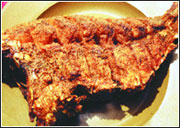 The fish feast is accompanied by chapattis from a nearby hotel, while the waiter will bring you tandoori naan on request. A tangy mint and tamarind chutney accompanies the main course. At first glance, it also looked like it came from the sea; however, thank God it tasted better than it looked. There is no salad on offer, though the waiter will grab you a small saucerful of sliced onions from the hotel next door on request. One feels that a few wedges of lemon and a slice or two of cucumbers and tomatoes would only add to the experience.
However, the oil used to fry the fish seemed a tad suspect and as a precaution, make sure not to have the fish too late at night, especially if you have a weak digestive system.
As for beverages, there is the option of the regular cold drinks. But considering that it was a freezing, windy night, I opted to experiment with fresh orange juice. However, this grand scheme soon crumbled as fried fish with fresh orange juice just doesn’t work, and you’re probably better off with the fizzy stuff.
Our knowledgeable waiter informed us that both types of fish we consumed – thankfully low on bones, one of the biggest drawbacks of eating fish – were saltwater fish, as opposed to the freshwater fish available in the Indus and other rivers of Pakistan. Matter of fact, it was recently published in this newspaper that palla, a fish renowned for its flavour and aroma, is fast disappearing from the waters of the Indus.
There are many other fish joints in Karachi that offer similar and perhaps better concoctions, especially those known for their fish curries, a variety of seafood I’m not exactly crazy about.
Considering the much warmer temperatures that prevail in Karachi during the rest of the year, perhaps a fishy feast is a well-deserved winter treat for the seaside citizens of the city.
qasim.moini@dawn.com
The road to redemption lies beyond a ticket
 Admittedly, the federal capital is all the better for a semblance of discipline inculcated by diligent personnel of the Islamabad Traffic Police following the successful Motorway Police model.
They have motored the citizens’ road behaviour like none before them: by issuing tickets even to the high and mighty — thereby, providing at least a symbolic manifestation of how law could, indeed, be equal for all.
This, of course, does not imply the high and mighty were not able to eventually get around to avoid paying the ticket fine, but at least, the willingness and spirit to set things right has been worth the while.
The average foreigner may have been amused when the police force announced last August to put their feet on the line, if drivers failed to fasten their seatbelts even as an air of cynicism abounded locally, over how the measure would be implemented. As a nation of cynics, we are given to dismissing trivial things like the rule of law on the strength of how powerful and connected we may be but skepticism in this case was also down to the dynamic range of egos ruling the capital’s roads.
Islamabad, of course, is the quintessential city of stiff upper lips — bureaucrats, political honchos, khaki machos and movers-and-shakers of other hues.
In that context, the year-end figures of traffic violations registered by the ITP are impressive, to say the least. The dossier given by ITP Senior Superintendent of Police Muhammad Zubair Hashmi, as a result of what he called “equal application of law” deserves mention.
According to the report card, traffic violation tickets were issued involving 487,273 vehicles during the last eleven months. During this period, a cumulative fine of Rs12, 26, 51,000 was imposed on violators that included 443 dignitaries.
The break-up of tickets for vehicular violations makes for interesting reading. Of the total 487,273 vehicles, 127,556 were motor cars, 81,016 wagons, 68,182 motorcycles, 66,962 taxis, 53,379 pick-ups, 50,596 trucks and 38,952 buses. Some 2,200 pressure horns were also removed from vehicles and destroyed.
From these figures, it is apparent that the majority of violators are in the realm of public transport, manned by drivers, who are either uneducated in proper road usage or simply take skills of beating the system — bred, no doubt, over the years by a lack of determination to implement a regimen of strict road discipline involving punitive action — for granted. The break-up of traffic violations show three major recurring offences since September 1, 2008, when the ticket-slapping regimen was set in motion. Failure to use seatbelt induced 44,450 tickets, using mobile phone while driving led 13,676 violators to be booked and flashing high beam snared 5,148 fines.
But, a more disconcerting corollary from these statistics is that the message is, perhaps, not reaching the intended road users.
The ITP may claim it is not for want of trying, for, they have held a few workshops and put up banners here and there as part of an education and awareness drive.
But it doesn’t take great genius to figure out that the disturbingly large number of violators are not quite the beneficiaries of these workshops nor are they exactly driven to fear by inane traffic qawaneen ki pabandi kee jiye (follow the traffic rules) messages in the form of irregular banners.
For instance, one has watched with great annoyance over time the lack of police control in Islamabad where the supposedly, banned high beam is concerned.
The general perception is that the police may be hesitant in reining in the “beamers” — as one friend dubs the offenders — because the dazzling flash is a particularly rich people’s fetish, who are too well connected to fear the long arm of the law.
Road users certainly need education and awareness. But, it is not formal education (whether one completed schooling) that matters but driver education and awareness, which instills the right road habits at the outset.
Britain has one of the toughest driving tests, which can be taken even by school dropouts. But the point is, by the time one passes the test, the correct road etiquette is ingrained in the mind of the driver.
The ITP has mercifully moved to the next level, where under the 11th schedule of the Motor Vehicle Ordinance, a driver who has committed 20 violations will have his or her licence suspended for a year. And another 20 would lead to the cancellation of the licence.
It is a positive step but clearly too lax. There is a need to drastically, reduce the number of violations for suspension and cancellation so that the law, rather than the wheel, rules the road.
The writer is News Editor at Dawn News. He can be reached at
kaamyabi@gmail.com


























