



 0
0

Sindhi and Urdu literatures have lost glory — Shamsher Al-Hyderi
 Shamsher Al-Hyderi is a poet, critic, journalist, broadcaster, former government servant and now the editor of a Sindhi-language daily newspaper. He is a qualified hakeem also. And if you see a traditional health-practitioner smoking incessantly, you may only exclaim: “God bless you,” or aap ka Allah he hafiz hai.
He began his writing career in 1951 and perfected his skills under the tutelage of his maternal uncle, Dr Naveed Husain Al-Hyderi, when he joined the weekly Aelan-i-Haq, edited by his uncle in Badin. At the weekly, besides his editing work, he wrote verses and pieces of literary criticism. In 1954, he moved to Hyderabad and joined a popular daily newspaper.
He is all praise for his uncle, “who was a known poet, critic, journalist, hakeem, orator and political activist, who had suffered incarceration for his political ideas”. “He not only helped raise me, but also bequeathed to me all his characteristics,” says Shamsher in an interview with Dawn.
His first collection of poetry was published in 1962. His published books total eight, but at least three books containing various genres of poetry — ghazal, nazm, wahi, kafi, lyrics, poems for children — and critical essays, both in Sindhi and Urdu, are ready for publication. “I have been contributing poetry as well as prose to various literary magazines all along my chequered career and a big stock of writings have piled. I’m trying to salvage some of the material. I’ll be content with whatever I manage to preserve for the future generations.”
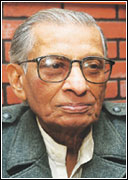 However, he is better known as a broadcaster, as TV and radio reach a larger number of people. “When PTV launched its Sindhi segment in 1970, I was invited by Aslam Azhar to join it as a script writer. The ‘ugly’ face the children first saw in the Sindhi programmes as a compere was mine,” he laughs. “I was the first person to write a play serial for it also.” He has written more than 100 Sindhi and Urdu plays and serials for PTV during his 38-year association with it, besides writing numerous songs both for PTV and radio.
What he likes among his many docu-dramas written for PTV include one on the Hur movement and the other on the life and achievements of Hasan Ali Affendi, the founder of the Sindh Madressatul Islam.
Asked if he could name who is the best among the current writers, he says: “It is difficult to say who is the best writer of the time. Who is a great poet is determined by history alone. We see hundreds of writers at a time in every country in every era, but how many of them live, and how long, after their death? Some survive for a year, a few for a decade, and some live on for centuries. For instance, Shakespeare is still alive, so is Shah Latif.”
He quotes T.S. Eliot who had said that a poet or writer may be popular during his lifetime because he writes what is the demand of the time, but his greatness lies in the opinion of the critics who measure the depth of his thought and his diction after he passes away. Asked what current trends are in Sindhi poetry and fiction, he says: “Influenced by Sufi teachings, Sindhi poets, writers and the people alike are generous, hospitable and liberal in nature. They are affected by injustices committed anywhere in the world — in Vietnam, Iraq, Afghanistan, Kashmir and Palestine, which is reflected in their poetry and fiction. But when something happens closer to home, they react to it more vehemently. So, the local issues, national and international ones have their due place in Sindhi literature.”
Asked if he is satisfied with the standard of current writings, he says: “A writer needs both observation and study. The present writers and poets seem to lack both. Consequently, both Urdu and Sindhi literatures seem to have lost their former appeal. Writers and poets now seem to be in haste to keep pace with the changing international times. They lack the drive to delve into international literary trends. So they produce much in quantity but not so much in quality,” says Shamsher, adding that “There is no reason to be disappointed, however. Such patches come in the history of every literature. Time will fill the voids.”
He says there has been hardly any poet or writer both in Pakistan and India whom he hadn’t known either when he edited the quarterly Mehran or when he was in the ministry of information. “They sent me their works for publication in the magazine and wrote to me otherwise too,” he says and adds with a sigh. “But, sadly, most of my contemporaries in the glorious caravan have proceeded to their heavenly abode.”
Born on Sept 15, 1931 in Badin, he received his early education in a Badin government school, then at Sindh Madressatul Islam in Karachi, and did his BA (honours) and Master’s from the University of Sindh. To carry forward his family tradition of hikmat, he acquired a diploma in Tib. He retired as a Grade 19 officer from the federal government in 1991 after serving the ministries of information, communications and youth affairs since 1956.
He has been a chain smoker since before partition and has never even thought of kicking this habit though he admits it is injurious to health. Surprisingly, he doesn’t have any symptoms of smoking-related ailments. There must be some hikmat behind it.
Left awaits return of the 1968-69 ‘revolution’
 “… a new 1968 is entirely possible in the next period” says Alan Woods in his introduction to Comrade Lal Khan’s detailed study of what he calls “The 1968-69 Revolution” in his recently published book, Pakistan’s Other Story. Alan Woods, renowned Marxist and an old friend and mentor of the author, bases his optimism on the prospects of the failure of the present leadership of the PPP and the return of the right wing which will trigger the kind of mass explosion experienced in the end period of Ayub Khan’s rule.
He argues that since the present PPP has turned its back on the Socialist traditions of the party and ignores its founding manifesto in trying to administer capitalism in a situation where the global crisis of capitalism renders this impossible, ‘they will be compelled to carry out deep cuts in living standards’ and pave the way for the rightists’ return and their own defeat.
This may be a likely scenario among others in drawing room chatter, but to imagine the kind of popular surge that was witnessed in 1968-69 can again gather force and shake the corridors of power would be hard even if some more elements of that ferment could be figured into the present situation. There is a stirring in civil society following the lawyers’ movement and it is wrong to say the general populace has no or little sympathy for it. But it is still a polite campaign with its moral strength and does not have the force of the 68 convulsion. And though people who were young enough then to know the direction that surge was taking may have forgotten the revolutionary character of the uprising, it should not be difficult for them to discern the difference between then and now, a difference that has gradually precipitated into the alienation of the masses from popular politics after the failure of what Lal Khan calls the 68-69 revolution.
He argues that in ordinary times society is dominated by ethics and norms of the ruling classes. All events are described in the language of the upper crust. The 68-69 revolution has also been a victim of this phenomenon in which the so-called left liberal historians and experts have also contributed. It has been described as an anti-Ayub agitation, general strike for workers’ demands, struggle for democracy against dictatorship etc. It was none of these asserts the author, and this is the other story of Pakistan.
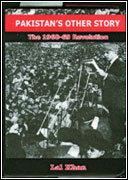 The 68-69 happening was “a mass upheaval that created a revolutionary situation, the character of which was socialist. This movement not only challenged the existing order, the dictatorship, the political superstructure, but above all the existing property relations. The revolution had instilled a will and determination, a consciousness of collectivism that dared to move forward and demand workers’ ownership and democratic control of industry, the economy and the whole of society.” The bourgeoisie was convinced that Pakistan was on the verge of revolution. And they were not wrong, says Alan Woods. Businessmen were paying large sums to get their money out of the country; foreign currency rates were spiraling and the British press thought the old regime could not hold for long. What the bourgeois politicians had acquired in ten years the masses had taken away in days. All that remained for them was what the proletariat and peasantry were prepared to hand over to them.
Lal Khan has surveyed this scene in the wider perspective of what was happening in the world at that juncture of time. He cites developments in Egypt, Indonesia, France (May 1968), the Italian “hot autumn”, Ireland , Mexico, Czechoslovakia, the USA and the Vietnam war and then revisits Partition, analyses the Communist Party and the degeneration of the left leadership and the early failure of democracy in Pakistan, the crossing over of the fence to the American side, the emergence of the new industrialists, institutionalization of corruption leading up to the 1965 war. This whole commentary reads like new history as it looks at developments from a window on the backside of the traditional façade.
The human face of the revolutionary struggle is beautifully captured by Lal Khan in the chapter ‘Witness to Revolution’ describing the activities of over two dozen workers in different parts of the country. It is a very readable portion, Munnoo Bhai quoting ZAB: ‘We may not mean it but they mean it’ after an impromptu address to village folk chanting ‘Socialism, socialism!!’
Chapter 7 of the book dealing with the crisis of the Left leadership is a profound analysis of the leftist scene from the Marxist view point going over the differences that resulted in the cleavage in the camp between Stalinism and Maoism, Lenin and Trotsky down to politics at home in the populism of Bhutto and the ideological confusion. Chapter 8 is again history discussing the sad saga of dictatorship and democracy taking sweeping views of General Zia, Benazir, the assassination of Murtaza Bhutto, the Kargil war and Musharraf stretching across to the present, the lawyers movement, Benazir’s assassination and the third term in power of the PPP.
What has happened, what has gone wrong with the state of Denmark? The 68-69 revolution had such a promise. All the ingredients of a classical revolutionary situation were present, except one: the revolutionary leadership. The movement in Pakistan , given correct leadership , could have led to a peaceful seizure of power, muses Alan Woods. But just as in France and Italy in 1968-69, the weakness was in the leadership. Neither Bhutto nor the National Awami Party were prepared to take power. This was what paved the way for the military coup. The new leadership of the PPP is sailing on a different boat towards different shores. Lal Khan thinks it is adrift. It is on course, moans the plaintive voice of the regime’s spokeswoman, Sherry Rahman.



























