



 0
0

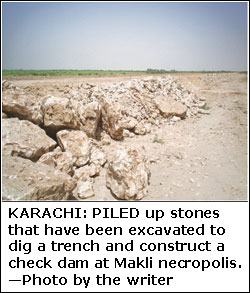 KARACHI, Jan 11: The resurvey exercise to determine the boundaries of the Makli necropolis, a world heritage site, that was to be conducted within a “couple of weeks” could not be started despite the lapse of over three months, it has been learnt.
According to highly-placed sources, the departments concerned are deliberately delaying the resurvey as it might reveal that certain portions of the Makli necropolis, protected under the Antiquities Act 1975, had been encroached upon, exposing the negligence of their duty of protecting the land of the historical graveyard, situated about 100 kilometres from Karachi on the National Highway near Thatta.
The issue came up when a neighbouring landlord, Ghulam Qadir Palijo, who is the father of Sindh Culture Minister Sassui Palijo, started digging a trench and built a check dam on the land that he claims is his, while the federal archaeology departments insists that the land is protected under the Antiquities Act 1975, which forbids such activities and prescribes long prison terms and heavy fines for violators.
As soon as the trench digging and dam construction work began, the archaeology department’s Makli curator approached the Thatta district administration about the activities, urging them to get the activities stopped to protect the heritage site.
The Thatta district administration swung into action and got the trench digging and dam construction stopped. Soon the well-connected Palijos pulled the strings and got a survey – in which the archaeology department’s curator also participated – conducted by the district officials within a couple of days, which declared that the Palijos were carrying out the work on their own land, which was adjacent to the Makli necropolis. As the issue involved a heritage site of international importance and the person – Ghulam Qadir Palijo – had already been accused of similar activities on the same site over a decade-and-a-half back, the media picked it up and gave it wide coverage.
In the earlier episode, Mr Palijo, then a Sindh Assembly member, was accused of building a road through the Makli necropolis to get direct access to his lands and after a lot of hue and cry raised by the archaeology department and concerned citizens, Mr Palijo stopped the road construction.
The government ordered an inquiry into the issue, the report of which was never made public, creating doubts in the minds of the masses that it probably held Mr Palijo – a ruling party MPA – guilty of tempering with the world heritage site that would not only embarrass the government locally but would also bring a bad name to the country internationally.
The news coverage probably put strain on the nerves of the accused and at least one of the mediapersons – belonging to a television channel – who had gone from Karachi to cover the issue was beaten up by Mr Palijo’s men – an act later regretted and described as a case of mistaken identity by Sarmad Palijo, a brother of Sassui Palijo’s. He had also explained that they were digging the trench and constructing a check dam on their lands to protect their lands from rainwater coming from the Makli necropolis, which is at a higher altitude.
Within a few days the Islamabad-based director-general of the Federal Archaeology Department, Dr Fazaldad Kakar, visited Makli to get first-hand information and, showing dissatisfaction over the survey conducted by the district administration, ordered that a fresh survey be conducted by the settlement department and a report be submitted to him within a “couple of weeks”.
He had pointed out that according to the department’s records, the Makli necropolis was spread over 912 acres, all of which was protected under the Antiquities Act – and all the relevant records and maps were available with the archaeology department.
He said that he wanted these 912 acres to be demarcated so that the department would put its markings showing the protected area and build a boundary wall and after that a buffer zone – as prescribed in the Antiquities Act – surrounding the protected site would be marked. He made it clear that the act did not allow excavation or construction activities in the buffer zone as well.
He said that after the demarcation was done, it could be determined if the trench digging and dam construction being carried out by the Palijos was within the protected area or outside it. If the work carried out was within the protected area, then legal action would be initiated.
Responding to Dawn’s queries, Dr Kakar said his department had continuously been contacting the settlement department and the Thatta district administration so that a fresh survey could be conducted, but he deplored that so far the exercise had not even been started.




























