0
0

 The goods in transit facility extended to Afghanistan (GITA), a major source of supply to local Bara markets is being misused to smuggle industrial raw material and consumer goods.
Some manufacturers told Dawn in Peshawar that the levy of regulatory duties on imports of luxury items has proved to be counter productive, as the Afghan transit trade facility has replaced the legal channels to bring consumer goods and raw materials. Pakistan has imposed regulatory duties on imports of more than 300 ‘luxury’ goods, to cut trade deficit.
“The regulatory duty on imports is proving to be a two-edged sword,” said Sharafat Ali Mubarik, president Sarhad Chamber of Commerce and Industry adding, “not only the government is losing revenue which it collects on imports, but it has also damaged the industrial sector in the face of growing volume of smuggled goods from Afghanistan.”
Sources said, raw materials and finished products imported under Afghan Transit Trade Agreement (ATTA) are sent back to Pakistan from Jalalabad, the bordering town of Afghanistan. Organised bands of smugglers ensure safe delivery of consignments to any destination in Pakistan.
A manufacturer in Peshawar told Dawn that a container load of stainless steel, imported through legal channels costs 800,000 whereas the same costs Rs300,000 if smuggled from Afghanistan through ATTA.
Consumer goods cost less if smuggled from Afghanistan. “I have to pay 35 per cent extra for many edible items if I import through legal channels compared to those being smuggled from Afghanistan,” said a trader in Karkhano market, famous for smuggled goods located on the fringes of Peshawar.
The negative list consisting 60 different items banned under ATTA to protect the local industry has been reduced to two items; now only cigarettes and automobile are under the ban.
With the present economic slow down, the volume of transit trade is on increase whereas the volume of Pakistan’s export is decreasing, said a Peshawar-based custom official.
“Pakistan’s exports to Afghanistan dropped to $600 million last year from $1.8 billion two years ago, whereas the size of transit business swelled to Rs85 billion in the same period from the Rs35 billion which clearly indicates that the facility is being misused greatly,” the official said. Currently the consumption of a number of items such as steel products, electronics, cloth, readymade garments and toilet-paper across the border is very limited, but their supply has increased considerably, he added.
Nauman Wazir, the president of the Industrial Association Peshawar, said: “The ATTA is responsible for the poverty and unemployment, particularly in the NWFP. If cheap smuggled goods are freely available, the local industries cannot flourish.” All transactions in this business are done through Hundi and illegal money transfers are also a serious issue of capital flight from here, he added while suggesting that the ATTA should be amended to facilitate the cross border trade in a way that it would not hurt the local industry.
The ATTA was signed on March 2, 1965 in Kabul to facilitate Afghan transit goods via land routes initially for a period of five years. Unless a notice of termination is given in writing by either contracting party to the other six months before the expiration of the five-year period, the agreement is automatically renewed for another period of five years. It can be terminated by either party at any time provided six months notice of termination is given by either party.
But the contracting parties are required to review the working of the agreement once a year. The agreement has not been revised for almost four decades, said the custom official. The revision of ATTA is currently under discussion on both the sides and a consensus has been developed on re-designing it.
Manzoor Elahi, a leading exporter and manufacturer, opined that ATTA is a two-way pact but practically it is unilateral, benefiting only Afghanistan. He said, bilateral accord is the need of the hour, adding that, “Pakistan has done enough to facilitate Afghan transit trade and now we expect the same from the other side.”
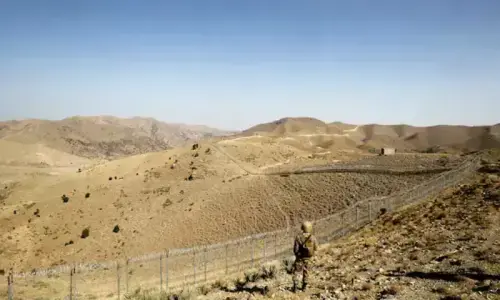
Apart from revising the ATTA, measures should be taken to counter smuggling of consumer goods from Afghanistan, said Mr Wazir, president IAP. Fencing of border is the only solution to counter the smuggling from Afghanistan, the major threat to our industries,” he added.
The growing volume of transit trade is also worrying the authorities responsible for checking re-entry of these goods into local markets, as measures are being taken to counter this trend, said Raja Sikandar, Director General Custom Intelligence, when approached by Dawn.
Curbing the smuggling is an uphill task because of the porous border, he concluded.