



 0
0

 Disability beyond its physical or psychological effects is often further debilitating because it has a tendency to exclude those afflicted from a normal life that others take for granted. Routine activities like going to the bathroom, driving a car, shopping and sometimes even sleeping are challenges that make life for the disabled an uphill task. To many it is an unimaginable existence and we are often quick to pity but we forget that life has a quality to persevere.
Disabled people across the world live fulfilling, contributive lives and their reality though a hard one is borne with persistence. This effort on their part is often enough matched by the care given to them by their family and friends; it is collaborative and is an important step towards inclusion.
Normalcy in such a context comes from removing the stigma surrounding these people of being ‘special’; it is by far the most important step. Inclusion is paramount. By treating them as individuals incapable of living without help, we rob them of their sprit as well as the confidence to face challenges of which there will be many.
It is in this regard that measures be taken to create such an environment. At home, this can be easily sought but what of the outside world. It would indeed be presumptuous to suppose that one can alter people’ attitudes; this of course is not to say that they can’t be but the burden there lies upon the individual. We can most surely start on this but let us look towards more pressing matters.
 As stated above, even everyday activities are demanding to the disabled but this should not be a bar to them as inclusion is vital. Now the government in certain cases can provide this to them. Public places are the most social of places for obvious reasons but to make them accessible to the disabled they need certain modifications. Of course these changes cannot always address the needs of all the disabled; disability in itself being quite broad but in most cases it most surely helps.
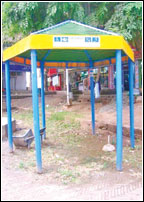
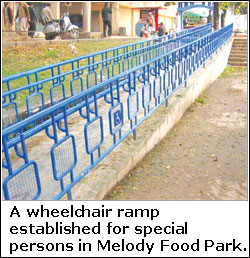
A good example of an accessible public place is Melody Market. Wheelchair ramps, separate sitting areas and parking are all but a few examples of the type of changes one can make to markets or public places. Melody has had them for a while now but as with all things has fallen to neglect and indifference; the latter being on the part of the citizenry for it is very easy to spot someone parking in a disabled only spots or sitting, as they use to in the designated area in the Food Street. As for neglect, the government, it seems, has more immediate concerns as the chairs and shelters in the said areas are either missing or full of holes. At least it was a step in the right direction. But when last remembered, Melody is not the only market in Islamabad and Rawalpindi, what of the others? Super, Jinnah Super, Aabpara, Commercial Market, Sadr, the markazs and all others are without any such aids and it is often observed how difficult it is for a wheelchair bound person and their helper to enter a shop or even just go around a market. One may think that these additions are unnecessary expenses and that ‘they’ should just get on by but it is exactly such condescension that needs to be removed. A simple ramp can mean the difference between going and not going out; between recovery and decrepitude. The cost of doing this is close to negligible but then, of course, this is more a matter of interest then anything else.
The Ministry of Social Welfare and Special Education is responsible and where it did appreciative work in Melody, it failed to extend these to other markets. Another thing missed was public rest rooms. In short supply to begin with, accessible rest rooms are unheard of; creating these along with those above would be a boon for the handicapped. Separate parking spots as mentioned above were initiated but their enforcement was not really a ministry issue.
The Traffic Police and CDA are responsible and according to some sources, the ministry communicated these concerns to them but no action regarding offenders or even maintaining such spots were ever taken. The authorities need to take this under consideration.
What else is imperative is awareness and education. Until and unless the common citizen is schooled in this regard, he will either be uncaring or even worse, indifferent. Just as the Traffic Police has started to teach a curriculum in schools about road rules etc, so should the Ministry follow suit. After all that is what it is meant to do.
Providing such facilities to the disabled is among their basic rights but as Mr. Azam, who has worked with the disabled, points out ‘no one cares, they think its someone else’s problem but disability can happen to anyone and then what?’ We need to honestly consider this for the sake of the disabled, as they are as much citizens as the rest of us.
The writer is a freelance contributor and can be reached at:


























