



 0
0

Mulla-bureaucrat alliance hampers development of drama — Ahmed Hamesh
 JUST to be able to describe a point clearly in his (in)famous story makhhi (the fly), Ahmed Hamesh visited the mortuary of the Civil Hospital in Karachi 20 times to see dissection of bodies and learn how the fibres of a heel looked like. This is his commitment to writing, which the noted poet, playwright and short-story writer has been doing for the last five decades. The golden jubilee of his writings was marked at a ceremony a couple of weeks ago, where speakers lavished praise on his contribution to Urdu literature.
“I wanted to make sure that what I write should be the correct description of a human heel,” he says in an interview with Dawn in the library of the National Academy of Performing Arts on Tuesday. “The heel fibres on the bone looked like noodles.”
Hamesh is probably the only person in Pakistan to have a command over Sanskrit as well as Hindi and Urdu. Zia Mohyeddin, the renowned artiste and chairman of Napa, recognised his this talent and asked him to teach Hindi drama to Napa students and translate Sanskrit and Hindi plays into Urdu. Beginning in 2005, he has so far rendered 40 such plays into Urdu, a few of which have already been staged. Speaking on the prospects of stage drama in Pakistan, he says he does not have much hope for it.
“The conditions here are not conducive to drama. The mulla-bureaucrat alliance creates hurdles in the way of its development. It is thriving in India partly because it is part of the Hindus’ religion. It is Zia Mohyeddin who manoeuvres through various hurdles and succeeds in staging plays. Otherwise, there is no appreciation and encouragement for drama here.”
Asked how he got away with a story like makhhi, whose explosive contents could have landed him in court, he says he was prosecuted in a Patna court as his book was published in India. But the court let him off as he was then a Pakistani citizen. Pakistani authorities probably ignored it because the book was published in India.
However, his story faced a barrage of criticisms at that time with critics saying he was promoting filth. He explains that he “wrote filth not to promote it but to warn people of it so that they avoided it.” The story has more nauseatingly sleazy matter than pornography in it.
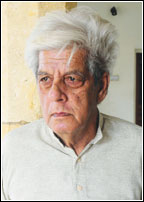 Hamesh has been editing a quarterly literary magazine, Tashkeel, since 1990. Now he is being assisted by his daughter, Injila Hamesh. In his magazine editorials he makes scathing attacks on unscrupulous individuals, and customs and institutions he thinks are not doing the right things. “I write in Tashkeel what I deem appropriate, and care little about how others will react to it. Fortunately, my enemies are jahil (ignorant) as they rarely understand what I write.”
Asked how he managed to acquire the mastery of Sanskrit, a language not only difficult to learn but dying even in India, he says he lived in an Indian town where Hindi and Sanskrit were part of school syllabus. “Actually I began learning Urdu rather late. After Hindi and Sanskrit, it was Arabic that I learnt as part of my religious education. My parents and grandparents were deeply religious people,” he adds. “I don’t claim that I’m a master of the two languages, but I’m a good student of Hindi and Sanskrit.”
Asked if he was impressed by any particular fiction writer in Pakistan, he says he hasn’t been impressed even by himself yet, “How can I be impressed by any other writer? As he is not satisfied with his literary achievements, he wants to write something really shocking. “I want to write something as shockingly close to reality as to run the risk of being persecuted for it – as is the fate of outspoken writers in Turkey. I do care about my family and do not want them to suffer on my account. But I’ll write that piece of reality no matter what happens as a consequence.”
What bombshell he is going to drop on the literary world will be known only when it explodes.
Ahmed Hamesh was born at Banspar in the UP on July 1, 1937. His mother died when he was 10 years old. When he could no longer bear the harsh treatment of his stepmother, he escaped from home and arrived in Lahore in 1955. He has been writing poetry since his schooldays, but he seriously began pursuing his writing career in 1958.
His first poem was published in Lahore’s Nusrat magazine in 1962. His bitter past is reflected in his writings, both prose and poetry. His first collection of short stories titled Makhhi was published in 1962. Hamesh Nazmein, published in 2005, is a collection of his poems. Kahani mujhay likhhti hay, his second collection of short stories, was published in 1998. The Napa library, where he works with his daughter, who is also a short-story writer and poet, has a lot of rare books on drama, some of them imported from India, and he naturally relishes their company.
He says prose poetry has its roots in Vedas, and claims that in Urdu he is the pioneer of this genre. “After the publication of my poems, several poets have adopted this genre. Some poets wrote it before me, but technically they were not prose poems. Tagore’s Gitanjali, which was a prose poem, was written in English.”
He seems to be very fond of Tagore. Speaking on the issue of Tagore getting a Nobel award and Iqbal being ignored, he says no comparison can be made between Rabindranath Tagore and Allama Iqbal. “Tagore’s canvas was broader. His subject was man whereas Iqbal’s focus was on pan-Islamism.”
No sir, all is not ‘thup’
 It is not all ‘thup’ (at a standstill or in limbo) in the country as everybody who is anybody in Islamabad is saying. No doubt a score of Planning Division officials hired on contract basis haven’t been paid their salary since May last as their file for further extension in their tenure is gathering dust in the Prime Minister’s office who doesn’t have time to look into probably scores or hundreds of such other cases. People are talking about projects which have been stopped in midstream because funds are not being released etc., etc. What is being suggested by saying ‘sub kuchh thup parra hey’ is that all the good works of the Musharraf regime have been stopped and all of his bad works continue without the need for reapproval. Yet, as I submitted, all is not ‘thup’. There are good men and women around who continue their good work, regardless.
There is this fellow, Tauseef Ahmed Khan, Ayub Malik and their team of honorary editors and contributors who have been bringing out a monthly Badalti Duniya for quite some time almost regularly with the meager resources they can manage. Malik is often seen at intellectual gatherings distributing the magazine free of cost to friends and participants. One can only hope some of its copies also get sold because among its honorary contributors are writers like historian Mubarak Ali, Prof Mehdi Hassan, Prof Pervez Hoodbhoy, Dr Solat Nagi, veteran journalist Hussain Naqi and Dr Aslam Naru.
Edited by Tauseef Ahmad Khan it offers good reading material and analyses of national and international events from a progressive perspective. The last issue has Hussain Naqi writing on the somersaults of the Peoples Party, Naresh Nadim on poverty in India, Aziz Bugti on the future of Balochistan, Abdul Khaliq Junejo and Dr Nazir Mahmood on the crisis of capitalism and Dr Mubarak Ali on the impact of resistance movements on society. Tariq Ali has been included as a guest writer.
Hum Shehri, a weekly on the pattern of the late Lail-o-Nahar, is another gallant effort of a bunch of young men who want to arrest the decline and channel the direction of change towards national progress. Edited by Shafqatullah (who also runs an FM channel from Lahore and Multan) and Wajahat Masud the magazine spans all aspects of the national scene, from politics to cinema and sports.
The 11th issue carries a very comprehensive interview of Dr Ayesha Siddiqa in which in addition to dwelling on her career as a writer she also holds that the military has not abandoned the possibility of another intervention in politics. Fully illustrated with pictures in colour and moderately priced at Rs30 only, it is affordable reading for a couple of evenings and helps you catch up with the going week.
Awami Jamhoori Forum is in its 46th issue. Edited by Aamir Riaz the magazine focuses more on the trade unionist side of the Left and the parochial side of the right of centre, and with its quaint emphasis on calling Lahore as Lhore and dropping prepositions to indigenize its Urdu suggests its proclivity towards creative journalism.
The editorial discusses Obama’s presidency and shows the thinness of illusions a considerable section of opinion has been spinning. There is an interesting interview of over hundred years old Agha Khan Sahotra, a legendary leader of Punjab’s lowest castes – the chooray, chamar, changar, mussallis. It reveals a forgotten inner layer of people’s struggle in Punjab. Why this great fighter, if he is still alive, not being given his due share in public recognition is hard to understand.
Ashfaq Salim Mirza’s review of Sarmad Sehbai’s new book of verse dwells on its mythological sources which no other critic has done.
Though printed and published in Pakistan Mustaqbil claims to be a European magazine and espouses human rights, peace and democracy. The copies of the issue devoted to the struggle for independent judiciary were distributed by a gentleman who had flown all the way from Belgium to participate in the launching ceremony of the Awami Party here in Rawalpindi last October.
The present judicial crisis and the lawyers’ movement have been discussed in detail besides informative articles on important court verdicts. Justice Nasim Hassan Shah’s review of Bhutto’s case is a special feature in which he claims he and the chief justice had tried to save Z.A. Bhutto’s life.
Irtiqa’s 46th issue is out. It has a fine piece of opinion on Ahmad Faraz by Dr Muhammad Ali Siddiqui. More on this important organ of enlightened opinion in coming weeks.


























