



 0
0

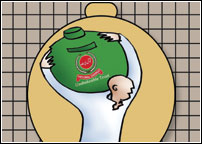 According to the State Bank Annual Report 2007-08, Pakistan’s total public debt rose by a whooping 26.9 per cent in that fiscal year.
On June 30, 2008, the figure was Rs6.417 trillion. To this staggering amount, another Rs379 billion were added until November 17, 2008, raising it to Rs6.796 trillion.
SBP places a fair share of the blame for record inflation during FY08 on rising public debt. Indeed fiscal management by the present and the previous government bordered on recklessness. In the coming years, that will be characterised by resource constraints hitting the economy in a variety of ways; it is imperative that fiscal deficit and monetisation thereof is contained in a determined fashion.
With the planned reduction in outlay on services and projects, economic growth in FY09 is estimated to fall to 3.5 per cent of the GDP. With its population growing annually at two per cent plus, Pakistan can’t afford it; we must revive a culture of restrained consumption and higher saving to invest more in assets and institutional arrangements that make self-sufficiency the lifestyle.
In spite of the problems that Pakistan faces on diplomatic front (with their adverse consequences on its domestic and external sectors), the state has the obligation to strive for economic stability. It calls for re-doubling the efforts to bolster state resources without increasing money supply (i.e. monetising the debt) and curb consequent rise in inflation.
The unfolding global financial crisis has worsened Pakistan’s already weak country risk perception, and internal political tensions, to which no end is in sight, have exacerbated it. In the foreseeable future this scenario will limit Pakistan’s ability to tap global capital markets either for borrowing or for privatising its state-owned assets.
What must be promoted now is saving by offering options that appeal to the people. For understandable reasons, banks (only two in public sector) haven’t shown the urgency the scenario demands because they need a profit (not economic rationale) to undertake any activity. Only the state, hopefully, can appreciate the economic benefit of boosting savings even if it is at break-even cost.
In a liberal setting, that we were made to believe was ideal for economic emancipation the state is left with few options; National Saving Schemes (NSS) are the ones that give it direct access to savers to mop up medium and long-term savings that the Shaukat Aziz regime exercised only reluctantly. The term-debt raised through NSS and PIBs since 2002, portrays this unhealthy tendency.
According to the SBP, continued rise in fiscal and trade deficits was visible since 2005. Yet, neither the previous nor the incumbent regime innovated options that could offer the state greater access to savers instead of borrowing from the SBP as depicted by the stagnant network of the NSS, frozen strength of its manpower, and its outdated procedures and systems.
The view that increasing the rates of return on NSS alone will do the trick reflects bad governance; it defies common sense, let alone meeting even the basic managerial challenges of the 21st century. What it does reflect though is a refusal to do even the minimum for achieving economic stability (i.e. containing inflation) in the toughest of circumstances.
With a network of just 369 offices, how will NSS schemes be marketed to millions of savers in scores of small towns? In a pervasive environment of financial illiteracy, can the archaic book and record keeping systems of the NSS provide savers – the majority – the operational convenience they deserve? How in this age can NSS boost its response speed unless its operations are automated?
Non-essential consumption won’t drop unless saving becomes an attractive and convenient proposition. Even though Pakistan’s worsening country image is making people aware of the challenges they must prepare to confront via greater self-reliance, high inflation doesn’t permit saving even by those cognizant of the need there for. In this setting, making saving a worthwhile proposition calls for a lot.
Yet, each increase in the rates of return on NSS entails an initial cost to existing NSS certificate holders – penalty for premature liquidation of existing saving certificates to re-invest funds in certificates offering higher returns. Is this how we propose to encourage saving among the financially illiterate? These punitive profit-raising tricks befit the private sector players, but not the NSS.
Rumours about recent capital flight aren’t mere stories. UAE-based investment bankers confirm these rumours. Confidentiality rules forbid quoting specific figures but their estimates disclosed the huge sums floating around without going into real investment in Pakistan. Many in the lot owning such wealth are not speculators; they are looking for positive real rates of return that banks don’t offer.
The recent banking sector crisis shook depositor confidence, fortunately only for a while. Some of the depositors are now unwilling to put their savings back in banks. The highest-ever amount of money in circulation shows just that. This scared bunch could be potential investors in NSS but they won’t invest in NSS because of the incapacity of the NSS to offer them the inter-active conveniences they seek.
Successive regimes did not appreciate the potential NSS has for diluting the cost of borrowing from the powerful corporate sector. True, the administrative cost of borrowing small sums is high but not the direct cost. For the state the priority should be bolstering its funding ability at the lowest direct cost to meet crucial expense needs. The benefit of inculcating saving will come as a welcome bonus.
In spite of all the marketing, inter-active and administrative handicaps that the NSS suffers from, in the past 17 months it mobilised fresh savings of Rs135 billion. It isn’t hard to imagine what it could achieve if its network was raised to, say, 500 offices, its operations were automated, its manpower doubled and, above all, its customer interaction procedures and systems were made truly customer-friendly.
It is time the government commenced a crash programme for implementing these reforms in the NSS to let this institution rise to its full potential. Capital expenditure on implementing these reforms could be the most productive that the present regime might undertake during its tenor. In spite of Pakistan’s high country risk, any IFI would be more than willing to lend for this expansion programme.





























