0
0

‘The LTTE is media-savvy’
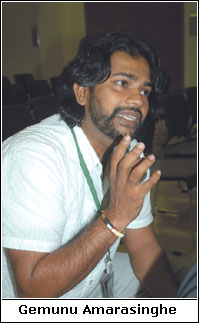 WE in Karachi are no strangers to violence. Unfortunate as that may be, it is still some solace that at least the metropolis is not a declared war zone – though at times this notion would be questioned.
However, photojournalist Gemunu Amarasinghe, who works for the Associated Press and is based out of Colombo, Sri Lanka, has spent the last 10 years covering issues related to the war which has raged for decades in his island homeland, pitting the Sinhalese government of the south against the Liberation Tigers of Tamil Eelam (LTTE) of the north.
Dawn caught up with Gemunu when he was in Karachi recently to attend an international seminar on photojournalism. The conversation centred around the conditions journalists have to face in a state of war.
“To understand the media situation there (in Sri Lanka), it is very much parallel to what is happening in the country. We had a war, there was a stalemate, and then there was an official ceasefire. During the ceasefire the media enjoyed quite a lot of freedom. There was freedom of access. But since the last two years, when the government officially came out of the ceasefire and went for all-out war … that approach has changed many aspects of democratic living in Sri Lanka. It has affected the independent media,” said Mr Amarasinghe.
He was asked if, as a war correspondent, he was provided with any protection or training before going into the field.
“The government has given no access to any independent media from going anywhere close to the war. In doing so, it has effectively made a situation that to gather information, we have to rely on the government’s official announcements. The government has set up an institution called the Media Centre for National Security, which is the sole authority to (report) anything related to the war.
“The government feels it is fighting a decisive war and that either you are with us or against us. The media – as I understand it – is always with the people, not with the government. That is the clash. The government has used a very heavy hand with journalists and photographers,” he said.
Gemunu Amarasinghe observed that the conditions are such that common people in Sri Lanka often suspect the media of being in cahoots with the ‘other side.’
“If you look back at the war, the government attacked the rebel-controlled areas while the rebels tried to destabilise the government. So, a fear psychosis was created in the minds of the people, even living in the south. The government set up about 12,000 neighbourhood protection committees basically telling people to be aware. This created a fear psychosis and hatred against independent media, for instance insinuating that the media might be taking pictures to allow the rebels to set up bombs. The situation in Colombo is such that if you pull out a camera, you’ll have 50 or 60 guys around you wanting to set fire to you.
“In a democratic society, people believe the media is helping them. But the propaganda has been so strong that the civilians see the journalists as a threat, helping the rebels. If someone is indeed doing so, they should be dealt with according to the law. But when you’re afraid your children’s school will be attacked, you don’t see such things. It’s frustrating to be an independent media worker in Sri Lanka.”
He was asked if the Tigers were also guilty of abuses.
“The Tigers have a history of doing so, but from my own experience, they do it very smartly. They seem to use the media – so does the government – but the Tigers are media-savvy. Rather than issuing death threats against the media in non-LTTE controlled areas, the Tigers are more accommodating, to an extent.”—QAM
Life in highlands not as pleasant as it looks
Tourists to hilly areas often turn out to be ignorant of the highlands and think that the mountain dwellers, unlike the people of plain areas, face no hitches in life and are living in total prosperity. But if someone peeps into the life of a common highlander, he will easily have an idea of how they brave difficulties in their daily life.
Mountain people in northern parts of the country like Chitral, Kohistan, Swat and Hazara region have little access to basic amenities. A major portion of the mountain populations still have no electricity, roads, telephones and health and education facilities. Buildings for schools and health facilities are without teachers and medical staff.
Take example of Thandiani, a famous hill station in Abbottabad district. Inhabitants of the area have no health facilities and have to go to Abbottabad city for getting treatment. A small dispensary established in a room at the hill station has been closed down.
Jamal Ahmad, who is running tea stall in Thandiani, said that local authorities had closed down the dispensary in 2005. The health facility was set up in a tiny room, a property of Church of Pakistan, to facilitate local people and provide emergency cover to tourists.
“People have now to go to Abbottabad city for treatment of minor health problems since this dispensary has been shut down,” he complained, adding: “Officials might think that poor people don’t fall sick that is why the facility was closed.”
Thandiani, situated 2,700 metres above the sea level and 24 kilometres away from Abbottabad city, is one of the famous hill stations in the country. Thousands of domestic and foreign tourists regularly visit this summer resort every year but the area has not been provided electricity.
Sardar Mohammad Sadiq, a resident of Thandiani, said that there was one middle school for girls and a high school for boys in Khatwal union council, which has over 25,000 populations. He said that teachers hailing from the far-flung areas usually remained absent.
He said that the girls’ school was without science teacher since long while headmistress did not bother to visit her office. He said that basic health unit in Kalapani had been without doctor and essential equipment. He said that district authorities had appointed a dispenser at the health unit.
People living in high altitude areas of Abbottabad district have been facing scarcity of drinking water particularly in winter season. They said that drinking water supply lines remained chocked when temperature fell to freezing point. Even their mobility is badly hampered and they remain confined to their homes as the hilly tracks, which are mostly dirt tracks, become dangerous due to rain or snowfall in winter.
Infrastructure in Chitral district is in the worst condition as compared to Hazara region of NWFP. A resident of Chitral said that the district had total 36 valleys where road network was in bad condition. Unemployment rate is very high in the mountain areas as compared to urban areas. Growing maize and potatoes are their main sources of income. He said that there were valleys in Chitral where government had yet to establish roads, schools and health centres.
Unemployment, poverty and lack of basic facilities are forcing highlanders to move towards urban areas of the country, which have resulted in burdening the cities’ infrastructures.