



 0
0

 LONDON, Dec 11: Oil prices jumped $4, or almost 10 per cent, on Thursday as Russia said it was ready to join forces with Opec and cut output.
Traders set aside forecasts of the first drop in oil demand in 25 years in anticipation of joints efforts by the Organisation of Petroleum Exporting Countries and Russia to slash production in a bid to propel prices, traders said.
Light sweet crude for delivery in January jumped $4.16 to $47.68 a barrel on the New York Mercantile Exchange (NYMEX).
On London’s InterContinental Exchange (ICE), Brent North Sea crude for January rallied $4.33 to $46.73.
Russia is ready to join forces with Opec to stem the plunge in crude prices and could even become part of the oil cartel if membership were in Moscow’s interests, Russia President Dmitry Medvedev said on Thursday.
“Our partners, colleagues from the oil club (Opec) are asking us to have a coordinated policy and whoever I meet, they are asking quite actively,” he said in remarks broadcast on state television.
“I would like to say that we are ready to protect ourselves as this is our base income, oil and gas,” said Medvedev, who was on a visit to the town of Kurgan outside Moscow.
“Such protective measures can be linked to a reduction in oil production volumes, joining existing organisations of suppliers as well as participation in new organisations, if we can agree about this ahead of time,” he added.
Russia is not an Opec member but ranks alongside Saudi Arabia, de facto leader of the cartel, as the world’s largest oil exporter.
His comments came ahead of a meeting of 13-member Opec on December 17 where coordination with non-Opec oil producers like Russia is expected to be a major issue.
The cartel is widely expected to cut production in an effort to bolster prices that have plunged from record highs above $147 in July.
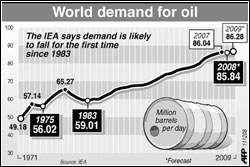
On Thursday meanwhile, the oil market largely ignored the International Energy Agency’s (IEA) forecast that global oil demand would fall this year for the first time since 1983 owing to a worldwide economic slowdown.
“Global oil demand is now expected to contract in 2008 for the first time since 1983, shrinking by 0.2 million barrels per day, with the total (daily demand) this year revised down by 350,000 bpd to 85.8 million bpd,” the IEA said in its latest monthly report.
In 2009, demand will grow again to a downwardly revised 86.3 million bpd, the IEA said, basing its forecasts on International Monetary Fund projections for a pick-up in the global economy next year.
The Paris-based IEA had previously predicted oil demand for this year and next at 86.2 million and 86.5 million bpd, respectively.
The Organisation of Petroleum Exporting Countries, which pumps 40 per cent of world oil, has agreed on cuts of 2.0 million barrels per day this year and is widely expected to slash its production quota again at a meeting in Algeria on Dec 17.
“In the past Opec has at times struggled to rein in production when crude capacity is rising, a phenomenon that is now reemerging in the face of weaker demand,” said the report.
The IEA said that there was consensus that Opec would decide to cut its output again in Oran, Algeria, but did not say by how much. Some analysts expect a cut of 2.0 million barrels per day.
“Perceived wisdom focuses on how much the reduction will be rather than whether it will occur,” it underlined.
Opec’s ability to influence prices depends on whether the market believes the group will actually limit its production.
Its effectiveness is contingent on members obeying quota levels and when prices and revenues are falling there is a particular need for discipline.
Some countries cheat at the expense of others by failing to implement cuts, thereby increasing their revenues.
“December supplies will likely be reduced further and Opec ministers meet on Dec 17 to mull further target cuts,” the IEA noted.
Growth in world daily oil supply, meanwhile, slowed to 165,000 bpd in November to bring the output total to 86.5 million bpd, it added.
“It’s a pretty weak market, the fundamentals are weakening,” said David Fyfe, chief IEA analyst.
“We would just caution that there may be some resilience in emerging countries ... Opec might be overshooting (with production cuts),” Fyfe added.—AFP






























