



 0
0

 KATHMANDU: Naresh Shrestha’s small Mercedes-Benz bus first rolled into Kathmandu sometime in the heady 1970s, laden with hippies completing the arduous overland journey from Europe.
Today the sturdy vehicle still plies the streets of the Nepalese capital – a reminder of the days before cheap air fares, when budget travellers took weeks or even months to get to Asia.
Once they had arrived, many sold their vans and buses to fund their time in Kathmandu, where the mix of Hindu and Buddhist cultures, and the cheap drugs, often proved irresistible.
For Shrestha, his battered German-built bus is perfect for its current job, ferrying passengers between Kathmandu and Bhaktapur, just a few kilometres away.
“I have driven plenty of buses but this one still feels wonderful, despite the fact that it is 11 years older than me,” said Shrestha, 24, as he nosed his way into the frenetic traffic.
“Hippies brought this bus to Nepal during the 70s and sold it to locals. I heard that the interior was like a room and had a toilet.
“They used to sleep inside. The locals who bought it converted it into a passenger vehicle.”
‘It rolls along very nicely’?
Nepal was often the end of the road for countless overland travellers who made the trip from Europe, through Turkey, Iran, Afghanistan, Pakistan and India.
The arrivals began to dry up in the late 1970s after Nepal officially outlawed the sale and use of marijuana, but many of their vehicles remain in action.
They rarely get sold on the open market, but pass between Nepalese for a few hundred dollars each. (New imported cars, by contrast, are subject to taxes up to 200 per cent – making them a luxury only Nepal’s elite can afford.)
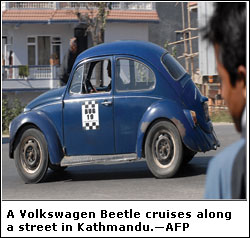
Some 200 Mercedes-Benz buses are still on the capital’s roads, along with around 60 Volkswagen Beetles and a few dozen Volkswagen camper vans.
Maintained with spare parts manufactured in India and Thailand, Shrestha said, his bus had years of life left in it yet.
“There are no jerky movements and it rolls along very nicely. After all this time the bus is trouble free,” he said, patting the dashboard which is decorated with stickers of Bob Marley and a statue of a Hindu god.
Ganesh Thapa, a 53-year-old haulage firm owner, relies on his fleet of eight Volkswagen camper vans, which he says are still reliable decades later.
“Even with a full load, they are quite powerful,” said Thapa, who uses the vehicles, which date from between 1960 and 1972, to deliver goods from Nepal’s international airport.
“There is a huge amount of traffic on Kathmandu’s roads these days, but their size is perfect for weaving through it,” he said.
But he says they rarely appear on the market for sale.
“People won’t buy them because it is very difficult to get the repair parts,” he said. “When the vans become impossible to run, I’ll just have to leave them in a junkyard.”
Thapa and Shrestha use their vehicles as work horses, but Satendra Siddhi Bajracharya only drives his beloved Volkswagen Beetle on special occasions.
The wholesale grocer first fell in love with the design classic when he saw Westerners driving in his neighbourhood 30 years ago.
“The hippies and their vehicles were very exotic for me as a kid growing up near what we called Freak Street,” he said, referring to the area in central Kathmandu where the hippies congregated.
For day-to-day use, Bajracharya drives a Hyundai hatchback, but the weekends and holidays are for his cherished 1976 Beetle. He bought it eight years ago for 1,300 dollars, and says he spent three times that much renovating it.
“When I wash and wax my Beetle, I feel like kissing it. It’s the shape that makes it so attractive and you can never get bored with it.”
On the streets of Kathmandu, the blue and white Beetle still turns heads, he said.
“You look at modern vehicles – Toyotas, Nissans or Tatas – and they all look the same,” he said.
“There is no mistaking a Beetle, and when I drive it in the backpacker area I still get thumbs-up from people,” he said. “The car just gets noticed.”—AFP





























