0
0

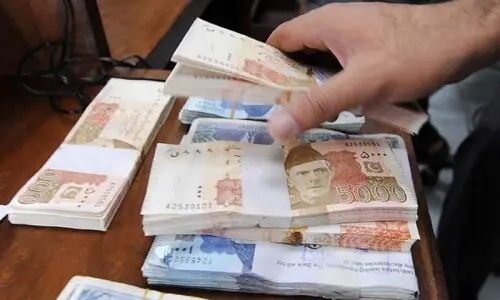
KARACHI, Dec 5: There are no apparent signs of revival of economy and resumption of normal business activities even after more than three weeks of signing of a programme with the International Monetary Fund last month and release of first tranche which has pushed up Pakistan’s foreign exchange reserves to over $9 billion.
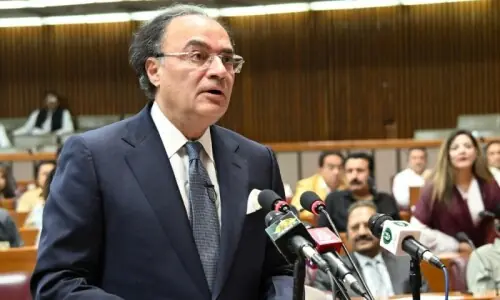
Retail stores report drop in sales, businessmen complain of banks failure to respond to their credit needs, banks still feel liquidity crunch and hence their limitations to respond to credit needs of their clients, farmers are not happy with water shortages, trade unions speak of layoffs on a large scale in formal and informal sectors and prime minister’s advisor on finance in an interview with Dawn on Thursday linked economic growth to improvement of security on the borders.
While signing the agreement with the IMF in mid-November, the prime minister’s adviser on finance had expressed the hope that confidence in Pakistan’s businesses would be revived, and that international financial institutions would now be more inclined to consider assistance to Pakistan.
Till last week of November, top leadership of Pakistan who participated in an international fair in New Delhi as a partner country came back full of hopes to convey that the total volume of India-Pakistan formal and informal trade is now well over $5 billion.
They urged the government to do trade with India on a negative list of items rather than a positive list as is being done now.
Even after Nov 27 when Mumbai was targeted by 10 young terrorists who kept Indian elite Black Cats force engaged for almost 70 hours, top Pakistani business leaders had not lost hopes of maintaining growing business relations with India though statements coming from Dehli bordered almost to hostility.
Business leaders and bankers say that after a recent stand-off with India, many friendly countries are a bit more reluctant than they were before Pakistan’s joining of the IMF, to come with a helping hand for assistance.
Ever since the popular elected government assumed power, close friends of Pakistan—China, Saudi Arabia, Iran, Turkey, UAE, US and UK—have been advising at different levels to promote trade and economic relations.
Even now when top leaders of Pakistan, Afghanistan and Turkey are assembled in Turkey to forge a tripartite business and strategic partnership in the region, India figures in the proposed arrangement.
During a meeting between President Asif Zardari and Indian Prime Minister Manmohan Singh in New York, the two countries agreed, in principle, to open five routes of trades. Trade between Pakistan and Indian Kashmir has resumed. Trade via Wagah in the Punjab is going on for almost a year now. Trade at Sindh border awaits laying down of necessary infrastructure by India at Barmeer and Pakistan at its side of border. But most significant is giving India an overland access to Afghanistan which would revive historical Grand Trunk Road from Peshawar to Kolkata.
After the collapse of the Lehman Bank and bankruptcy of US financial structure, there is a conspicuous drop in exports from Pakistan and all Asian countries to US and Europe.
“The only solution for countries, like Pakistan, India and others, is to promote regional trade,” President of Pakistan-India Chambers of Commerce and Industry S M Muneer said on Nov 27 when the same evening Mumbai can under attack of terrorists. Pakistan’s exports in July to October 2008 period at about $6.75 billion is short by hardly four per cent of the proportionate target, but higher than actual exports 5.79 billion dollars last year. But exports are now coming under increasing pressure and from top bureaucrats in commerce ministry to businessmen in Karachi feel it would be difficult to reach even 2007-08 level of $20 billion.
India has abruptly put off trade talks with Pakistan due next month which has obviously disappointed many businessmen in both India and Pakistan.
“Pakistan’s current trade policy for 2008-09 is heavily tilted towards India,’’ a senior business leader remarked to stress the point that present political leadership of Pakistan has taken bold decision to forge close trade and business relations with India.
“India will be net loser by limiting trade with Pakistan and creating problems for Pakistani political leadership,” said a businessman who is active in politics.
“The only way ahead for two countries is to keep moving, slowly but steadily, in the direction of mutual cooperation,” he said.