



 0
0

The tradition of ‘islah’
 The word ‘islah’ can loosely be translated as correction, modification, remedy, reform, rectification, improvement, amendment or revision. But in Urdu poetry it has a different connotation. In the lexicon of Urdu rhetoric, the word ‘islah’ refers to the act of correcting or improving the text of a specific piece of literature, especially the one composed by a student or a junior.
One who ‘gives islah’, as Urdu idiom goes, or improves the poetry of a junior, must have command over prosody, rhetoric, grammar, idiom and lexicon. He must be a veteran himself and a well-read person as ‘islah’ demands of him to be able to point out logical or philosophical follies, if any, and to make the piece presentable. Sometimes some connoisseurs of poetry or some veterans find some interesting aspects in the poetry of their contemporaries and suggest, maybe out of erudition or sheer professional jealously, amendments that make a very interesting reading.
Urdu has a long tradition of ‘islah’, both solicited and voluntary. The tradition was borrowed from Persian. This interesting practice of making amendment in poetry has produced a rich and very interesting, at times even hilarious, literature both in Urdu and Persian. In Urdu, it began as early as in the Deccan era of Urdu poetry, that is in the 17th century. But such instances in the early period were sporadic and it was in the 18th century that the tradition took roots and it goes on even today.
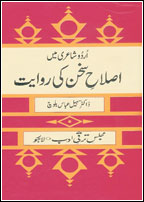 Surveying such a long history of ‘islah’ in Urdu poetry was a tremendous job and, considering the length of period and abundance of Urdu poets, demanded someone like Suhail Abbas Khan (who has now added another suffix to his name, Baloch), deeply engrossed in classical Urdu literature. Having drunk deep from the fountain of Urdu poetry and prosody and having annotated ‘Bagh-o-bahar’, he was just the kind of person who could handle the ‘deluge’ of ‘islah’ that our classical poets produced. So he decided to carry out research on the topic that had been haunting him for long.
And it was really fortunate for readers like me since there are not many experts of prosody and rhetoric left to tackle the topic and rarely a new book is published on such a typically classical subject. The result is the dissertation, ‘Urdu shaeri mein islah-i-sukhan ki rivayat’, just published by Majlis-i-Taraqqi-i-Adab, Lahore, that earned him a PhD.
In the introductory chapter, Dr Suhail says that the practice of making corrections in the poetry of others is not restricted to Arabic, Persian and Urdu only, but in western literature, too, we can find such instances. One good example is T.S. Elliot’s famous ‘Wasteland’, considered among his masterpieces. But it was Ezra Pound who added some masterly strokes to it as finishing touches and the poem became immortal, though earlier Elliot himself and his first wife, Vivien, had suggested many amendments to it.
In the preceding chapters, we see the history of ‘islah-i-sukhan’ unfold before us, with examples and commentary and one feels that Dr Suhail has ‘enclosed the sea into a jar’, as goes the Urdu expression. The various anecdotes he has quoted from the history of Urdu poetry are really interesting.
He is of the view that the ‘correction’ was an institution unto itself and it contributed a lot not only to enhancing the standard of Urdu poetry but also to the Urdu language. It trained Urdu poets for centuries but, he says he believes, this institution suffered from a decline as the impetus that promoted it – mushairas, royal courts and the status of a poet laureate – was missing in the later period. Another reason for the decline of the ‘islah’ tradition, according to him, is the fall of poetry in present times from a high pedestal that it had occupied for centuries. Secondly, it became mechanical and commercial.
While I agree with him, I cannot help saying that this tradition is still alive, though it has become more mechanical and more commercial. But still there are some veterans who do it dutifully and out of sheer love for it.The Majlis-i-Taraqqi-i-Adab has added yet another good book to its list of publications by bringing out this book. The Majlis, which hibernated for about a quarter of a century, has now been reactivated by its new chief, Shahzad Ahmed. He has revived the institution’s quarterly literary magazine ‘Saheefa’. And new books are coming out in a steady trickle.
— drraufparekh@yahoo.com
JUI-F, Jamaat join hands against ANP
 ON the occasion of Pakistan People’s Party’s 41st founding day, entire PPP leadership is convinced that all the political pressure groups, accused of some kind of intimacy with the powers-that-be, have come out with one-point agenda of government-bashing on various pretexts.
They think that Jamaat-i-Islami, which along with other religious organisations, had extended its political support to the previous quasi-military regime headed by General (retired) Pervez Musharraf during the passage of infamous 17th Amendment, is very much active against the present fledgling democratic arrangements in the country.
Speaking to his party’s activists at Markaz Al-Islami, JI amir Qazi Husain Ahmed had warned that his party would march onto Islamabad, if country’s foreign and domestic policies were not changed in favour of national interests. He also criticised Islamabad’s apologetic stance towards the United States.
The JI thinks that the federal coalition government, now sandwiched between pressure from Pakistan Muslim League-Nawaz and a host of militant groups, is responsible for the US missile strikes in the tribal belt of the country. The JI is also opposed to the “directionless” military operations in the violence-hit terrain stretch from Waziristan to Swat. The JI had launched a similar drive against the second Nawaz Sharif government, which secured a US-sponsored truce on the Kargil mishap with India. According to the political pundits, the JI has once again opted for another limited anti-American, not anti-imperialism, role that it along with the other religious parties and groups had played soon after the 9/11 in the province. After which, they argue, the US had lost its confidence in political forces and sought Pakistan’s subordinate role in its indefinite war on terror.
The PML-N has also started warming up its muscles against the Frontier government on the pretext of lawlessness, which has become an order of the day, price-hike and financial crisis.
Last week, the PML-N withdrew its political support, which it had offered to the coalition government 10 months ago. “Now onwards, our nine legislators will sit on the other side of divide in opposition benches. We have given ample time to the government but it has failed to establish even its own writ in the province,” said PML-N provincial chief Pir Sabir Shah, after the meeting of provincial council of his party in Peshawar.
But, later the provincial chapter of the party had to withdraw its decision, when a PML-N top gun intervened into the matter and assured ANP of their unconditional support in the province.
Mr Shah also lashed out at Jamiat Ulema-i-Islam-F for playing double-role with the democratic forces, struggling for the supremacy of elected parliament and restitution of independent judiciary in the country. According to him, JUI-F is a coalition partner in the centre but it is also playing a nominal opposition’s role in the province.
He criticised Opposition Leader Akram Khan Durrani for his unproductive and lethargic role in the 125-member House. The PML-N, he vowed, would perform a positive role in the provincial assembly.
Political analysts say that the meaningless statements by the prime minister, fast moving political developments in the country, so-called war on terror and the terrorist attacks in Mumbai, commercial hub of India, show that the honeymoon of the ruling clique is about to over. That is why JI, PML-N and Tehreek-i-Insaf have chosen to play a tough opposition’s role against the ruling alliance at the centre and three provinces. Despite its personality-based grouping, they say, PML-N has always been a second home to the JI-trained politicians. At present, the JI-trained hawks, fully entrenched in the PML-N hierarchy, are giving a tough time to PPP in and outside the parliament. The JUI-F, which has chosen for a two-prong fight against ANP and its erstwhile ally, JI, in the province, has failed to win what it called a “media trial” of its top leaders regarding the land scam in Dera Ismail Khan. The JUI-F polemicists, who appeared at various TV talk-shows in connection with land scam, could not convince the audience.
The JUI-F and JI, however, are agreed on one-point agenda of ANP-bashing. The JUI provincial leadership has accused ANP of struggling for the “Greater Pakhtunistan”, while JI has named it as an American National Party. The PML-N, being representative of a political trend, has always been opposed to the political philosophy of ANP since its inception in 1956. The militants are also targeting ANP leaders and activists in Swat, which has become a permanent powder keg for the political workers and security forces alike. The traditional power players, who are opposed to ANP, consider it a skunk in their scheme of things. How long they tolerate it in the power, it depends on puppeteers.


























