



 0
0

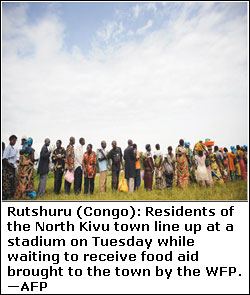 LUOFU (Congo), Nov 18: Rebels in east Democratic Republic of Congo announced a military pullback on Tuesday to support a UN peace initiative and the government sacked its armed forces chief following a string of defeats.
Rebel leader Laurent Nkunda's National Congress for the Defence of the People (CNDP) said it was withdrawing its Tutsi fighters 40 km back from two fronts in North Kivu province to create zones separating them and government troops.
The CNDP said it was doing this to help efforts by a United Nations envoy, former Nigerian President Olusegun Obasanjo, to end weeks of fighting which has driven a quarter of a million people from their homes and triggered a humanitarian emergency.
A rebel statement said the “separation zones” on the Kanyabayonga-Nyanzale and Kabasha-Kiwanja fronts should be occupied by UN peacekeepers. CNDP and government commanders would meet on Wednesday to discuss setting up the zones.
The UN peacekeeping force in Congo said it was checking whether the announced rebel pullback was actually taking place on the ground. “Separation of forces would be a good step,” UN military spokesman Lt.-Col Jean-Paul Dietrich said.
Nkunda's rebels announced the withdrawal as demoralised government troops clashed with their own local militia allies who tried to make them stand and resist the rebel advance.
After government forces in North Kivu fell back in disarray around Kanyabayonga, Congolese President Joseph Kabila on Monday replaced his military chief of staff, General Dieudonne Kayembe, to try to bolster the fighting capacity of his troops.
A local pro-government militia fought the retreating soldiers at Kirumba and Kayna on Tuesday with machine-guns and rocket-propelled grenades. Militia leaders said they tried to force the army troops back into battle against the rebels.
“These soldiers are cowards. They just flee and then rape and pillage in the cities,” General Sikuli Lafontaine, leader of the Pareco Mai-Mai militia, told newsmen. Local residents said they saw the bodies of soldiers and militiamen.
Before the CNDP's announcement of a pullback, Kabila's government and the UN had said Nkunda was not respecting a ceasefire he had promised UN envoy Obasanjo he would keep.
Nkunda and his commanders had accused the army of “provocation”.
The rebels said the planned separation zones would prevent any possibility of confrontation.
UN REINFORCEMENTS PLANNED: Kabila named as his new armed forces head the navy commander General Didier Etumba, a former military intelligence chief.
As aid workers struggle to help hundreds of thousands of refugees in North Kivu, U.N. Secretary-General Ban Ki-moon has asked the Security Council to reinforce U.N. Congo peacekeepers.
U.N. diplomats said on Monday the Council hoped to vote this week on a French-drafted resolution that would add 3,000 extra troops and police to the 17,000-strong UN force in Congo, which is already the biggest of its kind in the world.
This force, MONUC, has been criticised by aid agencies and Congo's government for repeatedly failing to protect civilians from attacking rebels and ill-disciplined government soldiers.
Kabila's government and its western allies have been struggling to put together a national army from the patchwork of central army soldiers and former rebel factions that fought in Congo's 1998-2003 war, which sucked in six African states.
But lack of training and a tradition of looting have made this a difficult task, compounded by ethnic tensions.
One Congolese government officer at Luofu near Kirumba, who asked not to be named, said his men complained they were not being paid, were ill-fed and received poor medical treatment.
He said they also did not trust their army land forces chief, General Gabriel Amisi, because he was a former comrade of rebel leader Nkunda from the Rwandan-backed RCD rebel group that fought in the 1998-2003 war.
Congo's North Kivu conflict traces its origins back to Rwanda's 1994 genocide, when Hutu militias killed about 800,000 Tutsis and moderate Hutus before fleeing into eastern Congo.
Nkunda says his rebellion is protecting east Congo's Tutsi minority and accuses Kabila of using a Rwandan Hutu rebel group, the FDLR, which includes perpetrators of the 1994 genocide, to fight against him. Congo accuses neighbouring Rwanda of supporting Nkunda's rebellion, a charge denied by Kigali.
UN envoy Obasanajo said Nkunda had agreed to take part in peace talks in Nairobi, but Congolese President Kabila has not confirmed he is ready to meet Nkunda face-to-face. The rebel chief says he wants to discuss Congo's future with Kabila.—Reuters





























