0
0

The sheer succulence of shawarma
 PAKISTAN’S massive export of manpower to the Middle East, specifically to the oil-rich Arabian Gulf monarchies, which started some time in the seventies, has had a profound effect on the country economically and socially. Petro-dollars have to an extent fuelled the consumerist appetites of the urban middle class, while the rural poor have had a chance to improve their lot through that region’s never-ending need for skilled and unskilled labour.
One of the effects on Pakistanis living in Riyadh, Abu Dhabi and Doha has been the development of a more conservative style of thinking where the faith is concerned, while scholars have also pointed out that the largely autocratic systems that prevail in these states have also helped depoliticise Pakistanis.
These are heavy things to digest. But perhaps just as much as importing an ideology (or lack of it) and a consumerist outlook, Pakistanis living in the Gulf states have also brought back a love for Arabic cuisine, specifically the delightful delicacy that is shawarma.
In a previous avatar of Kolachi Cuisine I had written about the availability of Arabic cuisine in our port city, while purposefully leaving out shawarma. Why, you ask. Well, primarily because other Arabic cuisine is relatively less known in these parts when compared to the ubiquitous shawarma.
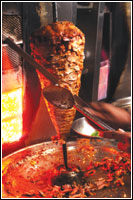 Having myself grown up in the Gulf, I – along with droves of others – can testify to the meaty, savoury appeal of shawarma fresh off the spit. Done right, it is simply irresistible. However, I must add that though it has largely come to be identified with the Arabs, the grand wizards of gastronomy are of the opinion that the Turks are the progenitors of this dish. Considering the long period of Ottoman rule over the Arabs, this theory is very plausible.
But the plucky little shawarma has spread far beyond the desert expanses of the Arabian Peninsula as today, you’ll be hard pressed to find a country which does not feature the meaty delight in one form or the other as part of its cuisine. A friend who had travelled to Austria told this writer that in his search for halal food, he stumbled upon a Turkish restaurant in the heart of Vienna. Looking to play it safe, he ordered a plateful of shawarma and sure enough, he was delighted.
Another friend recounted how he had encountered various shops hawking shawarma on the streets of Auckland, New Zealand’s largest city. Labelled ‘kebab’ and prepared by Arabs of the Levant, it lacked kick and, according to my friend, had been ‘dumbed down’ to suit the needs of the gora population.Even if you run a search on the word shawarma on old Wikipedia, you’ll see a list of countless countries that offer the dish. For the life of me, I had no clue they sold the stuff in Ecuador.
But far from the Andean heights of that Latin American country, we are more concerned about where shawarma can be found in Karachi. The answer is a whole lot of places. The downside is that most of it is not very good, especially if you’ve had the pleasure of digging into the real thing. And what, pray tell, is the ‘real thing’?
In Jeddah, near the old part of town known as Balad, a Yemeni chef was known to prepare the most delicious shawarma to be had in the ‘Bride of the Red Sea.’ Whenever one visited, one could see a long line of customers waiting to be served, with families waiting hungrily in cars nearby to attack the spicy little sandwiches.
If memory serves and if the gustatory senses are to be trusted, I have not had better shawarma anywhere else. The meat, slowly roasted in its own juices, was shaved off a rotating skewer, cooked by a gas flame, and placed into a crispy, fresh baguette, topped with hummus and hot sauce, known locally as shatta.
Traditionally, the meat is placed inside khubz, or pita bread, but I much prefer the baguette. Lemon and green chillies were offered on the side, while the sandwich – or two – could be washed down with a fizzy drink or fresh juice of choice. The meat was usually goat or lamb, but I was told that in the olden days camel meat was the basic ingredient.
But that was the case a long time ago in a galaxy far, far away. Now that I have given you a brief description of the real thing, let us discuss the shawarma that is available in Karachi. It is said the dish made its appearance here some time at the tail-end of the 1980s in the Boating Basin area. Today, it is available all over town, in wildly varying qualities.
One area that has become something of a shawarma hot-spot in the city is the Bahadurabad roundabout, with four stalls located in very close proximity to each other. Each claims to sell genuine Arabic shawarma, but the cats who prepare it look decidedly local.
On a recent night, I dragged a reluctant friend to this spot in the search for decent shawarma, as I had tried the stuff from here a few years ago and it was passable.
In Karachi, chicken shawarma is all the rage, and understandably so. We ordered two sandwiches each, one chicken, one beef, one in a pita and the other in a hot dog bun. The chicken pita bread shawarma was brought out first. It was okay in the taste department, though a bit too greasy, topped with tomatoes, onions, cucumbers, hummus and hot sauce.
However, the waiter had foozled our order as the beef shawarmas were prepared in a pita, when we had specifically asked for a bun. But, the agony did not end there. The sandwich was so damn spicy and thoroughly unpalatable that there were literally tears welling up in our eyes. Now I am all for moderately spicy fare, but food that burns your innards does not figure highly on my list. My dining companion – already sceptical of the gastronomic merits of shawarma – looked like he would never touch the stuff again.
On a rather interesting side-note, on a recent trip to Lahore, I had the opportunity to try – for the first time in my life – cheese shawarma. I can’t say I liked it, as it seemed to be an unnecessary innovation. To quote the Americans, ‘if it ain’t broke, don’t fix it.’
Our rulers are in the habit of asking the Saudis and Emaratis for various kinds of assistance. Perhaps on the next junket, they can request their majesties to send over a few proper shawarma chefs for Pakistani fans of the stuff.
qasim.moini@dawn.com
Forcing the issue…literally!
 ADMITTEDLY, it is difficult to match the thrashing prowess of a Wasi Zafar or his progeny — as those who were at the receiving end at airports or five-star hotels would testify — but the federal capital continues to reverberate with similar actions albeit with different characters.
But while we hear Wasi Zafar is a much-chastened man now and even contrite over his one-dimensional defence of General Musharraf’s actions to the detriment of an independent judiciary, there is no shortage of people willing to literally, translate the former law minister’s infamous threat to use “the long arm of the law.”
The threat was originally, directed at a journalist Wasi felt was hostile to him. The proverbial expression was first used as a headline for a news story contributed by the same journalist and which, many think to this day, was misinterpreted by the minister to have a hidden connotation — in Punjabi, perhaps?
But to return to the business of thrashing people who dare question the high and mighty, Islamabad was the playground last week for two instances of the influential apparently, getting their message across by using force.
The national media reported the son of a National Assembly deputy secretary and his accomplices manhandled a lady doctor at the Federal Government Services Hospital as well as the doctor’s colleague and Rescue 115 personnel when they tried to prevent the assault.
According to news reports, the daughter-in-law of the said deputy secretary arrived at the hospital to have an anti-rabies vaccine administered to her minor daughter, which was purchased outside the hospital.
The CMO on duty, Dr Riffat Pasha, refused to oblige, citing the lack of a doctor’s prescription and the fact that it would be unsafe to use the injection bought in the open market.
The woman then reportedly, threatened the doctor and her staff before calling up her husband, who arrived at the scene with his accomplices and assaulted the doctor.
As Dr Riffat bled from the head, her colleague Dr Ali Ahmed Khan and Rescue 115 personnel, who attempted to stop the attackers, were also beaten up, leading to Dr Ali being hospitalised with a severe head injury.
The drama at the Emergency Ward has since led to a virtual strike storm in the medical fraternity of the twin cities — and a counter attack in the form of complaints registered by the accused party of them being at the receiving end of an assault by medical staff at the Polyclinic (Federal Government Services Hospital) and even theft!
All this while the police and top government functionaries are continuing to pitch for a compromise to ensure the family of the top bureaucrat does not have to go to jail.
While Dr Ali was initially reported to have accepted a written apology, Dr Riffat Pasha stood her ground and refused to let the culprits go unpunished. The protesting doctors are now seeking the intervention of the prime minister as well as urging the chief justice to take a suo motu action on the issue.
In the second instance of the week, former president of Pakistan Muslim League-Q women’s wing Sumaira Malik — she was rendered former in the wake of the episode — also allegedly took the physical route over a dispute with a fellow MP.The object of her disaffection is Nosheen Saeed, who appeared to have left Ms Malik terribly blue after failing to show up at a dinner the PML-Q stalwart of the Musharraf era had billed as a show of force against the Chaudhrys of Gujrat.
The next day’s papers reported that an irate Sumaira arrived at Nosheen’s residence with her husband late night and after a hot exchange, the couple allegedly, did a Wasi Zafar on the poor MP.
An angry Nosheen then approached PML-Q chief Chaudhry Shujaat Hussain, who then did what some critics are calling, tongue-in-cheek, a Nilofer Bakhtiar on Sumaira Malik. He removed Ms Malik as the women’s wing president — a fate that her predecessor, Ms Bakhtiar, also met even if in slightly different circumstances. Caught hugging her male paragliding instructor after a successful parachute jump in France, the then tourism minister, slid into troubled waters once pictures showing the embrace were published in Pakistan last year.
Calls for Ms Bakhtiar’s head were compounded by a farcical fatwa issued against her by the Lal Masjid clerics and with the mercury rising, Chaudhry Shujaat asked her to quit.
Ms Bakhtiar saw in the publication of her pictures an interpretation that she called “sick” and blamed it on a campaign she alleged was initiated by her successor.
But those in the know suggest in both the incidents of last week — at the hospital and the MP’s residence — brawn may have contributed to the coup de grace although Ms Malik, who denies using a hand that rocked the cradle anyway, was reportedly, considering a defamation suit against Nosheen.
The writer is News Editor at Dawn News. He may be contacted at
kaamyabi@gmail.com