0
0

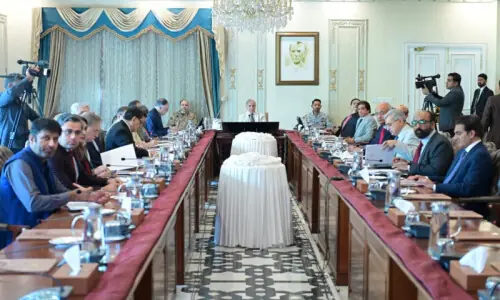
KARACHI, Nov 5: The recent approval of the industrial relations ordinance bill-2008 by the Senate came under sharp criticism at a national conference that declared the bill to be a mere reproduction of the IRO-1969, which has been adopted in haste and without incorporating the recommendations of workers and employers earlier submitted to the government.
The national conference on the industrial relations ordinance (IRO) was organized on Wednesday by the Workers-Employers Bilateral Council of Pakistan (Webcop) in collaboration with Friedrich Ebert Stiftung of Germany and Solidarity Council.
Speakers mainly comprising trade unionists and representatives of various employers’ bodies rejected the IRO bill 2008, saying that it was retrogressive in nature and was not acceptable to both employers and workers.
“The bill does not take into account the global and national developments in the industrial sector, the conventions of the International Labour Organisation, which have been ratified by Pakistan, and the conditions prevailing in the country.”
They said it was very unfortunate that a democratically elected government had passed such a controversial bill in haste. “Earlier, we were lashing at a military dictator who introduced the much condemned IRO-2002. Now, with democracy in place, it was unbecoming of the Pakistan People’s Party that claims to be a pro-labour party to ignore workers’ voice,” they said.
The speakers observed that prior to the approval of the bill the government had been informed about the workers’ concerns. Copies of the IRO draft prepared by the representatives of both workers and employers with consensus were presented to the authorities, but the government decided to ignore it.
Fearing that the bill would also be rushed through the NA, without inviting debate and suggestions from the stakeholders concerned, the speakers believed: “The government is now trying to downplay criticism over the bill by saying that the bill is for an interim period and a comprehensive law would be made after one and a half years. This is absurd.”
Referring to the prime minister’s first speech in the assembly hall in which Yusuf Raza Gilani had announced that IRO-2002 would be repealed, one of the speakers pointed out that the popular demand was not a complete repeal of IRO 2002, but rather of its amendment. “There are many favourable clauses in that ordinance enacted by the military government that only needed further improvement.”
Highlighting some ‘right’ clauses in the IRO-2002, they said: “It spoke about a code of conduct which is absent from the present bill.”
They said the new bill deprived workers of the right to make associations and gave sweeping powers to the government. It mainly compromised decades-old laws that had no relevance to the present ground realities, the speakers maintained.
The forum called for unity among the ranks of workers and employers, broader interaction of Webcop representatives with government officials at all levels and initiating a media campaign to make the masses aware of the issues affecting the industrial sector. In a unanimous resolution, the worker and employer representatives demanded that the bill should be referred to a select committee of the National Assemble before its final approval for eliciting views of representative organisations of employers, workers as well as other stakeholders.
The resolution further states that if the government proposes to adopt the bill as passed by the Senate, the government should also incorporate all the recommendations unanimously adopted by the Workers-Employers Bilateral Council of Pakistan. Thereafter, the government should convene a tripartite labour conference by inviting representatives of employers and workers as soon as possible in order to revisit the IRO act to make it more factual and relevant to present needs.
EOBI funds
Reports that billions of rupees have been transferred from the funds of Employees Old Age Benefit Fund (EOBI) as investment to support the ailing stock market caused the stake holders to express concern at the conference. They regretted that the huge funds were transferred on the recommendation of the finance ministry, much against the wishes of the labour ministry and the EOBI board of trustees.
“The trust is very sacred with specific aims and objectives to benefit workers from special generated contributions. Any attempt to dish out huge amounts for reasons other than specific to the trust no way serve the purpose of EOBI’s establishment and negates the ‘trust’ so conferred in the board of trustees and the labour ministry responsible for its operation,” they said, demanding a thorough investigation into the matter.