0
0

Wonderful world
 Life is full of these little ironies . . . I’d thought that sometime after the Second World War, we figured out that waging war – particularly pointless or unnecessary war – is not a very smart move. But it seems I was wrong. Yesterday’s papers reported the US homeland security chief, Michael Chertoff, as arguing in defence of waging war and, in fact, calling for international law to recognise a nation’s right to wage ‘pre-emptive’ war. Even if the targeted country has, as a formal state, done nothing to provoke such violence. And even if the aggressor has merely suspicions about the scale and potentiality of the threat.
“International law must begin to recognise that part of the responsibility of sovereignty is the responsibility to make sure that your own country does not become a platform for attacking other countries,” he said. “There are areas of the world that are ungoverned or ungovernable but nevertheless technically within the boundaries of sovereignty. Does that mean we simply have to allow terrorists to operate there, in kinds of badlands, where they can plan, they can set up laboratories, they can experiment with chemical weapons and with biological weapons?”
An ingenious argument, not least because it conveniently absolves the aggressor from having any responsible part to play in the what is otherwise touted as the ‘comity of nations’ and the ‘coming together of the world.’
Mr Chertoff’s comments cannot be stripped of the political contexts within which they were uttered, and therefore beg the question of which parts of the world are ungoverned or ungovernable, why, and which other countries had a part to play in them being reduced to such a state of anarchy. On the point of being badlands, or to use the favourite US hyperbole of being ‘hotbeds of terrorism’, the name of Afghanistan immediately springs to mind, to say nothing of Iraq. And one needs to be no student of history to know how much of a part the US played in reducing these states – sovereign, according to Mr Chertoff’s definition – to rubble, both literally and in terms of law and order.
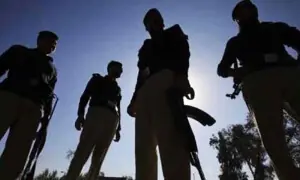
But of course, these particular views were expressed in the context of the numerous recent occasions when the US military has made incursions into Pakistan. Well, as a concerned citizen, I can only be glad that we have not yet found ourselves formally on the wrong end of the mighty machine that is the American military (I’m enjoying it while it lasts, since quite a few voices are warning me that this may be merely a matter of time). Informally, that’s another matter altogether. Pakistan’s current situation is complicated and unfortunately for those of us who like to play the blame game, cannot be linked to any unitary or easily identified factor. To distil it to its essence, however, let us not forget the eighties, when the country was flooded with arms and drugs in wake of the US-encouraged ‘jihad’ against the Soviets in Afghanistan. Let us not forget the aid and assistance provided to Pakistan’s shadowy agencies and assassins by the surviving superpower of the west. The terrorists and thugs of today are the heroes of yesterday, bin Laden being not the least of them. So Mr Chertoff’s argument is not unlike a situation where someone first helps create a mess, and then drags the other over hot coals for having that mess in their backyard.
Leaving Pakistan’s predicament aside for the moment, there are very dangerous implications to such a defence of taking pre-emptive action on the suspicion of potential threat. The line between ‘terrorist’ and ‘war monger’ is a very fine one; the former differentiates itself mainly by representing individuals or relatively small groups, rather than a nation state itself. Today, it is Al Qaeda or the Pakistani Taliban who have been labelled ‘terrorist’ organisations, for the linguistically good reason that they deal in fear and death. These groups do not constitute a state in themselves. But what if a nation that starts dealing in terror? Can we have a terrorist country? The US has come very close to formally giving this label to Iran, for example, and yet another unnecessary war in our corner of the world looked like a real possibility. Yet Iran has not, in this century, invaded any country or played a major role in them becoming the so-called ‘hotbeds of terrorism’. And in the last century, it was not Iran that sponsored the toppling of a string of governments around the world and dropped the only atomic weapons ever used.
The point is, you see, that the pigeons can come home to roost. Rhetoric is convenient sure, but once it’s out there, it can come back to haunt you.
— hmumtaz@dawn.com
The hour of reckoning
 AMERICAN drones may have knocked the daylights out of Pakistan but Islamabad is set to perform a different version today: revert the clock by an hour that it had borrowed all summer.
The clocks were advanced by an hour from First June in a supposedly, all profit-no loss equation that was directed at saving energy during the peak season. It also meant the people had an extra daylight hour.
In fact, officialdom in the federal capital felt so good about Daylight Saving Time (DST) that the nation was directed to chill out for another month when it was time to turn back the clock by an hour, effective First September.
Sound or not, this year’s measure was not the first time Islamabad took to playing for time.
A regime professing “enlightened moderation” experimented with DST in 2002, going from +5:00 to +6:00 on the first Sunday in April at 00:00 (GMT) till the first Sunday in October at 00:00.
Apparently, it didn’t quite set the stage alight because there was no follow-up. Or may be with the mega and gigawatts nightmare (read loadshedding) still some distance, the timekeepers felt they had all the time in the world.
Starting today, there will be no Dickery, dickery dock for the rest of the year, as the republic regains the lost hour. Whether it will regain lost time as well only (adjusted) time — and probably, an Obama Administration — will tell.
Five months of borrowed time — from first June to first November — brought forth many interesting observations from people across all walks of life never mind how much energy a power-starved nation was able to conserve — chances are you will only get burned electricity bills (thanks to the tariff blowback) for a report card.
One would have thought the past would be a guide where understanding the DST is concerned but as the forward button was pressed this year, a large population still seemed at sixes and sevens — to borrow a time-tested phrase.
When anyone approached yours truly to explain how DST worked, this is the standard direction one gave:
The clock moves ahead (thus, losing one hour) when DST starts, typically in the spring, and falls back one hour (thus, gaining one hour) when DST ends in the fall. To make it easier to remember which way the clock goes, keep in mind one of these sayings: “Spring forward, fall back” or “spring ahead, fall behind.”
But to return to the observations on DST, one met this shop-owner in G-10 sector, who runs a spare parts business. He dismissed the idea of daylight saving as an eyewash. “There is no change in our lives, the day begins when it begins…the time moves as it (used to) move so what is this business of about resetting the clock,” he said in exasperation.
He then pointed to a still ceiling fan in his shop and added: “And what is this nonsense about conserving power…you can see the light (power) continues to play truant as it used to.”
The maid at our house found the concept a little tough to handle initially, but she seemed to have conjured up this indigenous idea to deal with it. We were surprised when she turned up regularly at the appointed hour (the pre-DST schedule, that is). She told my wife that in order not to be confused, she was maintaining two clocks at home — one with the advanced time and the other with real time (yes, that’s what she called the steady hour).
But if you thought keeping up with the Joneses was hard enough for these simpletons, what do you have to say about a top sleuth, who mocked the idea of ‘changing’ time while talking to a friend.
He said: “I wouldn’t fall for it. I follow and will continue to follow the set time (he probably, meant clocking the pre-DST hour).”
My friend threw in his banter, suggesting that since he and his like wouldn’t “fall for it”, perhaps, the nation would…thanks to poor intelligence bereft of the idea of real time.
All he could do was smile.
However, the broader smile has come from the land, which is figuratively, knocking the daylight out of us: the US of A.
If a report published in The New York Times the other day is anything to go by, turning back the clock at the end of DST results in a five per cent decline in heart attack deaths and hospitalisations.
Quoting a New England Journal of Medicine study, the report pins down sleep deprivation as the cause. It suggests the scientists hadn’t bargained for what a lost hour could do.
May be, it is time to go back to the future alright — minus the tinkering, that is!
The writer is News Editor at Dawn News. He may be contacted at kaamyabi@gmail.com