



 0
0

Mumtaz Hasan — a multi-faceted diamond
 Some personalities are so versatile and have so many different attributes that it is difficult to describe them. Mumtaz Hasan was one such person. He was a poet, critic, scholar, historian and civil servant but on top of that all he was a man whose love, care and respect for humanity knew no bounds.
Mumtaz Hasan was born in a small town of Gujranwala district, Punjab, on August 6, 1907. Lahore’s FC College was the place where he spent, in his own words, ‘the happiest years’ of his life. There, from 1922 to 1930, he not only obtained a BA and a master’s in English literature, but also had the company of some able and dedicated teachers and brilliant students. Having an innate interest in languages and being a brilliant student, during the course of his studies at the FC College he learned Arabic, Persian, German and French as well. The ‘FC College magazine’, whose maiden issue was published in November 1903, was the first college magazine to have been published in Punjab. It was renamed as ‘Folio’ in 1925 and later Mumtaz Hasan became first its assistant editor and then editor.
Though he had Arabic as an optional subject in BA, Mumtaz Sahib developed more interest in English literature rather than Urdu and wrote several critical essays on English literature. One of the reasons for this change of heart was Dr F.M. Wallet, who had formed a literary society and the first meeting of which was held in his drawing room on November 11, 1926. Since it had 15 members from the FC College, the society was named the ‘FC College Fifteen’. Mumtaz Hasan attended those meetings and read out his essays. He also contributed Urdu essays and poems to the Urdu section of ‘Folio’. In Urdu, his takhallus, or pen-name, was Ahsan.
In 1931, Mumtaz Hasan joined the Indian Civil Service and soon rose to prominence. In 1946, he worked as secretary to Liaquat Ali Khan, who later become Pakistan’s first prime minister. After independence, Mumtaz Hasan held important posts in the government of Pakistan, including governorship of the State Bank of Pakistan.
Aside from his worldly achievements, Mumtaz Sahib was a man of letters. Despite his responsibilities and busy schedule as a high-ranking government official (and that included being the federal finance secretary, director of the national bank of Pakistan and some other high-profile portfolios), he took time out to read and write. Although he wrote on an amazingly wide range of subjects, including history, culture, archaeology, poetry, criticism, religion and national affairs, he truly adored Allama Iqbal and his poetry. He was greatly impressed by Iqbal’s personality when he as a student had a chance to meet the great poet at his residence in Lahore. He then became a frequent visitor to Iqbal’s residence and was fortunate enough to enjoy Iqbal’s and his distinguished visitors’ company for about 12 years, as intellectuals thronged his residence in the evening. There are three aspects of Iqbal’s personality and poetry that are especially reflected in Mumtaz Hasan’s personality: optimism, love of knowledge and love for humanity.
In addition to several articles on Iqbal, both in Urdu and English, Mumtaz Hasan wrote a book ‘Iqbal and Abdul Haq’, published in 1973. This research work reproduced Iqbal’s eight letters addressed to Baba-i-Urdu Moulvi Abdul Haq. Mumtaz Hasan wrote extensive notes and annotations on these letters, and the book is a living testimony to his scholarship and academic acumen.
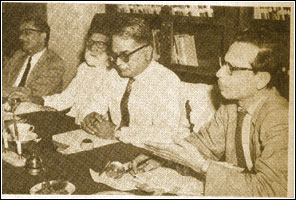 He was instrumental in establishing the Iqbal Academy and it was but a gesture of his love for Iqbal and his poetry. He also influenced German authorities to name a road in Heidelberg after Iqbal and to create Iqbal chair at the Heidelberg University.
Another poet that fascinated Mumtaz Hasan was Ghalib. During the Ghalib centenary celebrations in 1969, he arranged a series of English lectures on Ghalib at Karachi’s Pakistan American Cultural Centre and invited renowned Pakistani and foreign scholars, including Prof Ahmed Ali and American historian Prof Ansle T. Embree, to speak. He introduced the speakers at the event and the last lecture of the series was delivered by him. He later compiled the lectures into a book titled ‘The aspects of Ghalib’, which was published by the PACC in 1970. As he was a government employee, he did not deem it proper that his name appeared on the title of a book published by a foreign entity. But when the book was translated by Shah Mohi-ul-Haq Farooqi and published by Idara-i-Yadgar-i-Ghalib, Karachi, in 2000, titled ‘Jihat-i-Ghalib’, Mumtaz Hasan’s name was prominently printed on its title as compiler.
History and archaeology was another passion of Mumtaz Hasan. With a profound interest in Sindh’s history and by using his official clout, he rendered invaluable services for Sindh’s historical and archaeological sites. He got tourism facilities established at Moenjo Daro and at his behest began the preservation of historical tombs at Makli. Daibal was the first city of Sindh conquered by Mohammad Bin Qasim and its conquest ushered in the Islamic era in Sindh and, subsequently, in the rest of the subcontinent. Mumtaz Hasan was very keen about the remains of Daibal. His book ‘In quest of Daibal’ is but one sign of that interest. It was he by whose efforts excavations at Bhambhor, near Thatta, began in 1958 for the discovery of Daibal and, according to Peer Hussamuddin Rashdi, it was Mumtaz Hasan who had inaugurated the excavation, leading to the discovery of the Daibal Temple and the first mosque of the subcontinent built at Bhambhor.
He was a voracious reader and there was hardly any topic that did not interest him. He had built a sizeable library over the years and had donated some 14,000 books to the Punjab Public Library, Lahore. He had donated another portion of his personal collection to Karachi’s Goethe Institut. His services for the Urdu language and literary and academic institutions are simply beyond comparison.
Mumtaz Hasan was a precious gem, lustre of whose every facet dazzled everyone, leaving them wishing that they had more such government officials — humane, erudite, patriotic, devoted, far-sighted yet selfless.
The gem of a person known as Mumtaz Hasan, who loved everyone and was adored by all, died in Karachi on October 28, 1974. He was buried in Karachi’s Paposhnagar graveyard.
drraufparekh@yahoo.com
Drawn to the Indus
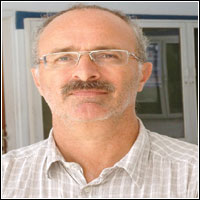 MICHEL Boivin is no stranger to Karachi or the rest of Sindh. The French scholar’s love affair with this region began more than a decade ago and over the past few years, he has made several trips to Sindh. He was recently in Karachi to launch Sindh Through History and Representations: French Contributions to Sindhi Studies, a collection of nine essays authored by French academics he has edited.
Dr Boivin sat down with Dawn after the launch for a brief chat about his fascination with Sindh and its culture.
At university he read modern history, Arabic and Islamic studies and Persian literature and Civilization and defended his PhD thesis at the University of Paris III-Sorbonne Nouvelle. The author of several books and papers on the modern history of the Sindhi-speaking area (including Kutch), he has focussed mainly on the impact British colonialism has had on Sindh, as well as the impact of partition on the region. Currently teaching at the University of Savoie (Chambery), his upcoming book is titled Interpreting the Sindhi World: Essays on Society and History.
When asked what inspired him to study Sindh, he said his journey to the land of the Indus began in the Arab world.
“As a student I studied history. I was interested in Muslim civilization. I began with the Arab world, moved on to Iran and made my way to the Indus Valley and Sindh. I came to live in Karachi around 10 to 12 years ago. I spent a year here with my family. I did a lot of tours inside Sindh. I was fascinated by Sindhi culture. It has a very rich history.”
He claimed that interest among European scholars in Sindh is quite high.
“Last year I launched a study group on Sindh in the University of Paris and now, the programme we have focusing on Sehwan Sharif is the result,” he said, referring to a current project where a long-term study of Sehwan is being planned. “To give you another example, next year in June at the University of Paris a PhD student will defend a thesis on Sehwan Sharif, especially the archaeology of Sehwan.”
When asked why he was focussing on Sehwan, Dr Boivin said it was because of the large amount of work already done in the area by French scholars.
“Before me a French archaeologist, Professor Dr Monik Kervran, did a lot of work on the Purana Qila or Alexander’s Fort in Sehwan. She did a lot of excavations in 2002. She asked me to join her because I was already working on Sufism in Sindh and she asked me if I wanted to do a study on Lal Shahbaz (Qalandar). That is why I came to Sehwan. Afterwards, I went to other French scholars and asked if they wanted to do research programme with me.”—QAM
Security planning, not a wall
 IT is hoped that we have heard the last about the Islamabad Wall, with the interior ministry authorities reportedly denying a few days ago that there was ever a proposal to wall off the Red Zone in the capital city.
The general public in Islamabad tolerated the armed guards, often behind piles of sandbags, the barbed wires, the concrete barriers, and the resultant myriad of blocked roads. But the idea of the wall is the limit.
Beyond permanently defacing the look of the master-planned capital city, raising such a wall is also a political issue: it is supposed to cordon off not only the diplomats but also our elected leaders and legislators, giving the impression that our rulers are only protecting themselves, leaving the general public at the mercy of suicide bombers.
Modern-day governments the world over have been demolishing old city walls that used to separate rulers from their people – one recent example being the demolition of the walls of Beijing’s Forbidden City after the founding of the People’s Republic of China.
The idea, therefore, of having a “kremlin” in Islamabad – no offence to Russia – physically and psychologically separating the rulers from the ruled and the government from the public is revolting.
Besides, the wall is essentially an outdated protection strategy. Aerial or rocket and missile suicide attacks would easily render the wall ineffective.
Instead of the wall, there are lots of other more effective measures that can help to gear Islamabad up and protect it against terrorist attacks in a more extensive manner. What we need basically is planning for security, coupled with availability of funds to put this plan into practice.
Planning for security means much more than simply establishing an Anti-Terrorism Squad within the Islamabad police force. The recent suicide bombing on the headquarters of this Anti-Terrorism Squad at Police Lines exposed the deficiencies in our counter-terrorism abilities.
In protecting people and buildings from terrorist attacks, the first line of defense – according to a foreign report “Planning for security: do planners have a role?” – is to identify and apprehend potential perpetrators before they can act. They must also be denied access to the means of attack such as explosives and delivery vehicles.
This, continues the report, encompasses a broad range of primarily security-related activities such as domestic and international intelligence and surveillance, domestic law enforcement, enhanced security, improved explosive-detection devices, vehicles screening and access and parking restrictions.
Technological installations – from the proposed CCTV cameras around the capital city to explosive detectors and scanners at all approaches to Islamabad – and steps like putting highly-trained and heavily-armed police and bomb-sniffing dogs at vulnerable locations and other security checkpoints in the city constitute important security-enhancing measures.
Acquiring the support of a vigilant private sector is also important in the first line of defense because terrorist operatives are known to obtain certain materials or training for their targeted activities in the private sector from businesses both inside and outside of Islamabads geographic boundaries.
Business owners, operators and their employees need to be encouraged to apply their particular business and industry knowledge and experience against each customer transaction or encounter to discern anything unusual or suspicious and to report such instances to the authorities.
The second and third lines of defense, according to the above report, requires the active collaboration of planners, engineers, architects, landscape architects, security specialists and others to ensure the attractive integration of site and structure in a manner that minimises the opportunity for attackers to approach or enter a building.
These include features such as landscaping and appropriately designed street furniture such as planter boxes, plinths and bollards that prevent vehicular access.
Blast resistance in buildings can also be provided by passive features such as additional reinforcement and connections in the structural frame for increased ductility, composite fibre wraps to prevent shattering of columns and slabs, and high-performance glazing materials that resist blast pressures.
Since it is clear from the recent Marriott Hotel and Police Lines bombings that it is difficult to prevent destructive acts by persons unconcerned with their own safety or survival, the fourth line of defense must therefore be rapid rescue and recovery of victims in the aftermath of an attack.
The speed and efficiency with which rescue personnel can safely enter and secure a damaged building as well as put out fires can reduce the loss of life, mitigate injuries, and prevent further damage to the structure.
Emergency service providers thus must possess considerable capacity in people who are considered experts in their fields, state-of-the-art equipment and configuration management, as well as other physical and institutional resources necessary for effecting recovery.
The kinds of policies needed to secure Islamabads safety may pose a dilemma for a city in which its people used to move about freely and openly and with privacy too.
Yet to survive, Islamabad needs, not a wall, but focused planning on protecting its people and its commerce, its government and its diplomats, and its future, against those who seek to undermine it.



























