



 0
0

Metro Mailbag
Dead phones
 Sir,
Sir,
Telephone numbers 461-9502 and 462-0840 have been out of order since June, 2008. Complaints were made several times but all in vain. A written application was submitted to the DE (phones), Block-7, Gulistan-i-Jauhar, on 9/8/08 but no action was taken to put my telephones in working order.
Therefore, I personally visited the aforementioned DE, who advised me to lodge a complaint on 1218, which I did on 23/8/08 having complaint numbers 109 and 110. Since then, one-and-a-half months have past, but my telephones remain out of operation.
Last year my telephones were dead for eight months. This shows that non-functioning of the telephone is a regular problem which is not being tackled seriously.
I request the PTCL authorities to kindly look into the matter seriously and put my telephones in working order immediately and adjust the payment of monthly bills which have already been made since June, 2008 for the period my telephones remained dead, failing which no payment will be made for future billing.
LUTFULLAH KHATRI
Karachi
KBCA’s role
Sir,
The Karachi Building Control Authority (KBCA) is responsible to check on the construction of buildings in this city in accordance with the relevant rules.
For this purpose, the KBCA is divided into different zones and in addition to the gigantic force of administrative and other staff, every zone has inspectors, assistant controllers of buildings, deputy controllers of buildings and controllers of buildings, who are responsible to implement the policies of the KBCA under the command and control of the chief controller of buildings.
It is a matter of sorrow and pain for every citizen of this city that more than 90 per cent of the construction carried out in the city is completed in violation of the approved building plans; in some cases even without getting the plans approved.
Many of the old houses/buildings to be reconstructed are being demolished without obtaining permission for demolition from the KBCA. Many irregularities can be hidden from the eyes of the agencies responsible to check and control the same, but demolition and construction of a building is always wide open before the eyes of even the common citizens. I am at a loss to understand how the same can escape the eyes of the personnel responsible to check and control it.
The situation becomes even more tragic when the irregularities pointed out by the citizens are not being checked and controlled, due to which doubts about the corruption and malpractice of the KBCA personnel start to crop up in the minds of the people.
ABDUL SATTAR GANATRA
Karachi
Forgotten date palms
Sir,
Around 2002, Niamatullah Khan, the then nazim of Karachi, visited Lahore. He was enchanted to see that the central medians of some of the roads were decorated with beautiful, full-grown, date palms, all along the length of the medians.
On return home, Mr Khan ordered the parks department of the CDGK to plant date palms on Lahore’s pattern. Accordingly, the department brought in some 1,500-2,000 grown-up date palms and some coconut palms from Khairpur, Gharo and Thatta etc., and planted them on Sharea Faisal, Rashid Minhas Road, Sir Shah Suleman Road, Nazimabad Road, Shahrah-i-Pakistan, University Road, M.A. Jinnah and some roads of Clifton at an exorbitant price of around Rs20 million.
Some plant lovers, through the media, observed that the trees were not being placed aesthetically. These were planted in between already existing trees, as against what was done in Lahore. It was also pointed out that the proper acclimatisation of the trees that had been grown in the hot, dry climate of Khairpur was not being done. No one paid heed, as usual, as is being done these days in the case of ongoing tree plantation.
We find today that 80-85 per cent of the date palms planted by the CDGK have died. Interestingly, around 30 date palms planted by a hospital on Stadium Road – brought by some Arab nationals from their countries – are growing successfully.
But the public is always the loser. We lost the trees as well as time, energy and huge amounts of public money.
TARIQ KHAN
Karachi
Drug menace
Sir,
In the roaring twenties in New York, the Sicilian and Italian Mafia of the city took silent and gradual possession of its fruit and vegetable markets, besides others. The same Mafia also took control of the New York waterfront by throwing the Irish and Jewish gangs out.
The Sicilian and Italian Mafiosi used arm-twisting techniques (even murder) to make the other New Yorkers leave their businesses. The reason for this coercion was to occupy the said market, enabling them to easily bring drugs and other contraband to and from New York with ease on trucks in the guise of fruit and vegetables.
Similarly, since the removal of the old Sabzi Mandi from the heart of the metropolis by the administration, the drugs and arms supply to ‘retailers’ in Karachi was badly hampered. So, in order to control the new Sabzi Mandi, ultimately, they (drug barons) decided to capture and force out other people.
Afghan refugees, for this very reason, have been consolidating their illegal settlement in the surrounding areas of the new Sabzi Mandi and it seems the next step is the main market. But the question is: why was the market committee so quiet over the issue for so many years? Why did they not lodge complaints with the police or administration earlier?
Remember, the very same mafia was controlling Sohrab Goth in 1985 and the area had the largest network in Asia of hashish and heroine. General Zia had ordered an army operation against the drugs/arms barons of Sohrab Goth to uproot the drug trade from Karachi.
KUNWAR KHALID YUNUS
Via e-mail
city@dawn.com
Of bills and shocks
 The bills are soaring while the darkness continues without any relief or respite. It seems that Karachians must resign themselves to two things if they wish to live in this sprawling, chaotic, darkness-ridden ‘City of Lights.’
Firstly, they must condition themselves mentally to pay through their nose for services not being provided to them, for our illustrious electricity utility company, with the ‘experienced’ professionals at the helm, has decided to set things right by penalizing the consumers come what may.
Secondly – and I do not jest – Karachians must adapt themselves to an improvised lifestyle where they must learn to live in darkness or adjust their lives and live without the use of electricity.
After all, we are a nuclear power and who needs electricity, gas and other services when we have the bomb and can sleep in peace, knowing that no one can dare to nuke us.
Coming back to the bills, the rates have been raised exorbitantly, much beyond the capacity and ability of the average man to pay. The most annoying aspect is that while the KESC has had its own dues outstanding against Wapda waived off, it has the gall to pass on the burden of the ‘subsidy’ – which the government refused to carry – to the poor masses.
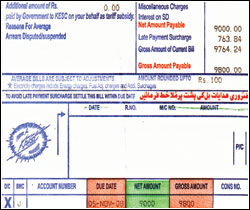 It seems everyone, who until recently had been paying power dues on a regular basis, is now running helter-skelter trying to overcome the shock after seeing the electricity bills of September. While hundreds of organizations of traders as well as merchants have already refused to pay the bills, the masses have started taking to the streets and setting on fire the bills to register their protest. The situation is getting worse day by day.
The fragile power generation, transmission and distribution system of the utility that has been run by four different managements, including the military, during the last decade has failed to show any improvement. The only ‘progress’ the twice privatized utility has made is that outages have become the order of the day rather than being limited to the summer. And all this is happening when the utility has failed to check large-scale power theft, estimated to be around 40 per cent.
With no checks and balances in place at all, not only the tiny hamlets on the city’s peripheries steal electricity, but the practice is gaining popularity in urban areas too, and yet nothing is being done to eliminate the illegal connections.
Why, then, should Karachians bear the cost of the corruption, ineptitude and negligence of the KESC? Even a simpleton understands that in such a situation the unnatural and unilaterally-fixed raise in tariffs amounts to triggering power riots or producing many more power thieves.
PS: The government has lately ordered power utilities to postpone the implementation of the tariff hike. So guys, you may not need to burn the bills anymore for a few more months.—Syed Ali Anwer
Wiper worries
Heading from Bath Island to Boat Basin for a late dinner, our vehicle stopped at a red light. We had barely come to a stop, when our car was quite literally attacked!
The assailants were not cellphone snatchers or suicidal militants, they were three young girls, barely in their teens, armed with windshield wipers. Before we had a chance to react, our front windshield had been wiped with dirty sponges.
My friend, who was driving, desperately blared his horn and yelled at them to stop, all to no avail. The assault was over in a matter of seconds, leaving the windshield streaked and grimy from the dilapidated rubber wipers.
The girls then crowded around the driver side window, demanding money for services rendered. My friend flatly refused to pay, and rightfully so, since we had not requested the service.
Before we knew it, the furious trio attacked our windows with their sponges, coating them with thick, dirty soap. Their revenge sought, they fled, laughing wildly and hurling curses in our direction.
While this particular incident may have been a rare case of aggression, it is reasonable to assume that many of us living in this city have come across this fairly recent and rapidly spreading phenomenon.
Street children armed with wipers can be found at almost every major intersection in the city. And the vast majority I have come across are extremely belligerent with their service, becoming a major nuisance for motorists.
Undoubtedly, growing poverty and rapidly deteriorating economic conditions force these young people on to the streets. However, it is important to note that this emerging group is morphing into another version of the notorious ‘begging mafia.’
Not surprisingly, the authorities concerned have turned a blind eye to this new problem afflicting our city.
And it is indeed a serious problem. Droves of desperate street kids milling around major thoroughfares and intersections speak volumes about the socio-economic health of any society or civilization.—Wasif Khan
Human dustbins
My workplace timings are such that the private van whose services I avail has to accommodate me with school-going children. The students with whom I commute from my workplace are mostly eighth graders. Travelling with them is an experience in itself, considering it’s been more than a decade since I was in their shoes. But here, I’d like to narrate one particular incident which happened last month.
It is common for school-going children to munch on their snacks in the van and then throw the used wrappers out of the window – or so I thought. In my van, the younger clan was no different. They’d eat and then they’d litter the roads. Two of the eighth graders remained party to this for a couple of days before they firmly put their foot down.
“No one is going to throw anything out of the window anymore,” declared one of them. “Do you litter your own house this way? Keep the wrappers in your bag and throw them in the dustbin when you get home.”
“Exactly,” said the other one. “You are actually contributing to environmental pollution, which is going to affect the ozone layer.”
Turning to me, she asked gravely. “Do you know about the ozone layer that protects us from the sun? Pollution is ultimately going to destroy that layer, that’s why I am not going to let anyone throw any rubbish out of the window.”
Needless to say, no one dared to litter the roads anymore.
This incident made me reminisce about the time when I was an eleventh grader and dubbed “human dustbin” in my own van because I’d keep a huge bag with me and ask everyone to put their litter in it instead of throwing it on the road.
Today, I was one of those who remained mum when children littered the roads – although, being an adult, I could have stopped them more effectively. It took two eighth graders to remind me about environmental pollution and the ozone layer.
Apart from feeling highly ashamed of myself, I can definitely say that all is not lost when it comes to the new generation of Karachians – they are aware, they are conscious of different issues and they are definitely capable of bringing about a much-needed social change. All they need is an effective leadership which can guide them in the right direction.—Hafsa Ahsan
Compiled by Syed Hassan Ali
karachian@dawn.com
The flock that’s up against concrete block
 LAST week I happened to meet an Australian journalist, who was curious to know about what has hit Islamabad of late with particular reference to last month’s deadly suicide attack at the Marriott, which would probably assume legendary status in time, save a more telling Metrocalypse.
A relatively small-scale blast last March at Luna Caprese, an Italian restaurant frequented by foreigners, which killed one Turkish woman besides injuring a dozen diners and one outside the Danish Embassy three months later have done enough to dent the confidence of foreigners, especially Westerners.
Adverse travel advisories and a spate of warnings emanating from regular meetings at the UN offices and foreign missions in Islamabad on security have led to rumblings at the highest level about what to do to stop the capital from sliding into the abyss.This has given birth to convoluted proposals like building a security wall around an elongated Red Zone without any thought for how it will inconvenience residents of the federal capital and those touching base for work in and around the area.
As well as disturb the lives of citizens who find that their daily routine — whether this be in the form of taking a familiar route to work or business itself is hugely affected — it also makes them feel like lesser mortals.
With a poor record of living up to its first duty to the citizen — protection of life and property — one wonders how, if at all, the state will exorcise the demons.
The Ministry of Interior is reported to have submitted a plan to the Planning Commission and Finance Division for the recruitment of some 10,000 personnel in Islamabad police.
Obviously, the bright idea is to reinforce security, which is stretched thin at the moment, and meet the ever-expanding challenges to protect the high life (and hopefully, lesser mortals) around the federal capital.
Besides, reveals an official news agency quoting sources, law enforcement agencies would be upgraded in terms of manpower, mobility, communications, weaponry and other equipment to deal with current challenges of internal security.
These are good plans but hopefully, more than just on paper. At the risk of sounding cynical, we are a country that usually gets wise after the event.
For far too long, we have seen one government official after another in a pantomimic avatar a la Captain Haddock of Tintin fame declaring an intent to deal the bad guys —anti-national/social elements in government-speak — with an iron hand.
But as experience tells us, usually this “iron hand” comes out of its velvet gloves once the devious hand has rocked the cradle. And if the rocked cradle is beyond repair, it is explained away by the masters of our destiny as the handiwork of the “foreign” hand, which Islamabad finds a trite difficult to fend off.
But the raw hand (not to be confused with the much-maligned research and analysis wing across the border) is quite familiar to us residents in Islamabad. It comes in all forms: police highhandedness, administrative blockades and even the security agencies literally, taking the law into their own hands.
For instance, last week, as one approached the road lining Federal Investigation Agency headquarters that leads to the Ninth Avenue, one was greeted by concrete blocks — and a personnel in civilian clothes, who motioned me to turn my car back on the road towards the signal that leads to G-9 and G-10 for an alternative route.
He turned deaf ears to my query about whose decision it was to block the public right of passage and without notice. I then parked my car in a corner and proceeded to demand an explanation.
As he froze — apparently, in panic — a man clad in civvies and wearing dark shades sitting close by spoke for him, saying it was a “preventive security measure” for only three days (it is still in place for a week now).
When I questioned him why there was no public notice, he pointed to a rather oblique signpost that merely stated daakhla band hai (entry is prohibited).
I asked him if he expected people to have the microscopic vision to catch the drift from nearly a kilometre away. In response, he sheepishly said the police had been asked to make a more visible public notice at the intersection but that it had not been done yet.
A twisted form of so near yet so far, perhaps?
The writer is News Editor at Dawn News. He may be contacted at kaamyabi@gmail.com



























