



 0
0

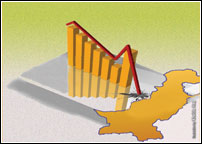 Pakistan’s economic predicament is becoming grimmer. Although Pakistan’s year-long economic crisis is largely self-created, the looming global financial crisis is also a part of the problem.
With so much uncertainty hanging over the world’s creaking financial structure, there are so few countries or institutions which want to part with cash, even though they may be sitting over piles of them.
The country is focused almost exclusively on how it would be able to service the $40 billion plus foreign debt, which is more than 10 per cent higher than when Musharraf took over, than to put food on the floor (on which most people eat) of its poverty-stricken bottom 40 per cent of the population.
The primary concern of our economic managers seems to be on how to save Pakistan from the threat of default on its foreign loans, which must be paid by the year’s end. The amount being discussed is in the region of $3-4 billion of immediate payments, although the total financing gap for the balance of payments was projected at around $7 billion for the fiscal year ending June 30, 2009.
The immediate requirement is less than three per cent of the GDP and equivalent to the remittances it receives every year from its workers and professionals abroad. It is something which the nation could easily adjust to if people had faith in their rulers and if they could be mobilised to make sacrifices equitably, even though the poor are already so heavily burdened that any additional sacrifice on their part can’t be suggested with any seriousness.
Unfortunately, this is not likely to be the case because the elites are unwilling to give up their gains acquired during the Musharraf regime. What is more likely is that the current budgetary deficit of seven per cent of GDP will be slashed to four per cent, largely by curtailing the expenditures likely to benefit the poor – such as food and fuel subsidies and social expenditures – while those benefiting the rich will be maintained or even increased.
The only thing being debated now is whether such a reduction in the budget deficit will be made under the auspices of an IMF agreement, which would include other contractionary and restrictive provisions.
The government of Asif Ali Zardari is apprehensive of concluding any agreement with the IMF which would compromise his party’s populist image and would further aggravate the suffering of the poor and lead to even greater unrest on the streets. It seems that the IMF is willing to recognise this political difficulty and get Zardari on board for longer-term reforms by bailing the country out from the brink of the precipice it stands at now. For that, the government is hoping that “Friends of Pakistan” consortium meeting in Abu Dhabi next month will approve a larger package of, say $10 billion, for stabilising the economy over the next two years (or seven quarters).
Pakistan has been in this kind of situation several times in its brief history, the last time being the period after its nuclear testing in May 1998 when the US imposed sanctions on it. It ended up by freezing over $12 billion of foreign currency accounts, much the same way the $12 billion of foreign exchange reserves have been put to as a result of a combination of political instability, economic mismanagement and deliberate efforts to ruin the economy.
It is now well-known that bailouts create serious moral hazard problems, never succeed in reforming and rebuilding the debtor economy. What is even more troubling is that bailouts result in rescuing those economic actors who are the primary cause of the default or who have most benefited from the foreign loans, which the country is unable to service.
The rest of the nation, especially the poor, who have played no part in foreign borrowing or have benefited, are being denied the attention they deserve from their elected representatives in the solution of their pressing economic problems, which have steadily escalated to unprecedented levels since the beginning of this year.
If the IMF-sponsored agreements are signed they will, notwithstanding the usual assurances about safety nets, they are likely to bring much more misery to them. The scare being created about the consequences of a default is highly exaggerated and is really intended to letting the nose of the foreign camel in the tent.
Many Latin American countries during the 1980s debt crisis and since have survived after debt default and have come out none the worse for it. What Pakistan needs at this time is not a contraction of public expenditures, except non-development, but an expansion of employment-generating development and social protection expenditures, which are likely to be curtailed in the event of an IMF-supervised package. A recent IMF working paper evaluates empirically four types of cost that may result from an international sovereign default: reputational costs, international trade exclusion costs, costs to the domestic economy through the financial system, and political costs to the authorities. It finds that the economic costs are generally significant but short-lived, and sometimes do not operate through conventional channels.
It is only the political consequences of a debt crisis which seem to be particularly dire for incumbent governments and finance ministers. If default is so important to the political class, especially the incumbents, it would behove them to pledge some of the prime properties and other assets owned by them in UK, Dubai and elsewhere, as a pledge against the amount due to avoid default.In many ways, Pakistan’s debt trap is a mirror-image of what has been happening to the US economy in the past decade. Both economies have been driven by the stimulus of foreign inflows and large current account and budget deficits that have provided the growth momentum to their economies.
At the end of the economic booms experienced during this period, both are finding themselves in grave difficulties, because the booms became unsustainable. Pakistan being a much more narrowly based and less highly leveraged economy was less susceptible to the financial crisis that the United States faced when the housing bubble burst a year ago.
It was however much more vulnerable to the extraordinary rise in oil and food prices earlier in the year, hurting the poor much more severely. Another common characteristic of the growth pattern of the two economies was the high inequality that it gave rise to in both countries. The entitlements of the poor, in terms of health, education and social services – albeit at very different levels – have been curtailed in both countries.
For almost a decade, both economies have been defying some of the basic economic laws with impunity, largely due to fortuitous global and domestic factors that have enabled the more well-heeled sections of society to enjoy a level and pattern of living that is well beyond the collective resources of their economies.
Both countries have one of the lowest savings rate in the world. While the United States has so far been bailed out by the rest of the world, especially China, East Asia and the oil-producing countries who have invested their current account surpluses in US securities and assets, Pakistan has run out of reliable sources of foreign savings to complement their low domestic savings rate. The current shock to both economies may well pave the way for corrective action to pursue sustainable paths of development for them in future.
syed.naseem@aya.yale.edu






























