0
0

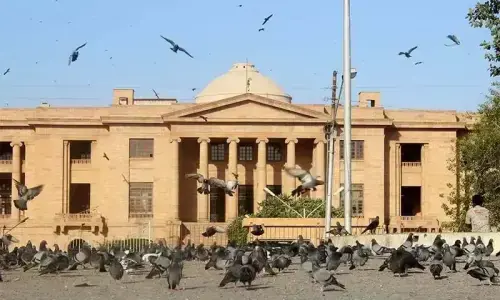
KARACHI, Oct 11: Police officers investigating the killings during the April 9 violence, including those in which victims were burnt to death in an arson attack on Tahir Plaza, told the Sindh High Court inquiry tribunal on Saturday that they had not yet achieved the desired results as the people concerned and witnesses to the incidents were reluctant to cooperate with the law enforcers due to an “unknown fear”.
The inquiry tribunal, headed by Justice Nadeem Azhar Siddiqui, before wrapping up its proceedings examined some six witnesses, including investigation officers of police inquiring into the killing incidents and family members of the victims who died during the widespread violence.
Sub-Inspector Fasih-uz-Zaman of the Specialized Investigation Unit, who had been assigned the case of seven killed people, including six those burnt to death in Tahir Plaza, registered under a single FIR lodged by the Risala police station, told the court that there had been no progress in the case.
“Did you visit the place of the incident and tried to meet the people concerned?” Justice Siddiqui asked the police officer, who responded in the affirmative, but explained the handicaps the police had been facing while tracing the reasons and people behind the gory incident.
“Sir, I met shopkeepers of the area and other people who could help in this regard, but they all are afraid to share any information while the witnesses do not cooperate with the police. I even issued notices to families of the victims but they preferred to remain silent and none of them turned up,” he stated.
“You mean it is an unknown fear that prevents them from assisting in your job,” Justice Siddiqui said to get a clear response from the police officer.
Inspector Fasih’s assertion seemed to carry weight because family members of only two victims of the April 9 violence appeared before the tribunal to record their statements.
Syed Yawar Hussain Rizvi, father of Syed Dawar Hussain Rizvi, who was burnt to death in Tahir Plaza, appeared before the tribunal to state that his 37-year-old electrician son was father of four minor children and the family came to know of his death only through news reports aired by television channels on the April 9 evening.
“God knows better that who did this,” replied the aged Mr Rizvi, when the tribunal asked him about his suspicions. “My younger sons went to the Civil Hospital later in the evening and brought the body home. It was badly charred and beyond recognition.”
Unpaid compensation
The tribunal was surprised to learn that despite passing of more than six months, the government had not paid any compensation to the legal heirs of the victims. Later, it asked the media persons inside the court room to come up with facts regarding the government’s response over the incident. “Does any of you remember the government’s announcement in this regard,” asked Mr Siddiqui. “I mean is there any formal order, reported in the media, to compensate the affected and their families or was it just a verbal or political statement?”
A media person told the tribunal that it was difficult to remember any of such happenings after more than six months but said the tribunal could be assisted in the next few days after going through the record of statements issued by the government in this regard.
The tribunal also examined Zahoor Shah, the younger brother of Jauhar Shah, a driver who died on April 9 as gunmen opened fire on his Dost Coach while it was travelling on Shahrah-i-Quaideen. He said the victim left a wife and a seven-year-old daughter while a son was born four months after the victim’s tragic death.
On his account, Justice Siddiqui regretted the way the authorities responded to address the grievances of the affected families, which had received nothing in compensation.
The investigation officer of this particular case, Inspector Syed Najabat Shah, could not give any clue to the tribunal to the identification of “those unknown miscreants”. He said it was non-cooperation of the witnesses due to an “unknown fear” that made the police job difficult. The same was the experience of Sub-inspector Sanaullah Cheema, who had been investigation the killing case of two persons, who died on April 9.
Though the tribunal concluded its proceedings to finalize a report and submit it to the Sindh government by the stipulated time of Oct 21, 2008, Justice Siddiqui raised serious questions over the police performance and security arrangements and the government’s response to paying compensation to the families of the victims.
At least 11 people were killed when violence erupted in the city after groups of lawyers clashed at the City Courts a day after the manhandling of former federal minister Dr Sher Afgan Khan Niazi in Lahore. Police record shows that a total of 61 vehicles were burnt in the large-scale violence in different parts of the city.
With the conclusion of its fifth open hearing, the tribunal, which was set up in June 2008 by the Sindh government with the terms of reference “to find out reasons and people behind the widespread violence”, has recorded statements of a total of 86 witnesses to prepare the final report.
Summarizing statements of all the witnesses in the last proceedings, Additional Advocate-General Sarwar Khan, appointed to assist the tribunal, put his findings before Justice Siddiqui. He said though the tribunal could summon more witnesses, the trend during the proceedings suggested that there was no difference in statements of the witnesses, which could lead to some new facts.
“Out of the 86 witnesses we have examined, only one of the police officers came up with an assessment that the April 9 incident seemed to him a reaction of Dr Sher Afgan Khan Niazi’s manhandling in Lahore,” he said. “Similarly, the police officers assigned to gather intelligence information were unable to perform their duty, which could not help the authorities to take pre-emptive measures to avert the incidents.”
He assessed the April 9 incident was so sudden and unexpected that the law enforcers were powerless to control the deteriorating situation. Mr Khan, however, added that other relevant agencies such as the fire department tried hard to carry out their operations but the law and order situation hindered them.
“Finally, I would request the tribunal to recommend compensation for the legal heirs of those who lost their lives, and people whose properties were damaged in the violence,” he added.