



 0
0

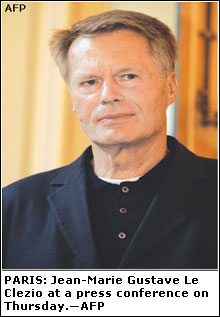 STOCKHOLM, Oct 9: French author Jean-Marie Gustave Le Clezio, whose world travels form the poetic and descriptive backdrop for his body of work, on Thursday won the 2008 Nobel Literature Prize.
The Swedish Academy hailed Le Clezio, 68, as an “author of new departures, poetic adventure and sensual ecstasy, explorer of a humanity beyond and below the reigning civilisation”.
Le Clezio, whose name has been mentioned as a possible Nobel laureate for years and was seen as a favourite this year, told Swedish Radio he was “very moved” by the news. “It’s a great honour for me, I’m sincerely grateful to the Nobel Academy,” he said.
The newest Nobel laureate is one of the French writers best known outside his country and one of the most wide-ranging in his choice of subject matter.
The Academy cited his novel “Revolutions” from 2003 as summing up “the most important themes of his work: memory, exile, the reorientations of youth, cultural conflict”. “The emphasis in Le Clezio’s work has increasingly moved in the direction of an exploration of the world of childhood and of his own family history,” it added.
Le Clezio is an avid traveller, and his fiction is as likely to be set in Mexico or the Sahara as in Paris or London. With his first novel, “Le Proces-Verbal” (1963, The Interrogation), published when he was only 23, Le Clezio was seen as a newcomer to the New Novel movement spearheaded by Alain Robbe-Grillet.
But he defied easy classification and rapidly became a cult author, a lonely chronicler of the perils of modern life, particularly in its urban variety.
A passionate admirer of two other great travellers, Robert Louis Stevenson and Joseph Conrad, Le Clezio won the Renaudot award in 1963 for “Le Proces-Verbal”, France’s second most prestigious literary award after the Goncourt prize.
His latest novel “Ritournelle de la faim” (Same Old Story about Hunger) released this year has been hailed as breaking new ground, exploring French guilt over its wartime past.
The story revolves around Ethel, a young girl growing up in the French bourgeoisie whose self-satisfied existence is shattered by the war.
Among the better-known of his more than 20 novels are “La Guerre” (1970, War) “Mondo” (1978), “Desert” (1980), “Le Chercheur d’Or” (1985, The Prospector), “Onitsha” (1991) and “Etoile Errante” (1992, Wandering Star).
“Wandering Star” and “Onitsha” are among his works that have been translated into English.
Le Clezio was born in the Riviera city of Nice on April 13, 1940 to an English father and French mother; the family had roots in both Brittany and the Indian Ocean island state of Mauritius. He went on to study literature, and taught briefly at the universities of London and Bristol.Married and the father of two daughters, he and his wife now share their time between Albuquerque, New Mexico, the island of Mauritius, and Nice.—AFP




























