



 0
0

Iran faces US challenge in ‘pistachio war’
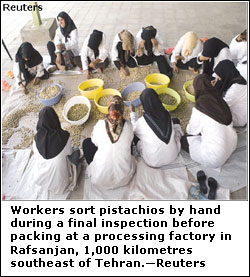 KERMAN PROVINCE (Iran): For some Iranians, it’s a galling thought: the United States may oust Iran as the world’s largest producer of pistachio nuts this year because of one of the worst harvests ever in the Islamic Republic.
The popular nibble is Iran’s main export commodity outside the oil sector, earning it more than $1 billion last year, and providing many people with jobs in the arid, southeastern province of Kerman, which has 140,000 pistachio farmers.
Unusually cold weather during the flowering in April dealt a blow to the 2008 crop, which farmers say is down by as much as 75 per cent from last season’s record of 280,000 tonnes.
The shortfall has helped push up pistachio prices but not by enough to compensate for lower volumes, they say.
The poor harvest follows a severe drought that is forcing Iran to import millions of tonnes of wheat and causing power shortages in the world’s fourth-largest crude producer.
“We actually never had production as low as this,” said Behrooz Agah, whose grandfather pioneered exports of the split-shelled nuts in the 1930s.
“For Iranian pistachio farmers, yes, it is a crisis,” he said, standing in sweltering heat amid rows of trees with bunches of the red-green nuts growing in desert-like terrain.
Agah said he expected export revenue to fall to $350-400 million and that this year’s frost would also hit the 2009 crop.
Though pistachio prices have now jumped after a period of stagnation, margins have been squeezed by double-digit inflation – running at an annual 27 per cent – and rising costs.
The relative stability of Iran’s rial against the US dollar has not given those selling abroad any major relief.
Mehdi Agah, Behrooz’s uncle and a board member of Iran’s Pistachio Association, said the country was experiencing the so-called Dutch Disease, where the value of a currency is strong because of lucrative oil or gas exports, hurting the ability of other sectors to compete internationally.
“Already the carpet industry has lost business to the Dutch Disease,” he said, referring to another export earner.
Economic consultant Saeed Laylaz said Iran’s imports were growing faster than its non-oil exports, making the country more sensitive to the price of crude, which has plunged from a July peak of $147 per barrel on deepening global economic gloom.
Iran relies on windfall gains from its hydrocarbon wealth for its budget and to pay for surging imports of goods, which are forecast to almost double to $83 billion between 2005-2010.
For Iran’s pistachio farmers, however, the most pressing problem is this year’s crop failure at a time of growing demand from new consumers in countries such as China and Russia.
Big farms employ hundreds of mainly Afghan labourers during the harvest in September. But this season warehouses stand half-empty and machines lie idle.
“Workers are going to be laid off,” said Ali Alizadeh, who manages a processing plant where the nuts are cleaned and dried.
He expected the firm’s exports to fall by around 70 per cent.
The pistachio problem alone would be serious enough in a country where the official jobless rate is around 10 per cent, but there is also a political dimension.
The Sarmayeh business daily said last month the United States might this year produce more pistachios than Iran for the first time.
“Americans are using all advertising tools and their financial power for victory in this market,” it quoted Mohammad Hossein Karimipour, head of the agricultural commission of Iran’s Chamber of Commerce, as saying.
The United States has more than doubled production in the last decade to about 190,000 tonnes in 2007, most of it in California. With a good pistachio year usually followed by a weaker harvest, California’s output is expected to fall to 260-270 million pounds in 2008 but this would still be more than many are forecasting in Iran.—Reuters



























