0
0

Ghulam Rasool Mehr, Unionist Party and Pakistan Scheme
 What should one write if one has the ability to write almost anything well at will? History, biographies, editorials, columns, politics, Islam, translations, poetry, literary criticism, research articles, commentaries on Iqbal and Ghalib’s poetry? As for me, I would choose something my heart is in. At least, that’s exactly what Ghulam Rasool Mehr did.
By any standards, Ghulam Rasool Mehr was an unusual person. He was the stuff of the classics even before he shot to fame with his work at Zafar Ali Khan’s newspaper Zameendar. A scholar armed with an encyclopaedic knowledge and an indefatigable energy, Mehr became a working journalist and pursued the rest of his interests at leisure, excelling in all of them as well as he excelled in journalism -- except, of course, for poetry, which was not his forte though he had drunk deep at the fountain of Urdu and Persian poetry. Another exceptional role that Mehr played was that of a sage who guided the Muslim political efforts and helped shape public opinion, especially in Punjab, at the critical juncture of the second quarter of the 20th century, though in the end he was unhappy over the partition of Punjab and Bengal for the creation of Pakistan.
Though a dissertation had been written on Mehr sometime back, the need for further research on him was felt as just one book and sporadic articles can neither capture nor do justice to his multi-faceted personality and prolificacy. Mehr’s political stance and his vital role during and before the Pakistan movement needed a re-evaluation as much has been written with a tongue-in-cheek style about him and Abdul Majeed Salik, his colleague first at Zameendar and then at Inqelab, the latter being the newspaper both launched from Lahore after quitting the former. The writings about Mehr and Salik, the famous duo of a bygone era, have been somewhat muddy and have clouded their role in the Pakistan movement, especially when one looks at their affiliation with the Unionist Party.
Muhammad Hamza Farooqi, a veteran scholar, travelogue writer and humorist, has carried out the much-needed research on the aspects of Ghulam Rasool Mehr’s personality, his thoughts and his political leanings.
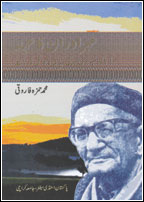 Farooqi’s book ‘Mehr aur un ka ahad’ has just been out. Karachi University’s Pakistan Study Centre has got another feather in its cap by publishing this scholarly work. Hamza Farooqi is among those Pakistani scholars who have faithfully been doing their part of the work for long and who have a long list of books to their credit, but who are marooned on the remote island of anonymity just because of their lack of public relations skills and their total immersion in their work rather than lobbying and/or making public appearances -- mostly in useless book launches.
Farooqi has a special interest in the history of the subcontinent and has collected and published Abdul Majeed Salik’s columns in four volumes. Iqbal is another passion of his that made him do some original research on the great poet. Farooqi’s wanderlust sent him globetrotting and the result was his travel accounts -- peppered with his bubbling wit and pinching satire. But in this book Farooqi’s style is altogether different as was the demand of the work, though at times he cannot refrain from pinching at what seems grotesque to him.
Ghulam Rasool Mehr was born on April 18, 1895, in Phoolpur, a village five miles from Jallundhar, East Punjab. Lahore’s Islamia College, says Farooqi, and its instructors left indelible impressions on Mehr’s mind. Not only did he get a BA from there but also an unflinching belief in Islam and an unfaltering love for its culture and history. Here he studied English, Persian and philosophy. From Persian he picked up the classical literary style of writing and philosophy taught him logical thinking, reasoned analysis and a propensity to ponder.
Mehr was immensely impressed by Abul Kalam Azad, Allama Iqbal and Zafar Ali Khan, though not necessarily in that order or intensity. Of them, says Farooqi, Iqbal’s and Azad’s impressions were everlasting. Weirdly enough, Azad’s political thoughts were quite opposite to those of Mehr, as Mehr believed in a separate and distinct Muslim identity. But what Farooqi should have mentioned is the fact that in the beginning Abul Kalam Azad was a firm believer in Muslim renaissance and a universal Islamic brotherhood, transcending political and geographical boundaries. His newspaper columns preached the same in an ornate language laden with Perso-Arabic expressions. What convinced Mehr was Azad’s emphasis on Quranic teachings and his laments for the Turkish Muslims during World War I and the Balkan wars.
But Azad discarded his old notions and, joining the Indian National Congress, began stressing a common Indian nationalism, sacrificing the idea of Muslim brotherhood at the altar of Hindu-Muslim unity. This was an idea to which Mehr was so averse. Mehr staunchly believed in a separate Muslim identity, as Farooqi has mentioned, and fought throughout his life for separate Muslims electorates and their distinct entity. It is quite strange that Azad’s total metamorphosis could make little dents in Mehr’s appreciation for him.
Another enigma is Mehr’s leaning towards the Unionist Party. When the Quaid-i-Azam reorganised the Muslim League and infused a new spirit into it, writes Farooqi, Mehr and Salik, at the behest of their Unionist ‘masters’, opposed the Muslim League. And when Iqbal denounced the Unionist Party, ‘Inqelab’ did not even bother to publish his statement. The Unionist Party was a stooge of the British, needing the colonial crutches to stand on any political ground, yet Mehr supported it with his editorials in ‘Inqelab’.
Still more enigmatic Mehr appears when one reads about him taking great pains to work out a ‘Pakistan Scheme’ on the basis of which the Muslim League presented the historic 1940 Pakistan Resolution in Lahore. But when the time came for the creation of Pakistan and the June 3 plan was announced in 1947, Mehr again disagreed and lamented the partition of Bengal and Punjab for their annexation with India and Pakistan.
One must praise Hamza Farooqi for his straightforwardness: he does not hesitate to point out any incongruity in the attitude or thinking of a prominent figure. He has repeatedly mentioned where Mehr missed a point or was influenced by his Unionist connections. As this is the first of a two-part study, one hopes the sequel would be more enlightening.
Dr Jafer Ahmed has rightly said in his forward to the book that Mehr’s biography is not a mere account of his life events, rather it is a history of an era. One can see historical events unfold themselves and Farooqi punctuates the account with facts and figures, fully supporting them with references and original texts.
But there is one aspect of the book that irritates the reader: the first 100 pages, barring a few ones, are more of a history of Zameendar and Zafar Ali Khan and his skirmishes with Mehr and Salik rather than Mehr’s era. Though it is dotted with anecdotes and Farooqi’s crisp comments and his impeccable language make it a good reading, it also leaves the readers wondering whether they are reading a history of Urdu journalism.
drraufparekh@yahoo.com
Negligence turning ‘Islamabad the beautiful’ uglier by the day
 ISLAMABAD is becoming a major link in the narcotics trade in the region but the steps taken to check the alarming development don’t arouse much confidence.
One indication that Islamabad has emerged on the narcotic traffickers’ supply line is the increasing number of people being picked up by the city police for transporting the illegal stuff.
In the first nine months of this year the police arrested 354 “carriers” and registered cases against them on the basis of the 6.57kg of Chars (marijuana), 15.48kg of heroin and 11,051 bottles of liquor recovered from them.
But strangely police took no interest in pursuing the drug barons identified by the accused as the suppliers. Not a single “principal supplier” has been caught by the city police in the past few years.
Islamabad police routinely blame the rise in crime in the city on elements from surrounding areas and the tribal areas.
Since the excuse sticks easily in the case of narcotics, the police transfer the entire blame to “the negligence of Anti-Narcotics Force”.
It is the responsibility of the Anti-Narcotics Force (ANF) to trace and arrest the smuggler, according to the city police. Its own job is only to curb trafficking and apprehend the carrier in and around the city.
On September 13, the Tarnol police arrested a woman passenger carrying 5kg of fine quality heroin. The police intercepted the woman coming from Swabi on a tip-off. During interrogation she revealed that she was working for a Peshawar-based drug smuggler and taking the illicit drug to Lahore.
Police charged her and sent her to Adiala Jail and closed the case without making any effort to nab the narcotics smuggler at Peshawar or the traffickers in Lahore the heroin was destined to.
The ANF does arrest the men behind the illicit trade, but not many.
Both the ANF and police have the excuse that the main smugglers are located in Tribal Areas, beyond the reach of the law.
Still, according to the ANF, it is the responsibility of local police to go after street peddlers and help the ANF in tracing their further links. “But it has never happened,” claims the ANF.
Afghanistan is the largest producer of illicit narcotics in the world and more than 40 per cent of its produce passes through Pakistans four major cities - Islamabad, Rawalpindi, Lahore and Faisalabad - for distribution in the country and abroad, ANF and police sources say.
First the Afghan narcotics reach Tribal Areas. From there carriers smuggle it to Islamabad or Faisalabad via Grand Trunk Road and Motorway.
Islamabad is gaining the reputation of being “the gateway to wide world” for smuggled narcotics which enter the city through Tarnol and Golra. Carriers bring it in, using rented cars or public transport, and are arrested mostly on a tip-off from police informers.
But the smart ones escape the police by putting local number plate on their cars before entering the city limits and safely deliver their cargo within the city.
For extra caution they also carry women passengers to give the impression of a family on the move. And for the reason women carriers are used to transport narcotics by passenger buses.
Some have been caught with the stuff wrapped to their abdomen to give the look of their being pregnant, and so untouchable.
Police have arrested narcotics carriers at check posts within the city as well, but only by chance, not of any effort.
Carriers and users of narcotics arrested by police are booked under the Narcotics Act, applying its section 9A if the quantity of drug on their person is less than 100gm and 9B if more, up to 999gm.
Offences covered by the sections are bailable and conviction under them carries terms of imprisonment from two to five years.
Section 9C of the Act is applied if the recovery of narcotics is 1000gm or above. It is a non-bailable offence and carries the maximum punishment of death or live sentence.