0
0

The economic performance during 2007-08 was debilitated by the twin shocks of rising food and fuel prices.
The food and fuel prices climbed to record levels with the poor segments and fixed income groups, hit hardest by inflated prices.
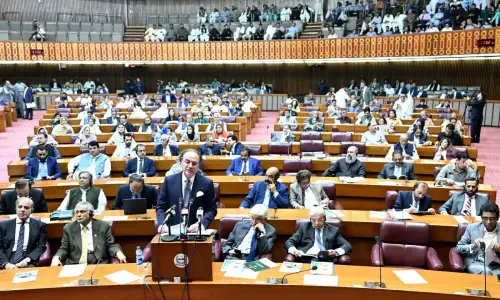
The government in an effort to protect the consumers, offered heavy subsidies which collectively reached to a record level of Rs300 billion, accounting for about 3.6 per cent of GDP. This resulted into an obvious overshooting of the budget deficit from four to 7.4 per cent of GDP. The present government has been taking many unpopular decisions to correct the fiscal and external imbalances with a view of restoring macro-economic stability which is vital for sustaining higher economic growth, job creation and poverty alleviation.
Needless to say, stabilising the economy and protecting the poor and vulnerable segments of the society from the effects of price adjustments poses a serious challenge to the newly-elected government. There is an increased realisation that further policy inaction in the long-run is bound to have disastrous consequences for the economy. Therefore as a strategy, the ruling administration has been making difficult choices which have been accompanied by strenuous efforts to mitigate the sufferings of the poor. Notable initiatives among these include:
• The Benazir Income Support Programme (BISP), launched from Sep 1, offers Rs1,000 per month to each of 3.5 to 4.5 million families, covering about 14 to 15 per cent of the population in the lowest income bracket.
• People’s Works Programme with an allocation of Rs28.4 billion is another initiative that would provide provisions of electricity, gas, farm to market roads and water supply. This is expected to create sizeable employment opportunities by improving access of low-income groups to the basic necessities of life.
• Government has announced to set up ‘human resources development commission’, which will review the state of unemployment, regularly monitor the unemployment rate and suggest measures for its control. It will co-ordinate all programmes aimed at providing employment, imparting skills to the unemployed, broadening the opportunities for technical training and vocational education and encouraging work for food programmes.
• Low cost housing: The government has proposed an allocation of Rs2 billion for the construction of one million housing units announced by the prime minister in his 100 day plans for providing housing facilities to low income groups and government employees.
The implementation of these programmes becomes problematic not only because ensuring transparency or correct identification of deserving individuals is difficult but also because, the government is hard pressed to find sufficient resources required for the financing of these schemes. This leads us back to the negotiation table where we have to somehow convince the international donor agencies to provide us with ample finances on one hand and reduce the external debt burden on the other.
The Budget 2008-09, approved by the parliament, earmarked an amount of Rs34 billion for the implementation of Benazir Income Support Programme (BISP). The government claims that the original targeted level of allocation for this programme was Rs50 billion, however due to budget constraints it has been limited to Rs34 billion which will be increased depending on the availability of funds. The administrative cost of the implementation of the scheme would be 1-2 per cent of the total cost of the scheme.
The Finance Minister, Naveed Qamar was quoted as saying; “We want to target more poor families but due to budgetary constraints, it is not possible. However, with the passage of time, the government would increase the amount fixed for the scheme by arranging finances from other resources, so that maximum number of deserving families could be brought under the scheme”. If rational and long- term decisions are to be taken, borrowing in the form of debt from external or internal sources is simply out of question, so the possible options for funding of this programme are very limited indeed.
In this context, a debt swap for the purpose of uplifting the poor is not only favourable but also offers minimum risk in the face of severe budget constraints. Theoretically a debt-for-poverty-swap would involve the cancellation of external debt in exchange for local currency funding for initiatives aimed at reduction in poverty in the borrower- country.
There is a need to do an in-depth analysis of how debt swaps can be effectively exploited to provide funds for poverty reduction efforts through micro-finances, BISP, People’s Works Programme, Human Resources Development Commission, People’s Rozgar Programme, and Low Cost Housing, etc. For this purpose, various stakeholders in microfinance, bankers, policy makers, and international organisations can be approached for deliberating on the issue to chalk out suitable strategies.
The increase in world fuel and food prices, especially for rice and wheat, the two main staples in South Asia, has had a dramatic impact on poor people. The World Bank Group has recently announced loans, credits, grants, equity investments, and guarantees totalling over $5.5 billion to South Asia in fiscal year 2008. The funding supports 79 new projects designed to overcome poverty and boost growth through practical plans enhancing the business and investment environment and empowering poor people.
International multilateral and bilateral donors do realise that Pakistan as a developing economy needs to be provided with substantial funds, since the menace of poverty can only be eradicated through collective endeavors. Isabel M. Guerrero, World Bank Vice-President for South Asia, was quoted as saying that the last year posed profound economic, political and social challenges for countries in South Asia. The bank has extended an additional financing of $75 million for the Pakistan Poverty Alleviation Fund, which has touched the lives of more than 2.5 million people in about 5,000 villages.
Given the rising figures of debt and deficit, the government is in an effective position to negotiate the provision of these funds into a debt-for-poverty-swap. As stated earlier these assets are mostly in the form of loans, equity investments, grants and guarantees. If a debt-for-poverty-swap is effectively implemented it can play a important role in breaking the vicious circle of poverty, apart from relieving some of their budgetary restrictions.