



 0
0

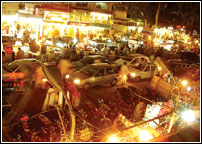 Eid ul Fitr generates as much as Rs70 billion business, according to conservative estimates. During the religious festival, the household spending touches its peak.
Though this year, inflation and suicide-attack scare weighed heavily on shoppers’ spirit, shop they did. May be, it was their way of rejecting terrorism and putting a brave face to economic hardships. About a million shops and 600 markets all over the country, did fairly good business under the current circumstances.
A market survey by this paper in six bigger cities published two days before Eid indicated that most retailers found the visitors’ enthusiasm milder as they reported 20 per cent fall in the total sales this year.
“We are aware of the risk but we cannot let scare knock us down. Besides in the environment we are living in, risk is unavoidable. No matter how big is the threat, we have to go about living our lives. I do not want my family to miss on whatever little happiness we can draw from Eid celebrations”, Waqar Ahmed who was out in a posh market last week in Karachi with his wife and all three children told Dawn.
In the absence of actual consolidated countrywide sales or an expert’s study on changing consumer behaviour, the guesstimate of Rs70 billion was arrived at by tripling the total turnover of Rs22 billion reported for Karachi last year. Siddique Memon, Chairman Karachi Traders Action Committee quoted the number based on some private estimation by the association in 2007.
We assumed that the impact of increase in inflation, consumerism, shops and markets, population and rural to urban migration cancelled each other out and the total amount stayed put at the last level.
Another way of arriving at an estimated size of Eid market was by determining average spending per person and multiplying it with the percentage of population who incur extra expenditure on Eid. Except for very backward areas in Sindh and Balochistan, the level of activity might vary in volume, but the spending is certainly higher during pre-Eid period all over the country. This indicates extra per head spending by at least half of the population-- about 80 million people.
Our survey revealed that in Karachi even low income group spend nothing less than Rs1000 per person in the family. This is inclusive of all expenditures that include spending on dresses, footwear, accessories, edibles, household durables and transport. This yardstick gives a staggering figure of Rs80 billion.
But can poor, barely surviving, actually afford to manage this type of spending? The simple answer is that they cannot but the society can. The fact is that not only the rich but the middle class reach out and spend for those who cannot afford to do it for themselves.
“Yes, a person (unskilled worker or the people at the lowest rung such as guards, sweepers or seasonal workers) making Rs5,000 (about $75) per month living off a make- shift hutment in a shanty township (kutchi abbadi) supporting a family cannot spend his full salary on Eid shopping.
But go to any nook or corner in Karachi and you will see people in new clothes. If they did not buy it themselves someone bought it for them. What does it matter to market as long people spend ”, said Amjad a shopkeeper in downtown Saddar.
There is no denying that families who can afford to dress new just one time in a year they choose Eid to indulge. “I am sole earner and make both ends meet with difficulty”, said driver Wazir who lives in Hijrat Colony.
“On Eid when company gives early salary I buy clothes and shoes, provide for better than normal meal and socialise with my family. It costs me more than half my salary for a month”, he said. To cover shortfall in the month ahead Wazir relies on his friend who owns a general store in his locality. “It will take me two months to clear off the debt I will incur on monthly expenses later”, he said.
The market sources confirmed that inflation has jacked up the prices but the rise in prices of fabric, footwear and ordinary accessories is much less in percentage as compared to hike in the prices of edibles.
“The food inflation is backbreaking high at 25-35 per cent. For a variety of reasons, the rates of ordinary local fabric and garments have risen marginally by 5-10 per cent”, a market analyst observed.
Another interesting aspect of Eid market is that the share of locally made items in the market has risen as compared to imports. The depreciation of rupee and policies of the government that discouraged imports combined to work in favour of local manufacturers this year during the high spending season.
“Last year about 2200 containers of merchandise were imported. The number dropped to 1,050 this year because of revised tariff rates and also because the falling rupee has squeezed the profit margin of traders”, Chairman Action Committee of Karachi Traders told Dawn.
He said that Karachi saw extraordinary business in footwear this year because Eid coincided with arrival of winter when shoe sales rise. He confirmed that more drop was noticed in middle class markets as compared to those serving extremely rich or the poor.
This highlighted another feature of Eid market: its dependence on growing middle class. The middle class sets the trend and the mood of spending. “This is the most status-conscious class of people, struggling to outsmart their likes. They end up setting the bar higher than their reach,” a lady lawyer observed.
Add to this is the social compulsion to maintain certain living standard that necessitates increasing spending as family is influenced by lifestyles as shown by electronic media. Now you have a perfect picture of a white collar worker going nuts”, commented a colleague.
A few reports on philanthropy confirmed that the collective streak of sharing and caring is at its zenith during Ramadan month preceding Eid. About a decade earlier the quantum was reported to be in the vicinity of Rs70 billion. Probably a portion of this is also spent by philanthropist organisations for Eid.
Our survey showed that the trend of spending is not uniform all over the country, as it has direct relationship with the level of prosperity. Punjab takes the lead over other three provinces excluding Karachi in generating business.
“Being a port city, Karachi is the biggest wholesale market. There are 60,500 shops and 550 markets in the city with a total strength of about 80,500 regular workers. The city employs another 20,000 people on temporary basis at the time of Eid every year. There are 10,000 small units of tailoring and embroidery that engage no less than 35,000 to 40,000 people”, said Mr Memon making a case for Karachi to be the biggest business centre.
The season was busiest in Karachi. Punjab with probably more at stake was found to be nervous because of spreading wave of violence; NWFP though most affected, did better than Balochistan in Eid business.
Another feature that surfaced from the survey was the surge in the use of plastic money this year. At some upper class markets in bigger cities it was reported to be as high as 60 per cent of the total sales. People attribute it to both: worsening law and order and availability of easy credit. “It is not safe to carry cash around, besides it gives some cushion to middle class to meet the demand of Eid shopping”, observed a banker.
Traders, however, are not too happy with the rising use of credit cards at the current rate as it creates problems of liquidity for them. Their transactions are still primarily cash based.





























