



 0
0

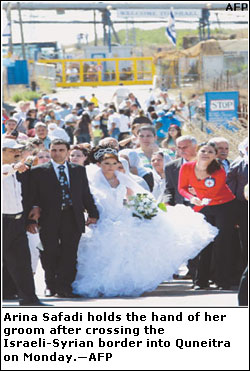 QUNEITRA (Golan Heights): Arina Safadi, wearing a sumptuous white wedding dress, walked past barbed wire in the Israeli-annexed Golan Heights so she could join her future husband on the Syrian side.
She was beaming with happiness at the prospect of embarking on a new life, but the young bride could also not hold back the tears as she waved farewell to her native home, knowing she could never return.
Just before she reached the Quneitra border post, Safadi had one last heart-wrenching task to perform – signing a document in which she pledged to relinquish her right to residency in the Israeli-annexed area.
“I give up my right of residence and I know that I may not return because of the absence of diplomatic ties between Israel and Syria,” says the text.
The Golan Heights, a rocky mountainous plateau rich in water and also a strategic military outpost, has been at the core of the Syrian-Israeli conflict since it was seized by the Jewish state in the 1967 Six-Day War.
Israel annexed the mostly Druze-inhabited territory in 1981, a move never recognised by the world community.
Israel and Syria have been holding indirect peace talks with Turkey as a mediator since May, after an eight-year freeze, with Damascus expecting the process to lead to the eventual return of the Golan Heights.
But until that happens brides such as Safadi, 24, who wish to marry on the Syrian side of the Golan, must make a one-way trip past barbed wire covered in camouflage netting and past “checkpoint Charlie” in a demilitarised zone.
Safadi will tie the knot with her cousin, Rabih Safadi, and the couple will live in Jaramana, a town near Damascus but miles away from her little village of Ein Qiniya on the windswept borders of Israel, Syria and Lebanon.
“Of course I’m happy to get married, but I am sad to have to leave my parents,” Safadi said as she sat in a beauty salon having her hair done as part of the flurry of preparations for the big day.
Before that she got a facial – a bittersweet escape from the family home for a short while, away from the constant stream of friends and relatives who have been calling in every day for the past two weeks to bid her farewell.
“The more the clock ticks, the more difficult it gets,” Safadi said.
“I love him,” she said of her husband-to-be. “It is my choice to start a new life, but I will have to start from scratch.”
Safadi has never been to Syria and only knows what she has seen about it on television. “Of course they have a different lifestyle from ours,” she said.
She met her future husband in Jordan during a reunion of the extended Safadi clan which, like many Golan families, was broken up after Israel conquered the strategic plateau in the 1967 war.
More than 18,000 Syrians, mostly Druze, are left from the Golan’s original population of 150,000. The vast majority of these Druze have refused to take Israeli citizenship.
The plateau which overlooks much of northern Israel is also home to nearly 20,000 Jewish settlers.
The father of the bride, Yahiya Safadi, is sad to see his daughter leave.
“I raised her, took care of her,” he said, his voice choked with emotion. “I didn’t sleep at all last night. I will never see my grandchildren.”
Safadi, hair coiffured and clutching a bouquet of flowers, turned for a last look, a final wave. Then the yellow gate of the crossing gently snicked shut behind her. There is no going back.—AFP



























