0
0

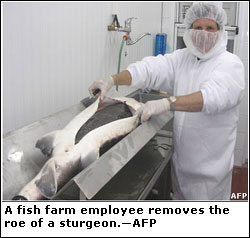 KIBBUTZ DAN, Israel: Thousands of kilometres from the Caspian Sea, Israel is cashing in on a global caviar crisis, gearing up to export tonnes of the delicate and costly roe from farm-raised sturgeon.
It may not be quite kosher – depending on who you ask – but there is definitely a huge international demand for the gourmet treat.
“This is top quality,” says Yigal Ben Tzvi, managing director of Caviar Galilee, holding up a blue tin of “Made in Israel” sturgeon eggs, which he says caviar giant Petrossian buys wholesale at 2,800 dollars a kilo.
In the past, the Caspian Sea was the world’s main source of the coveted delicacy, but overfishing and pollution have led to dwindling yields in the region, triggering a grave caviar shortage.
Israel is getting a name for itself on the lucrative market by farming Osetra sturgeon at Kibbutz Dan in the north of the country, just a stone’s throw from positions of the Hezbollah militia in southern Lebanon.
To date, Caviar Galilee’s limited production has earned praise from some distinguished connoisseurs and orders from top retailers. Staff at Kibbutz Dan are already checking on the money-makers, inserting a special instrument to extract a few eggs from the fish in order to determine their size and quality.
Each of the females carries an average of two kilos of the precious pearls, which could bring in as much as 7.7 million dollars.
What could one day become a cash-churning business began with a simple idea: raising a fish destined specifically for the sizeable Russian-Israeli population.
“Then in 2003, caviar prices skyrocketed so we decided to get into this business,” says Ben Tzvi.
The first step was to bring in fertilised sturgeon eggs from the Caspian Sea. Once the gender of the fish is determined – this usually takes four years – they are placed in sex-segregated tanks.
Males are destined for the fish market and what Ben Tzvi describes as “the most beautiful females” are artificially inseminated and kept as caviar producers.
Normally, a female Osetra takes about 15 years to reach egg-bearing maturity, but Israeli biologist Avshalom Hurvitz has managed to cut the period to eight or nine years.
The fish are pampered with a special diet specially prepared at a nearby factory, and swim in water drawn from the snow-fed Dan river, kept at a constant temperature and regularly oxygenated.
Sturgeon is one of the world’s oldest fish and has been around since the days of the dinosaurs.
But is it kosher?
Most rabbis say sturgeon – and by extension caviar – are not because the fish apparently has no scales, which makes it a forbidden food under Jewish dietary laws.
But Hebrew University scientist Berta Levavi-Sivan, who has participated in the sturgeon-rearing project, begs to differ, insisting that magnification will reveal that the fish do indeed have tiny scales.
“If you ask me, it’s kosher.”—AFP