



 0
0

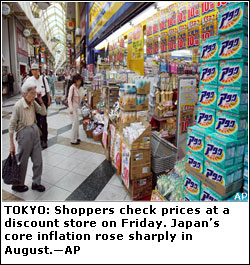 TOKYO, Sept 26: Japan’s core inflation rate stayed at a decade high of 2.4 per cent in August as soaring energy costs continued to pressure Asia’s largest economy, official figures showed on Friday.
Core prices rose for an 11th straight month, and at the same pace as in July, when inflation was the fastest since October 1997. The figure matched market expectations.
Japan was trapped in a deflationary spiral for years, but the return of inflation has also caused concern as it is being driven by rising import costs rather than a stronger domestic economy.
Core inflation in Tokyo, a leading indicator released a month earlier than the figures for the whole of Japan, picked up to 1.7 per cent in September from 1.5 per cent in August, the government reported.
Core inflation excludes volatile fresh seafood, fruit and vegetable prices.
There are concerns that rising prices will dampen already tepid consumer spending, adding to the troubles of Japan’s economy, which contracted last quarter, heightening fears of a recession.
Despite the resurgent inflation, Japan’s central bank is not expected to raise its super-low interest rates any time soon to try to contain price pressures, due to the weak state of the global economy.
The Bank of Japan has kept its benchmark lending rate at 0.5 per cent, the lowest among the major economies, since February 2007.
Analysts say that a recent drop in the price of oil and other commodities should help to rein in inflation in the months ahead.
Rising energy and material costs are starting to push up the cost of other goods and services, which analysts said could prompt consumers to tighten their purse strings as the economy skirts recession.
Japan’s economy posted its sharpest contraction in nearly seven years last quarter. Consumer spending remains sluggish, while exports to the United States and Western Europe are falling due to the worsening global economy.
“Rising grocery prices are particularly negative for consumer demand and this trend of high prices is likely to last for some time which could weigh on the economy,” said Norio Miyagawa, an economist at Shinko Research Institute.
Japan was trapped in a deflationary spiral for years but few people are cheering the return of inflation because it is being driven by rising import costs rather than a stronger domestic economy.
Japan’s new finance minister said the government must ease the pain of rising prices for consumers and business.
“I think counter-measures are needed to tackle factors that are pushing up the cost (of living or doing business) for consumers and businesses,” Shoichi Nakagawa told reporters.
Excluding food and energy, Tokyo prices rose 0.5 per cent, suggesting that inflationary pressures are spreading to other goods and services, analysts said.
“Cost-push price increases are spreading,” said Mamoru Yamazaki, an economist at RBS Securities Japan. “That’s negative for consumer spending.
Nominal wage growth is miserable at the moment.” Despite the resurgence of inflation, Japan’s central bank is not expected to raise its super-low interest rates any time soon to try to contain price pressures, due to the weak state of the economy and current financial tumult.
Analysts said a recent drop in the price of oil and other commodities should help rein in inflation in the months ahead.
“It looks like the headline inflation rate has peaked and will be dragged lower by oil prices in the fourth quarter of 2008,” predicted Macquarie Securities economist Richard Jerram. –AFP






























