0
0

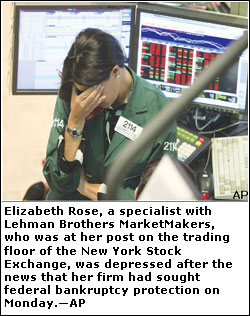 NEW YORK, Sept 15: In a stunning reshaping of America’s financial landscape, two venerable Wall Street firms fell from the shockwaves of a credit crisis that has plunged the financial system into turmoil, as stocks tumbled across the globe on Monday in response.
Lehman Brothers, burdened by $60 billion in soured real-estate holdings, filed for federal bankruptcy protection in the US Bankruptcy Court after attempts to rescue the firm failed. Bank of America Corp said it is snapping up Merrill Lynch in a $50 billion all-stock transaction.
Stock markets fell precipitously as investors reacted to some of the most dramatic economic news in modern US history. The Dow Jones industrial average fell 300 points in the early going.
The demise of the independent Wall Street institutions comes six months after the collapse of Bear Stearns and 14 months after the beginning of the crisis, sparked by bad mortgage finance and real estate investments.
Ominously, American International Group Inc, the world’s largest insurance company, was asking the Federal Reserve for emergency funding and planned to announce a major restructuring this week. A global consortium of banks, working with government officials in New York, announced a $70 billion pool of funds to lend to troubled financial companies. The aim of the bank consortium, according to participants, was to prevent a worldwide panic on stock and other financial exchanges.
Ten banks – Bank of America, Barclays, Citibank, Credit Suisse, Deutsche Bank, Goldman Sachs, JP Morgan, Merrill Lynch, Morgan Stanley and UBS – each agreed to provide $7 billion “to help enhance liquidity and mitigate the unprecedented volatility and other challenges affecting global equity and debt markets”.
The Federal Reserve also chipped in with more largesse in its emergency lending programme for investment banks. The central bank announced late on Sunday that it was broadening the types of collateral that financial institutions can use to obtain loans from the Fed.
Lehman Brothers’ announcement that it is filing for bankruptcy came after all potential buyers walked away. They were spooked by the US Treasury’s refusal to provide any takeover aid, as it had done six months ago when Bear Stearns faltered and earlier this month when it seized mortgage giants Fannie Mae and Freddie Mac.
In an effort to calm the markets, Lehman pre-announced third-quarter results on Wednesday. In an affidavit filed with the bankruptcy court, Lehman Chief Financial Officer Ian Lowitt said that action “did little to quell the rumours in the markets and the concerns about the viability of the company”. He said the uncertainty made it impossible for Lehman to continue.
Insurer AIG, hit hard by deterioration in the credit markets, said on Monday it was reviewing its operations and discussing possible options with outside parties to improve its business after a week when its stock dropped 45 per cent amid concerns about the company’s financial underpinnings.
The Wall Street Journal and The New York Times both reported that the American International Group was seeking an additional $40 billion in emergency funds – possibly from the Federal Reserve – to help it avoid a credit rating downgrade, which would make it more expensive for AIG to raise money. The insurer has already raised $20 billion in fresh capital this year.
The AIG was working with New York’s insurance authorities and a representative of the governor’s office through the weekend to craft a solution that protects policyholders, according to a spokesman.
The end of Lehman may not stop the financial crisis that has gripped Wall Street for months, analysts said. More investment banks could disappear soon.
That’s partly because some of the firms, particularly Merrill, made bad bets on real estate. But several analysts said that investment companies will need the deep pockets of commercial banks to survive the next few years.
The common denominator of the financial crisis, analysts said, was the bursting of the housing bubble. Home prices in the US have dropped on average 25 per cent so far. Analysts predicted they could drop another 15 per cent.
The crisis has begun to slow the broader economy as banks make fewer loans and consumers have begun cutting spending. Many economists are now forecasting that the economy could slip into recession by the end of this year or early next year.
That, in turn, could cause additional losses for commercial banks on credit cards, auto loans and student loans.
The International Monetary Fund predicted earlier this year that total losses from the credit crisis could reach almost one trillion dollars. So far, banks have only taken about $350 billion in losses.—AP