0
0

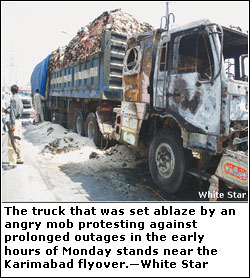 KARACHI, Sept 15: On a day when the power crisis in the city aggravated as the Karachi Nuclear Power Plant, after a surge in the circuit linking Kanupp to the Karachi Electric Supply Company at Baldia, tripped, it was announced that Al Abraj would take over the utility on Tuesday, much ahead of the expiry of the three-year condition against any change of the guard at the KESC.
After the privatisation, Aljomaih had taken over the utility on Nov 29, 2005, but the management passed on the utility to new owners as they had 50 per cent right shares, said official sources. Naved Ismail would be the new head of the utility. Aljomaih might maintain a “ceremonial presence” for a while to deal with legal issues, they said.
This happened on a day when a high-level team headed by the federal secretary for water and power, Ismail Qureshi, arrived here and its technical committee visited the KESC generation facilities to find out reasons for the rapidly deteriorating generation capacity of the KESC and the cause of prolonged power outages.
The high-level team was sent to Karachi after the Sindh governor and the federal minister for water and power had a telephone conversation about the need for urgently resolving the problems of unannounced power cuts and long hours of load-shedding.
The three-member technical group was headed by PEPCOs Director-General (energy management) Tahir Basharat Cheema, Chief Engineer (thermal) A. K. Leghari and Chief Engineer (Grid System operations) Iqbal Anwar.
After the fact-finding visit, the secretary for water and power, with the PEPCO MD, called on Sindh Governor Dr Ishratul Ibad and also held exhaustive meetings with the KESC’s incoming management.
According to a media release, the new management assured the federal secretary that they would be “going all-out to increase and ensure optimal generation from the utility’s existing power plants, besides taking full supplies from the IPPs supplying power to the KESC.”
The new owners said that “from now onwards the planned load-management should be reduced to only 2-3 hours a day and that the public would be kept informed about the unplanned closures, if any”.
According to official sources, the new management of the KESC was still negotiating with the government about possible waivers in outstanding liabilities and the tariff structure.
The managing director of the Sui Southern Gas Company also assured the government that against the allocated supply of 235MMCFD of gas for the KESC, the gas company would enhance the supplies up to 300MMCFD. This would enhance the generation capacity of the power utility.
The managing director of the Pakistan State Oil also promised to meet full requirements of furnace oil, further securing full generation capacity.
It seems that the foreign management’s strategy of generating less electricity than it could and causing the public tremendous inconvenience forced the government to agree to a deferred payment mechanism and bear much of the fuel cost of the privatised utility managed by the foreign company, which has not given any assurance of clearing its outstanding dues and making direct investment in the company to rehabilitate its infrastructure.
Meanwhile, the government has decided to continue with the monitoring of KESC operations and performance through its technical staff. Additionally, PEPCO would continue to provide more power to the KESC than the stipulated 400MW during daytime and 500MW during the peak hours, as it has been doing in the past.
It was also stated that two rental power plants with an accumulated capacity of 500MW, as approved by the ECC, would be shortly installed to provide an additional supply exclusively for Karachi. The KESC’s new management has pledged that it would also be arranging and generating and an additional 300MW from its own resources by mid-April 2009.
The shortfall on Monday oscillated between 650 and 700 MW following the erosion of 80MW from Kanupp. Under the Nuclear Regulatory Authority’s directive, power supply cannot be resumed unless the KESC gave assurance of uninterrupted supplies.
Kanupp tripped in the morning due to loss/tripping of both KESC transmission lines. Kanupp authorities have informed the KESC officials that they would not start the plant unless the KESC ensured the stability of its system, said the spokesman of the nuclear power plant.
Despite power-related violence in the city on Sunday, the privatised foreign management failed to improve its generation, especially from the Bin Qasim power plant, which was operating below capacity as the management remained determined to cut the operational cost.
At 3pm, the Bin Qasim plant was churning 830MW electricity. Its Unit 1 was giving 175MW while Unit 2 was generating 180MW. Unit 3 was churning 70MW only as the utility operated it far below capacity to save on oil. Unit 4 also gave 80MW due to the same problem. Units 5 and 6 generated 180 and 160 MW respectively. Earlier in the night, some fault had developed in the boiler of Unit 5 of the power plant. The Korangi thermal power plant was supplying 50 megawatts rather than its usual capacity of 180MW.
Residents in the area of Gulbahar and Mehmoodabad protested against power outages and chanted slogans against the power utility.