0
0

 A debt-for-environment swap involves the cancellation of external debt in exchange for local currency funding for conservation of nature and environmental protection in the borrower- country.
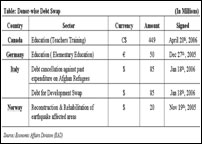
Typically, a conservation organisation purchases sovereign debt at a discount in the secondary debt market or from a bilateral export credit agency and then negotiates with the debtor for cancellation of the debt in exchange for payment in local currency or bonds, which is used to implement environmental protection programmes. Since the first debt-for-nature swap in 1987, it is estimated that close to 30 countries have benefited from such programmes, which have generated over $1 billion. Pakistan has explored a variety of financial instruments to counter the adverse impacts of external debt. Up till now it has concluded several debt swap agreements mostly with western nations. The detail of these transactions is given in the Table .
Reconstruction & Rehabilitation of earthquake affected areas$20Nov 19th, 2005Source: Economic Affairs Division (EAD) The debt swap initiatives have been limited to developments in the area of education, and re-construction and rehabilitation of earthquake affected areas. The concept of debt-for-nature swaps remains unexplored and unexploited in most of the developing countries so far and Pakistan is no exception. Such initiatives have mostly been implemented by European countries and some countries in Africa. Developing nations however are increasingly becoming conscious of the fact that, the pursuit of growth and development places a heavy burden on sustainability for now and for the foreseeable future.
Development, sans environmental aspects is counter productive in sustaining the pace of progress. According to a recent assessment made by the World Bank (WB), the annual cost of environmental neglect and degradation to Pakistan’s economy amounts to Rs365 billion ..
The Paris Club, including major European countries, Japan and the US, is the main agent involved in bilateral loans. The European countries like Italy and Norway have been involved in debt swaps done in the area of reconstruction, rehabilitation and other developmental programmes following the October 8 earthquake that hit the country in 2005. Germany and Canada have facilitated the nation by agreeing to debt swaps in education.
Environmental concerns are also rapidly gaining momentum in all industrialised countries in the face of ever increasing risks from climate change. The 34th G-8 summit held in Tôyako,, Japan from July 7–9, 2008, concluded with a unanimous agreement on considering ‘climate change’ as the most critical challenge facing the planet, before terrorism and economic slowdown. The developing world should also wake up to the fact that we are entering an age where maintaining environmental standards is intrinsically linked to the future of humanity.
In Pakistan, the deterioration of environment continues to affect livelihoods and health thus increasing the vulnerability of the poor to disasters. Approximately less than one-fourth of the population, like in most developing countries, is poor and directly dependent on natural resources for their livelihood—whether agriculture, hunting, forestry, fisheries, etc.
There is a need to take substantial and practical initiatives to counter both the adverse impacts of environmental degradation and debt burden. To serve this purpose debt-for-nature swaps are the most appropriate financial instruments that have the potential to deal with these pressing issues simultaneously. Since western countries have been involved in debt swap initiatives with Pakistan, they can be further negotiated with for debt-for-nature swaps.
The growing awareness of environmental issues among industrialised nations has in it the seeds to substantially catalyze the process of such a transaction into an effective and attractive option serving two critical issues of a developing economy like Pakistan.
With a view to combating environmental pollution in various sectors and at various levels on the national front, the government has enhanced the allocation for the environmental projects in Public Sector Development Programme (PSDP) during the current year. Overall, an allocation of Rs8.5 billion has been made for the environment sector projects in the PSDP 2008-09. There are about 52 environmental projects currently under implementation.
These projects fall in the brown, green and capacity building components/sub-sectors of environment such as: mass awareness, environmental education and environment protection; preparation of land use plan; fuel efficiency in road transport sector; protected areas management; forestry; biodiversity; watershed management; hospital waste management; environmental monitoring; capacity building of environmental institutions; natural disaster, early warning and mitigation; improvement of urban environment; etc. Utilisation of funds in these projects till January 2008 was less than 25 per cent of allocation. Adaptation and research on climate change issues are also underway through different collaborating agencies i.e. government and non-government.
Should the government be successful in negotiating an effective debt-for-nature swap, the involvement of western nations in these initiatives can enhance and catalyze the process of implementation and facilitate research and development in these areas.
For this purpose, the government should firstly create a secretariat for ‘environmental debt swaps’ within the Planning Commission, ministry of finance or Economic Affairs Division (EAD). This Secretariat should be further overseen by an effective task force, so that the implementation phase of such a transaction faces no hurdles.
The writer is an economist in the Debt Policy Coordination Office (OPCO) , Ministry of Finance. The article represents his personal views.