0
0

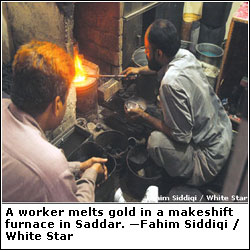 KARACHI, Sept 8: Hundreds of goldsmith workshops operating in multistorey buildings in congested residential and commercial areas of the city are posing a serious threat to public health and environment, Dawn has learnt.
Experts believe that the industrial workshops, emitting hazardous gases and fumes by burning concentrated chemicals and using gas cylinders, furnaces and industrial equipment, are a major hazard not only to workers employed at these units but also to area visitors and residents living in close proximity to these buildings.
The then Sindh ombudsman, Haziqul Khairi, acting on a complaint filed in 2001, had directed the chief controller of the Karachi Building Control Authority in 2003 to ensure that all illegal environment-degrading goldsmith workshops in the Saddar area be dismantled within three months. Though the KBCA enforced closure of some workshops in 2004, the decision could never be implemented in letter and spirit due to violent protests by goldsmiths, who had the backing of a political party.
A survey of a number of these workshops in Saddar, which has about more than 1,000 such units, revealed that workers are directly exposed to toxic fumes as they work without any protective gear and in the absence of any sufficient exhaust system. Also, there are no emergency fire escapes in the multistorey buildings where a large number of such workshops operate in small, congested rooms secured with iron grills. Most of the work at these workshops is carried out with the help of gas cylinders.
The situation’s gravity can be gauged by the fact that burnt chemicals are simply drained into sewers that carry the risk of damaging the sewerage and water supply system. About the use of various acids at different stages of gold processing, Mohammad Hussain, a goldsmith who has been in the business for over 15 years, said: “Though people can use a combination of different acids, the two most commonly used acids are nitric and sulphuric acids. The former separates gold from other impurities while the latter is used for polishing purposes.”
Explaining the procedure, he said that at the first stage pure gold was obtained by melting impure gold and mixing it with twice the amount of silver. Later, nitric acid was added and the mixture was heated up again. “Gradually, pure gold settles down in the pan while other impurities get dissolved. The procedure is repeated twice or thrice to obtain gold. Later, copper is added to recover silver and iron to take out copper. The recovered pure gold is later mixed with silver, cadmium or copper, this time according to goldsmith’s own requirements.”
Gold, silver and copper, all have high melting points: 1,063 Celsius, 961 Celsius and 1,083 Celsius, respectively. The melting and mixing process with the help of nitric acid is carried out on coal fuel many times while sulphuric acid is needed at the polishing stage.
“The manufacturing item gets black after going through different stages. It regains brightness when dipped in sulphuric acid and heated up. The acid is used again at the final stage to enhance the shine.”
The survey revealed that there were specialists for each processing and manufacturing stage and they had set up their separate workshops in the same building. Though chimneys were installed at melting workshops in Saddar, workers were still exposed to the smoke and fumes emitting from the burning coal and nitric acid, as one could easily see that the stove and chimneys were not specially designed for the purpose. Besides, workers had no protective gear.
“It took me some time to adjust to the working conditions here. I found difficulty in breathing initially, but gradually I adjusted. None of us have any health problem due to the burning of chemicals,” claimed a worker.
At most polishing units, there was no sufficient exhaust system and workers told Dawn that the used chemicals were just thrown away in drains. A majority of workers were addicted to gutka and were reluctant to admit any health problem they might have suffered due to the working conditions.
KBCA, Sepa turn a blind eye
While Saddar is considered to be the hub of gold jewellery works, goldsmith workshops also exist in Kharadar, Hydery, Liaquatabad, Shah Faisal Colony and PECHS. Their operation in residential and commercial areas is not only a major health and environmental hazard, but their very establishment is a major violation of building laws.
The workshops are mostly set up in multistorey buildings whose occupancy status, according to the master plan, is reserved to be strictly residential-cum-commercial. Going by the book, the workshops are illegal because the buildings in which they run are being used for small-scale cottage industrial activity in violation of their status in the master plan. Besides, major infrastructural changes have been made inside the buildings in violation of the approved maps, making the structures vulnerable to accidents.
The five gold workshop owners Dawn talked to didn’t have any licence for launching the business though registration with the labour department is mandatory under the shops and factories’ acts.
Recalling the past fires in jewellery workshops in Saddar, shopkeepers in Bohri Bazaar said that a major fire had erupted in 1994, when eight people were killed and five injured in a jewellery workshop in Mohammadi Centre. The fire was caused when workers, in the absence of electricity, were working under a leaking gas burner. There were about 40 workshops in the same building using gas cylinders.
In June 2001, a complaint was filed by residents of Parr Street, Saddar, requesting the demolition of illegal constructions raised in Saddar and the closure of harmful goldsmith workshops established in residential-cum-commercial areas. The chief controller of the Karachi Building Control Authority and the director-general of the Sindh Environmental Protection Agency (Sepa) and the district commissioner, south, were asked to submit reports on the matter.
In its report, Sepa admitted that heavy noxious fumes emitted from goldsmith workshops and that people living in the nearby flats could be affected by the fumes’ discharge.
The report, however, didn’t mention the names of specific chemicals used by goldsmiths. It stated that gold and platinum were treated with some chemicals in the workshops where people worked in unsafe conditions in highly polluted atmosphere for long hours and there was no proper system for channelising the emission of toxic fumes.
In 2003, provincial ombudsman retired Justice Haziqul Khairi conducted a detailed inspection of a number of unauthorised buildings and directed the government to close down the 927 hazardous and polluting workshops. Nothing happened. In fact, Saddar witnessed opening of more such workshops.
The matter was taken up in the following year by Yousaf Jamal as the ombudsman and some 150 goldsmith workshops in residential areas of Saddar were sealed by the Sadar Town administration. However, the shops later reopened following protests by representatives of goldsmiths.
Talking to Dawn, Derrick Dean, chairman of Shehri, an NGO, who filed the complaint with the ombudsman said: “We approached the ombudsman’s offices because the operation of the workshops was adding to the air pollution and traffic congestion. The complaint was signed by 300 to 400 residents and shopkeepers. Seeing no government action, however, many people left the place.”
More buildings with gold workshops have come up in Saddar, he says, since the ombudsman’s order and, in some instances, heritage structures have been converted into industrial workshops. Derrick also took the case to the Supreme Court two years ago, but nothing happened.
Speaking on behalf of KBCA head Manzoor Qadir, the town building control officer of Saddar Town 1, Zahid Naeem, said: “On the ombudsman’s order, the KBCA carried out a survey of such workshops in 2003 and came to know that 541 such workshops existed in Saddar. Subsequently, we took action and sealed about 150 units. While meetings were going on for a possible relocation of the workshops in Korangi, the KBCA action provoked violent protests all over Saddar and the DCO ordered that the campaign be halted. The order was to maintain the status quo till further development. The status quo exists and the KBCA won’t take any action until directed otherwise by the high-ups.”
On Sepa’s stand on the issue, Dr Mohammad Ali Shaikh, director-general of Sepa, said: “The handling of these chemicals and the resultant emission do have adverse health effects. These workshops do not consult or seek approval from the agency. They may require permission from the town municipal administration or the labour department. Sepa would conduct a study shortly to determine their present status of trade.”
Under ‘Dangerous articles and offensive traders’ provisions of the the Sindh Local Government Ordinance 2001, the penalty for deliberately exposing an ordinary citizen to health and life hazards is imprisonment for three years.
Health hazards
On the health hazards workers are exposed to in the goldsmith workshops, Dr Nasiruddin Khan, head of the centralised science laboratory, Karachi University, said: “Burning of concentrated chemicals at these workshops is extremely dangerous for workers’ health as well for those living nearby. The acid fumes can cause respiratory, eye and skin ailments in workers who should be provided with protective gear. The toxic fumes must undergo a filter and treatment process before being released into the atmosphere.”
He also said that special precautions needed to be taken for chemicals’ disposal as they might damage and block underground pipelines. “The chemicals must be neutralized with caustic soda first and then released little by little with bulk supply of water.”
Dr Nadeem Rizvi at the Jinnah Postgraduate Medical Centre said that the exposure to toxic fumes led to a number of respiratory ailments that might result in respiratory failure.
“Exposure to hazardous gases and fumes cause the reactive airway dysfunctional syndrome. Generally such patients, mostly of middle-age group and old, arrive late at hospitals and show very little response to treatment. Younger patients can have asthma. The last stage, however, is respiratory failure for which no treatment is available.
“Disease progression continues despite no exposure to chemicals. We get such patients once or twice a month, but this needs to be remembered that all of them don’t seek treatment in the JPMC. So, it is difficult to say anything about their exact number. What is sure is that occupational lungs disease is a serious health concern in Pakistan.”