0
0

 COORPORATE farming encompasses the production of all crops as well as allied activities including processing of seeds and businesses relating to pesticide, fertilizers, agricultural machinery/equipment used and related research activities.
The average agricultural growth rate over last 40 years was 4.3 per cent which reflects good performance. Population growth rate averaged around three per cent over the last 40 years three per cent which is slightly below the growth rate of agriculture sector.
With the advancement in technology and awareness, the trend of food consumption is changing towards high nutritional and hygienic foods. This is also widening gap between demand and supply. Food crisis is being observed now-a-days which is likely to persist in future.
In this scenario, a higher growth rate of agriculture sector is needed so that the domestic needs could be fulfilled and the surplus exported to reduce the trade deficit.
The scope of horizontal expansion in agriculture production has become limited. After the construction of Mangla and Tarbela dams neither any big reservoir has been built nor any initiative taken so far in this direction.
But there is space for horizontal growth but it is limited due to shortage of irrigation water. The major scope is now in vertical expansion through improving farm productivity levels. This can be accelerated through corporate farming.
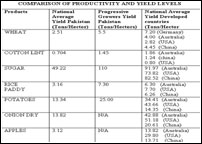
The following table of productivity/yield levels has been prepared based on the year 2006 data given in the websites of the UN, FAO and the Federal Agricultural Ministry of Pakistan.
The table depicts that there is the potential to increase farm productivity/yield as progressive grower is already obtaining almost more than double production than our national average yield. The average national yield/production of developed countries is more than double of our national average yield. By applying requisite resources and taking appropriate measures, our agricultural production can be doubled in the next 10 years.
There is a need to make quality seeds and fertilisers available at competitive cost; improved pest/weed management; transfer of agriculture-related technology and providing technical knowledge to farmers together with the requisite funds needed by them and introducing well-planned marketing mechanism.
In addition to improving facilities given to small growers, the government should formulate policies for initiation of corporate farming on persuasive basis.
Agriculture research and extension department needs to be revamped and its policies and programmes re-designed so that they may play vital role in bringing a revolution through corporate farming.
There is a need to make stringent laws in respect of adulteration of pesticides/fertilisers to enhance crop yield and protect farmers financially.
Investment in agriculture sector needs to be increased significantly--- by. 100 per cent for every subsequent year--- and this practice should continue till the achievement of desired results. Credits to conventional farmers should also be increased and monitored to ensure that it is consumed for the purpose it has been sanctioned. The SBP should ensure that any genuine and legitimate request in respect to corporate farming is not turned down by any financial institution.
Agriculture which is contributing around 21 per cent to GDP is highly neglected by the financial institutions. There is a need to make programmes and policies and necessary laws for development of this sector on ‘war’ footing so that financial institutions can offer loan to this sector like they offer to industry.
Higher and sustainable economic growth cannot be achieved unless we succeed in doubling our agriculture production in the next 10 years.
For this purpose, there is a need to make arrangements and provide desired share of financing i.e. at least 20-25 per cent from credit/loan portfolio of all financial institutions. That is suggested to be achieved gradually with in next five years.
The SBP needs encourage banks to invests in productive sectors like agriculture and industry and discourage to non-productive (consumer financing and capital market) loans.