0
0

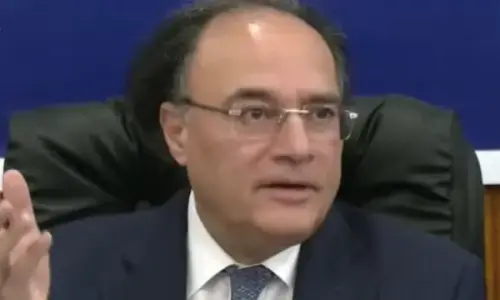
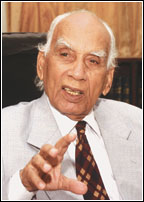
Ghalib’s thought needs fresh interpretation — Farman Fatehpuri
 A cursory look at Prof Dr Farman Fatehpuri’s achievements would fill any person with awe and make him wonder how he managed to accomplish so much. He has been the chief editor of the celebrated literary magazine Nigar since 1962, when Allama Niaz Fatehpuri died. He is the chairman of the Urdu Dictionary Board, which formally began work on the dictionary under his supervision in 1986 and has already completed 21 of the 22 volumes. Besides, he has about 50 valuable books, hundreds of research articles and much more to his credit.
He would surprise many time-conscious people who are always complaining that they do not have enough time to do one thing or another when he says: “I do all the things I do and still wonder how to spend the time left.”
This feat he attributes to a habit developed while he was in class VIII, when he lived close to the Ganges and studied in a Fatehpur school. “Early in the morning a Hindu teacher of ours would take a boatful of pupils for a dip in the Ganges. He would impress on us the importance of rising early. He would quote from Azan and tell us how important the morning prayer was,” he tells Dawn in an interview in his office on Tuesday. “I get up at five in the morning and begin reading and writing and finish reading even the day’s newspaper before coming to office.”
The Urdu dictionary is set to complete within six months, when its 22nd volume will be finished. “But the board will not cease working with it. Rather its work will expand like that of the Oxford University Press. Certain professional dictionaries, such as medical dictionary, legal dictionary and scientific dictionary, will emerge from these volumes,” says Farman sahib in answer to an obvious question, pointing to the dictionary set in a shelf near his desk.
 He says that with more than 300,000 words, Urdu has the vocabulary next only to English’s. According to a Unesco report, Chinese is the second largest language after English and Urdu is the third. “But Urdu covers a vaster area than Mandarin.”
"This dictionary will have no parallel in the world except for the Greater Oxford Dictionary. In no other language such a gigantic work has been carried out. Wherever it is kept alongside other such works, people would stop to take notice of it and ask to which language this dictionary belongs. When they are told that this belongs to Urdu, it would naturally bring good name to our nation and country in the world’s academic circles.”
Asked how the board selects words to include in the dictionary, he says: "We do not take words from dictionaries. Our scholars have culled words from books written in standard Urdu since the time of Amir Khusrau and included them in the dictionary. Any Urdu word that exists in any book, both poetry and prose, is in this dictionary."
Asked if it has the Urdu equivalents of words which have become part of Urdu such as roll number, identity card, permit, etc, he says: "Yes, there are words such as fard nishan, shanakhtnama, ijazatnama, etc. But our focus is not on pure Urdu words that may be unknown to most people. We use ‘college’, for instance, in Urdu because we believe it doesn't have an Urdu equivalent. ‘Madressah’ and ‘jamia’ are seminaries and not ‘college’ and ‘university’. We retain many English, Arabic and Persian words in Urdu though with pronunciations that are convenient for Urdu speakers. Urdu itself is not an Urdu word and we cannot replace it with ‘Lashkari zuban’. If we speak Arabic, we should say Arabi, harakat, barakat. But in Urdu they become Arbi, harkat and barkat. We say hulia in Urdu what is hilia in Arabic. We have changed the meaning of ‘lantarani’ from ‘you can't see me’ to ‘nonsense’. So Urdu is a combination of languages and has an extraordinary ability to take in words from other languages and make them its own with alteration of pronunciation or meaning. There is no hitch in adapting and adopting the flexible Urdu language for science and literature and other disciplines."
Dr Fatehpuri says that our own people who matter try to make this second or third largest language of the world into a minor one. “Nothing is being done to enforce the national language in Pakistan despite its being a complete language. Practically it is spoken, understood and used everywhere. Urdu is spoken in all the five graduate assemblies and the senate of the country. But when it comes to writing a summary, an official communiqué, the bureaucrat does it in English. In courts, the accused, the witnesses, the lawyers and even the judges speak Urdu. But when it comes to writing a few lines of judgment, it is done in English as if it could not be done in Urdu.”
Dr Fatehpuri is a great admirer of Ghalib. He has written as many as five books on the poet's life and poetry. Asked if there is any aspect of Ghalib's life and poetry that still needs to be uncovered, he reads Iqbal's couplet about Ghalib:
Fikr-i-Insan par teri hasti say yeh roshan hua/ Hay par-i-murgh-i-takhayyul ki rasai ta kuja (Your intellect has proved to humans that the bird of imagination can soar to heights that were unimaginable before).
He says since Iqbal was well versed in modern knowledge and science, his tribute to Ghalib depicts the depth of the latter’s thought. "In view of modern developments in the world of knowledge, Ghalib's thought needs to be worked on to uncover fresh layers of his poetry," says Farman sahib. Responding to a question, he says Ghalib and Iqbal were the greatest representatives of their different eras and any comparison would be proverbially odious.
Dr Fatehpuri had a long association with Allama Niaz Fatehpuri, who persuaded him to take over Nigar after his death. It is the only Urdu literary magazine which has appeared without break for over 80 years. He is also a great admirer of his mentor and rejects the edicts of ‘kufr’ against him, saying that he was a religious man.
Born as Syed Dildar Ali in 1926 at Fatehpur in Uttar Pradesh, Dr Farman Fatehpuri has two sons and four daughters — all doctors (two MD, four PhD). He did his graduation from Agra University in 1950 and migrated to Pakistan to settle in Karachi. Here he earned degrees in MA, LLB and later did PhD and D.Litt. He has won various awards, including Sitara-i-Imtiaz, for his literary work.
Overseas Pakistanis and the presidential race
 Overseas Pakistanis in some ways are queerer than the local residents. Now this fellow Nasser Ahmad who migrated to England in the early sixties from Rawalpindi’s Babu Mohalla thinks Musharraf made a mistake listening to advice to resign just as Gen Ayub did disgusted with public uproar. This love for the martial leader is not exactly hero-worship but the belief the uniform has something to do with stability, of which, by the way, a close aunt is ideology, by which a great many of us continue to swear. It is love of the land indeed, which from Slough looks secure with the baton and the boot. His more republican younger brother, Munir, who runs a Karrahi corner shop, however thinks Musharraf could have made a smarter exit by restoring the judiciary the same way he had dismissed it. This way he could have restored himself also in the public eye somewhat while blocking the road to the presidency whose doors his resignation has left ajar for his go-getting dealmakers.
Salim, who left a government job in the eighties because he could not get a government accommodation in Islamabad after 15 years of service and now has a house of his own in Luton, criticised people who never objected to khaki presidents, never questioned their ability to govern, never asked about their education, experience, morals, probity, political background, their assets etc but were now raising eyebrows on the likelihood of Mr Zardari becoming the president. He said if the electoral college formed under the constitution chooses Zardari, he would be the country’s lawful president and his position would be unquestionable. How he behaves in that office would be a different matter altogether, but to oppose his candidature at this stage was hypocritical of those who have been accepting gatecrashers without a whimper. He rejected Mushahid Hussain outright and expressed shock and awe at his gall in trying to step into the black boots he had been licking for eight years.
Saajid, who hails from Kahuta and has an accountancy business in Coventry, said that according to his calculation Mushahid was actually a Zardari nominee added to the gross to deduct any numbers he could from Justice Siddiqui’s net. He was sure that the crafty Shujaat Hussain had cut a deal with Zardari at the behest of Musharraf or whoever the former president now represents. Asked why then Mushahid was asking uncomfortable questions about Zardari’s assets and raising the issue of the reported release from forfeiture of $60 million by a Swiss court, the accountant said it was nothing but ‘Noora Kushti’. “Samjeya karo sir jee !” (try to understand) he winked meaningfully.
Zubair Bhatti, who had a flourishing retail business in the Melody market and had left Pakistan in disgust when Gen Zia hanged Zulfikar Ali Bhutto, is still a ‘jiala’ at heart. He has a general store in Birmingham and is very well off. He opposes Zardari’s presidency for a very different reason: his love for the Bhutto clan. He thinks by re-inducting the family into politics Zardari was endangering his own and his children’s lives. He thinks they should have kept away from power politics, as there was a curse on the family like the Kennedys and the Gandhis of India. “But they are a brave and ambitious lot, ready to buy power with their lives,” he mused. Then should they have handed over the party command to the Makhdoom of Hala? No, he said. The Makhdoom lacks the spark. Could someone from Punjab assume the party leadership? No. There is no chance. You see, it must be a Bhutto, even a half Bhutto, he remarked smarting under the admission.
No such aura or magic attaches to the house of the Sharifs. But over the years, among Pakistanis living in England, they seem to have earned themselves a good name as political workers and lot of respect too for espousing popular causes, the justice’s issue in particular. Riaz Raja from Murree, who works with a legal firm in Manchester, believes that if Zardari manoeuvres the ouster of the Nawaz League from Punjab all hell would break loose and could rock the boat for the PPP in Islamabad. He discounts the common belief about Punjab worshipping the rising sun. He pointed to the wash out the Q League suffered in the February polls because of the great awakening in civil society that has been seen since Musharraf’s action against the judiciary. The present setback Nawaz is likely to suffer when Justice Siddiqui loses the presidential race is also going to be a long-term gain for him, as the problems facing the PPP government are daunting and beyond early solution.
Zardari should not have ditched Nawaz when he needed him most but ambition got the better of him. Raja Sahib goes on and on. But it appeared he was giving voice to the general feeling of disappointment overseas Pakistanis now have about the outcome of the February polls.