0
0

Democracy, warts and all
YOU may not have noticed given all the chaos and mayhem nationwide, but our democracy, young and fragile as it is, has started to putter along. It looks ungainly, but nobody said learning to walk would be pretty.
Those who are repelled by its ugliness and awkwardness need to understand that this is what democracies look like, warts and all. Take it or leave it.
It helps to get some perspective. Pakistan isn’t the only democracy which has politicians bickering while the economy tanks and hardworking families struggle to put food on the table. It’s also happening, among other places, in the United States of America, which is not only a longstanding democracy but also the most powerful nation on the planet. We’re not in bad company.
Many people are anxious that since Pakistan’s previous experiments with democracy haven’t lasted, this one too is doomed to fail. This anxiety is understandable. After all, barely had the ink dried on ex-President Musharraf’s letter of resignation that all hell broke loose in the ruling coalition.
Asif Zardari is plotting the realisation of his dream to become head of state in a country where not long ago he was treated like a pariah. Nawaz Sharif has dug his heels in on reinstating the judges minus nothing, and threatens to twist the knife with which he has already wounded his arch foe, the outgoing Musharraf. JUI-F, a junior coalition partner, is tut-tutting that the judges are much ado about nothing.
Meanwhile, elsewhere on the chessboard, men full of rage keep blowing themselves up in the middle of innocent crowds, and a Taliban insurgency boils over, even as the cost of living takes to the sky and a bewildered populace looks around to figure out who’s in charge.
Well, you are. All of us are. That’s what happens in a democracy. It’s an uncomfortable feeling, because being in charge is a scary place to be. It comes with responsibilities. If things go wrong, you get to blame no one else — not America, not the army, not the ISI, not fate — but yourself. Hence the anxiety and the uncertainty.
Yet circumstances suggest that this time around the outlook for Pakistani democracy is different. For one, there is transparency. The whole mess of our national governance is being broadcast as uncensored ball-by-ball commentary from numerous television talk shows, news programmes and print media outlets. In this atmosphere, sinners cannot hide. Oh sure, they can still go ahead and sin, but it will have to be in broad daylight and will inevitably invite criticism. The best thing about proliferation of the media, as President Musharraf painfully realised, is that you can no longer silence your critics.
And if you cannot silence your critics, then you are not in control. The dagger of public opprobrium that fell on Musharraf can fall on others too. It is as simple as that.
The other, perhaps equally important factor, is that a more people-friendly administration is poised to move into the White House. It is no coincidence, as journalist Ahmed Rashid points out in his latest book, Descent into Chaos, that Pakistan’s two longest-running dictatorships coincided with Republican administrations in Washington that used Pakistan as a vehicle to secure American interests in the region.
The Republican mindset, with little patience for ugly inconveniences like Third World popular opinion, was always comfortable with one-stop shopping through a compliant dictator obsequious towards the Americans.
But Democrat Barack Obama, who continues to lead in the polls and is odds-on favourite to become the next American president, has already gone on record that he wants a foreign policy towards Pakistan that engages the Pakistani people as a whole.
Not only that, in Senator Joseph Biden he has named a vice-presidential running mate who is a vocal democracy advocate and has been a trenchant critic of Pervez Musharraf.
So Pakistan’s relationship with an Obama administration is likely to be very different from the lopsided contours of the existing Pakistan-US ties. This point has been lost in the clamour over Obama’s hawkish statements about bombing Pakistan made during his bitter primary fight with Hillary Clinton.
But George W. Bush’s foreign policy failure in Pakistan leaves room for little other than supporting democratic forces on the ground.
Certainly, there’s ample room for a win-win arrangement between an Obama administration and a representative and accountable Pakistani government.
While Pakistani dictators want naughty things like limitless money and perpetual power, the Pakistani people want peace, security, and prosperity, just like anyone else. It is no secret that it was ultimately American patronage that sustained Pakistan’s dictatorships.
Sad that we would have to turn towards America to help sustain our democracy too but, should it come our way, let’s not look this gift horse in the mouth. (Of course, all this is null and void in case of a McCain victory, but no point worrying about something that may never happen and over which, in any case, we have no control.)
Meanwhile, whatever shape Pakistan’s democratic future takes, it is unlikely to be the neat, tidy and cleanly packaged road to health and happiness that many of us are hoping for. Political infighting, petty intrigue, and shameless ambition are all innate to the democratic beast — not just in Pakistan but anywhere.
The likes of Musharraf, Zardari and Nawaz Sharif will continue to come in and out of our lives. The difference is that if the democratic process takes hold, they won’t be able to do much damage, and we’ll continue to putter along, warts and all.
Incompetence all around
‘CRISIS’ has become a popular cliché to describe Pakistan’s situation at any particular point in its chequered history.
We keep stumbling from one crisis to another. Some people wonder how Pakistan has managed to survive these multiple crises all these years. And what is the latest crisis to confront us? Is it the rising militancy in the Frontier region? The runaway inflation? Or is it the fast deteriorating law and order situation? These are real issues, but the most crucial problem Pakistan faces is not among these. The real crisis in Pakistan is the all-pervasive incompetence and the lack of capacity to do things at every level.
The situation in Fata and elsewhere can improve if we take a clear stand against the militants, and develop a national consensus on how to deal with them. There can be a turnaround in the economic situation also if we escape from the ‘conventional mould’, introduce structural changes and learn from the experience of countries like China, Brazil, Chile and Cuba. But how can we deal with the incompetence and lack of capacity which have become the bane of our existence? In spite of the endless rhetoric regarding reforms, there are no signs of any improvement. On the contrary, the level of our incompetence is rising with each passing day. We are fast becoming a nation of mediocres, a bunch of disorganised, inefficient people, with low productivity levels.
We are the sixth most populous country in the world and a nuclear power at that. But if we look at our performance during the last 61 years, it can put the most shameless to shame. Our track record shows that in spite of huge expenditure on defence, we are incapable of fighting (far from winning) a war, as is obvious from our dismal performance in 1971 and recently in Kargil. We cannot provide basic services such as potable drinking water, sanitation, healthcare, education and housing to the poor; we cannot run our railways; we cannot provide public transport to our people; we cannot manage our jails, police stations or courts. At a more mundane level, we cannot remove garbage from our streets, cannot locate ‘ghost’ schools and cannot manage the traffic.
There is a general perception that politicians in the Third World have not proved themselves as effective rulers. They are also accused of sleaze, cronyism and indecisiveness. The army often seizes power using this argument. In some countries military rulers have been successful in giving direction and political stability. But not in Pakistan. Here they seem to have all the weaknesses of politicians, and in the ultimate analysis end up creating more mess than the ‘bloody’ civilians.
If we evaluate the performance of Pervez Musharraf’s unbridled rule during the last nine years, what would our conclusion be? This depends on which side you are on. But the international verdict is that we have regressed. Instead of any improvement, Pakistan is now counted among the top 10 dysfunctional states and is bracketed with countries like Somalia, Chad, Congo, Sudan, Central African Republic, Zimbabwe and Afghanistan.
Our bureaucracy and politicians are blamed for their lack of understanding and their incapability to tackle serious issues. They have the alibi of the constraints under which they work. But what about professionals who unlike others have all the independence in the world? What has been their performance during the last 61 years? The hand-picked economic ‘wizards’ for example, exude an air of competence and capability, but have they ever shown the capacity to think and act independently and creatively? Most of them are mere imitators, and have been blindly following the prescriptions taught to them in Boston, Harvard, Chicago or Stanford.
These were the very people who made the world believe that we were ready to enter the club of middle-income nations, and unlike our previous two experiences, this time our growth rates would result in sustainable development. But barely a year later Pakistan is faced with an economic meltdown causing serious hardships for its teeming millions. Surprisingly nobody has yet asked the all-important question: what lies at the heart of the economy’s boom and bust cycles — sheer incompetence or naiveté or both?
Isn’t it lamentable that after 61 years of following the prescriptions of these World Bank-oriented economists, 73 per cent of our people still live on $2 a day, sans the basic necessities of life? This is not because Pakistan is a resource-poor country or has been devastated by wars or natural calamities. What has brought us to this state is the absence of creativity, flawed development models, the mismanagement of resources and incompetence at the implementation level.
One can ask what are the basic causes of our over-arching incompetence and lack of performance. Have we always been like this? Is it a genetic or a cultural problem? Is it because of our under-development or vice versa? The answer to this question is not difficult to find. In 1947 we inherited one of the best administrative systems in the world. It is needless to give details of this ‘colonial’ legacy. People of the last generation have seen it all. It worked well for another 25 years, maybe because of its own momentum.
But then our military and populist rulers started tinkering with it. Of course it was necessary to ‘democratise’ the imperial system, and humanise stringent laws, rules and regulations, but everything colonial was not bad. It was unfortunate that instead of giving a better system of governance, our rulers weakened all existing institutions and promoted personalised rule. They considered themselves above the law. Accountability was for others. The neutrality, independence and competence of the bureaucracy were destroyed by design.
Simultaneously, the state assumed more responsibilities than it could discharge. Cronyism and sifarish became the order of day. Politicisation of the day-to-day workings of the administration, the constant threat of arbitrary dismissals and lack of incentives disheartened public servants who soon became the servants of the ruling party. All this has happened over the last 30 years. The results are obvious.
It is ironical that there is no shortage of competent, qualified and committed people in Pakistan. They have the ability to take their country forward but unfortunately our ruling oligarchy and their cronies, who are both well-entrenched and well-organised, have always tried to stop the process of change, their primary aim remaining the selfish protection of their power.
In the foreseeable future we do not see any sign of improvement, and the country is likely to go further downhill unless we redefine the role of the state and strengthen our institutions. Our tragedy is that our rulers neither accept that the world around us has drastically changed, nor do they want to learn from their past mistakes. History’s verdict is that if you don’t learn from your mistakes, you will be condemned to repeat them.
Necessary cacophony
IT is painful when clichés hit targets repeatedly: Pakistan is really at a critical juncture as Shehzad Roy’s latest song portrays so well.
What is of greater concern is not just the gravity of the situation but the number of issues that are occurring simultaneously; battering further an already strained national psyche.
That Gen Musharraf did not invoke the dreaded Article 58-2(b) shall be of enduring significance to Pakistan. With elections done Pakistan has a real stab at democracy and has perhaps evolved politically in the last 18 months more than it might have in all its 61 years.
And so like toddlers running around we have chaos. The answer to this unfamiliar confusion is not iron-clad martial law, but the evolution of a democratic society that solves its issues with discussion and expression of the vote. Military rule has permeated itself in the psyche of the Pakistani nation to the degree that statements like “we don’t deserve democracy” and “our nation only understands military rule” are commonplace.
Democracy and a civil society are not gifts, they are built with pain and sacrifice with the clear understanding that processes and principles must be placed way above personalities. The Muslim world in general and Pakistan in particular has been plagued with personality cult politics for far too long.
The judges must be reinstated for without an independent judiciary a democracy is dead. Asif Ali Zardari’s personal fears of accounting for corruption charges must be entirely secondary if his claim that his first fight will be for democracy in Pakistan is true. His PPP workers stoutly defend him in television talk shows saying that none of the charges were proven and the charges by foreign nations were withdrawn. That does not appear to be factual, and if indeed it is, then, nothing to fear, let the entire nation see that his money and mouth are concordant.
A nation can tolerate much but moral bankruptcy it cannot. And with Pakistan the double jeopardy is its creation in the name of Islam whose foundation is adl or justice. While a wrong accusation is punishable in it, stealing and that also from the national treasury is much worse. And a leader with that stain ought not to be its president, regardless of the unanimity and released doves and cheers and waved flags and sweets distribution the PPP party workers may indulge in.
With the economic morass, load-shedding and terrorism the country is dealing with, a segment speaks of the trial of Gen Musharraf, stating that civilian politicians have been jailed for lesser crimes and dictators go scot-free. Another view is that he made judgment errors but there was no criminal activity in them and that Pakistan, besieged by bigger things, would not be able to tolerate his trial.
Again for the sake of processes and principle, it is important to set up a tribunal to first determine if any criminal activity did occur. And if the very impartial tribunal determines that it did, then, unfortunately for Pakistan, a trial must take place. Only and solely to set a precedent. To show to all and sundry that the accountability process has been reincarnated (or created if you will) and shall live forever; to get you regardless of your stature or connections. This is important again to erase the entitlement element from the Pakistan psyche: ‘I have immunity for I am in power or I am well-connected’.
The unhappy union of the Pakistan government to its armed forces has finally come to an end and for this my undying tribute to the visionary commander-in-chief Gen Ashfaq Kayani. Single-handedly he has changed the course of Pakistan’s history by pulling the armed forces out of politics and the CEOship of governmental organisations. Had he put personality before processes and principles, we would be seeing military rule today.
Even in the US there is a reluctant understanding in opinion columns that democracy ought to be nurtured in Pakistan for the alternative does not work very well.
Pakistanis themselves have a habit of underestimating the incredible resilience of the Pakistani nation. We tell each other repeatedly that we must concentrate on the economic and security nightmare and that ‘Musharraf was better’. This becomes a self-fulfilling prophecy of sorts and we re-invite the army in a few months. We are at a point in time illustrated by Shakespeare: “There’s a tide in the affairs of men which when taken at its flood leads on to fortune”. We must make good at this very rocky time in our history for in it lies our salvation.
Dictatorship repels and silences. Democracy is inclusive and vibrant; it brings out issues and multiple confusing opinions and resolves them by voting. It builds institutions and sets up processes. Currently it is Pakistan’s necessary cacophony.
The writer is a physician and freelance columnist residing in Toledo, Ohio, US.
mahjabeenislam@sbclobal.net
Machiavelli in Pakistan
AS political developments rapidly unfold in Pakistan, it appears that Mr Zardari will now become Mr President. Is this just an existential irony of history or Pakistan’s phenomenal misfortune?
The answer lies in whether one regarded the post-Feb 18 period as a promise for change or a repeat of the same old thing. To an observer from afar, it is now clear that the poor huddled masses of Pakistan — in giving the PPP a narrow majority to form a government at the centre — also desired political accommodation and a new era of legal and social justice. But this hope for change has been dashed.
Killing hope, in the Pakistani context, is about the mind-numbing dexterity displayed by Mr Zardari to turn this narrow win around — and effectively to achieve absolute majority through cold social engineering moves in order to have a choke-hold on institutional power. He is sitting in the driver’s seat and will soon control the president’s office, while his party occupies the offices of the prime minister and the speaker of the National Assembly and controls the justice system.
But, not content with this kind of absolutism, Zardari and his henchmen (and one henchwoman) have been playing all kinds of games to block the reinstatement of deposed Chief Justice Iftikhar Chaudhry in order to ensure once more that a docile and timid judiciary will quietly acquiesce to the will of the mighty feudal lord. The current moves to expand the high court benches and eventually the Supreme Court are all efforts to dilute the powers of the chief justice, should his restoration ever come to pass.
In reaching this pinnacle of absolutism, some could argue that Zardari out-manoeuvred Nawaz Sharif and displayed the skills of a shrewd politician. Granted that politics is about expediency. But elementary decency is not usually jettisoned for the instrumental rationality of that brief gain thereby justifying the means to obtain it. Pakistan’s convulsive state, its precariousness, required that political leaders tread the path ever more carefully. This was not to be, and now the country is going to be polarised by the very real likelihood of a Zardari presidency.
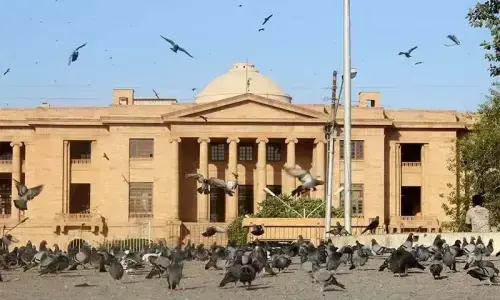
On who should be the president, the media and a host of people in Pakistan have made very thoughtful comments. The consensus is for someone who is a bridge-builder, a visionary and whose character is beyond reproach. But it seems that these words of wisdom have fallen on deaf ears and all sides have thrown caution to the wind for their short-term gains.The irony is that the MQM, the party most vociferous about feudalism’s elimination, wants a feudal lord to lead the country! And not to be outdone with a mere proposal, the party’s stalwarts went one further and trotted off to the Sindh High Court to file Zardari’s nomination papers.
Considering the ease with which one coalition was disbanded and another formed, it is becoming obvious that in Zardari’s mind Nawaz Sharif was expendable in favour of the MQM and the ANP, which also has quietly conducted itself as the PPP’s B-team. In the unfolding of these developments, Sharif has no one other than himself to blame for his lackadaisical dealings with Zardari.
Beyond Sharif, political leaders of the PPP and other parties — in short the political elite — appear asleep at the switch as the country bleeds, burns and ordinary people are made destitute, their lives wrecked by the painful squeeze of runaway inflation, lack of electricity and clean drinking water. This is not to mention the displacement of about half a million people from Bajaur and the war zone that the Sarhad has become.
It is painful to see that the PPP, its roti, kapra aur makan slogan notwithstanding, has been callously unreflective about continuing the neoliberal economic policies — of privatisation, deregulation and the eager embrace of the market — of the Musharraf era. The current rulers have even accepted the impositions of the IMF without a whimper, as subsidies were removed and electricity rates skyrocketed. Amid 16-hour blackouts, the government thoughtlessly announced another price hike for the residents of Karachi.
The private owners of KESC, without making much new investment, benefit from the people’s misery as the latter wallow in the sweltering heat and get crushed under the burden of price hikes. Privatisation of the KESC really has made a bad situation much worse. Other relatively stable organisations, such as the Oil and Gas Development Corporation, are also said to be on the privatisation anvil.
Pakistan’s late romance with neoliberalism, especially the push towards privatisation, comes as a surprise, and at a huge cost of widening the wealth divide. Indeed, the surprise is compounded by the lack of resistance or challenge to this neoliberal turn, despite the enormous dislocations.
Latin American states which took the lead in the 1970s with their marketisation policies, and later rushed towards privatisation and deregulation, are now much more sanguine about past policies. As Venezuela leads the charge against neoliberalism, countries from Argentina and Ecuador to Uruguay are turning their backs on this corrosive policy. But, official Pakistani economists in contrast, see privatisation as a godsend tap to obtain foreign exchange on the cheap. They are in for a shock and need to wake up and smell their neoliberal brew.
Returning to the very real possibility of a Zardari presidency, information is coming fast and loose about our feudal lord. One is about the Swiss prosecutor who has withdrawn money laundering charges and has released the frozen $60m apparently back to Zardari. Then, there is another about the cosy relationship that the PPP leader has had with Zalmay Khalilzad, America’s UN ambassador who has been called on the carpet by none other than Richard Boucher, Washington’s point man for Pakistan.
The third piece is about Mr Zardari’s mental health issues. This is an area about which one has to be sensitive and non-judgmental. However, the would-be president needs to come clean not just about his mental and physical health, but also about how he amassed this enormous fortune, why he was charged with money-laundering, and the nature of his relationship with US officials.
Given these circumstances and the challenges that lie ahead, Pakistan will be well-served if Zardari withdraws his nomination in favour of an individual who is less partisan. I hope he takes heed.
The writer teaches politics at Ryerson University in Toronto.