



 0
0

Islamabad — the ace of media base
 A FRIEND who came calling after spending more than a decade in Japan was stunned to see the charged atmosphere in Islamabad — this was just after an experimental coalition government was sworn in last March. The electronic media scene is what caught his attention.
One had to explain to him that, in the interim, Pakistan had undergone massive transformation and he was not the only required to make adjustments.
To be sure, the comeback political leaders, too, were trying to come to terms with the unsettling media gaze that readily made pygmies out of once-haughty power purveyors.
Indeed, Islamabad is now more than just a seat of the federation in terms of setting the news agenda.
To be sure, its capacity to enthrall the rest of the country in political terms was rarely in doubt but now more than ever, it remains the fulcrum of all activity that determines where the country is headed.
Many put this down to increased activity in the corridors of power as well as an “enhanced street theatre” — as one observer put it — over time.
The defining lawyers movement (supplemented by a vigorous civil society presence) following the sacking of then-Chief Justice Iftikhar Mohammad Chaudhry, an unprecedented military operation at Lal Masjid (after months of disturbing militant activity) and a spate of suicide attacks (a relatively new phenomenon) have certainly, lit the stage in more ways than one.
But the federal capital, which used to be derided as being “half the size of Arlington cemetery and twice as dead” not long ago assumed a larger-than-life proportion thanks to the amplifying base provided by the daredevils of Islamabad’s electronic media ‘village’.
Without a vigilant media, one dare say, the lawyers movement may not have achieved the progress it did in rallying the nation.
This is not to belittle the spirit of the lawyers and the supporting cast provided by the civil society. But the fact is the movement was primed for television, with a clear understanding of what impact it would have on a public now completely, absorbed in it. In fact, some media outlets suffered the consequences of “turning it on” with their offices damaged by law enforcers, no less!
There is absolutely, no doubt that, in their avatar as harbingers of a media revolution so-to-speak, these real-time practitioners have changed the national outlook by raising the profile of public participation.
Of course, not everyone is satisfied with the level of public discourse per se. In fact, some TV anchors based in Islamabad are charged with inherent bias and politicising issues on purpose.
However, the academic debate about rights and wrongs as well as dos and don’ts cannot be partaken in isolation. The fact is the electronic media is still undergoing growing pains and will take time to evolve. This is not to condone any shortcoming in terms of content and objectivity.
However, the inescapable conclusion is that the powers-that-be have found it difficult to digest the unpalatable truth on a daily basis — in full public glare. To them, it is an anathema to be read out the riot act and therefore, the attempt to undermine open debate and sow seeds of doubt about the motive of discourse.
It says something for the power and reach of this medium that despite a draconian blackout as part of an extended Emergency measure last year to stop the ‘revolution’ being televised, the hand that tried to rock the cradle was himself forced to seek a foreign hand for secure hibernation but the same muzzled media is still coming out all guns blazing.
Of late, there have been murmurs in the federal capital of the ‘outspoken’ talk show hosts being warned not to even contemplate “doing what you did last summer” — a Hollywood-like reference to the electronic media’s candid depiction of last year’s crises originating in Islamabad that eventually, took a political toll on the ruling clique of the time.
However, such threats did not work then and are much less likely to stand the test of time in Islamabad’s hot cauldron. In short, shooting the messenger is no longer a guarantee of shooting the message itself.
A whole army of media persons that has survived to tell the tale for more times than one can comfortably count is, by now, used to watching over the public interest in the form of a tall fourth pillar.
And Islamabad is undoubtedly, the ace of media base.
The writer is News Editor at Dawn News. He can be reached at kaamyabi@gmail.com
From burgers to bun kebabs
 GROWING up in the Middle East and coming to Karachi every year for the summer holidays, I must admit that in my childhood, one of the things I would look most forward to when in the city was the array of delicious, spicy street foods available, which I and my trusted cabal of cousins would devour, far away from the watchful eyes of our parents, who frowned upon the practice, mainly due to street food’s suspect quality of hygiene.
Today, though many aeons have passed since childhood, my love for street food remains as strong as ever. And looking at the sheer number of joints that hawk a cornucopia of street food in this city, it seems that my fellow Karachians – a fair number out of roughly 18 million of them – must relish street food with as much delight as I. And perhaps the king of Karachi street food is the bun kebab.
It would not be an unfair to assume that the bun kebab and burger were separated at birth. Though it is difficult to say which came first, methinks the burger might have a slight edge. But this chronological advantage should in no way be taken as a slight to the humble, desi bun kebab.
The burger and bun kebab are so near and yet so far. One is sold in air-conditioned, franchised environs supported by an army of mascots. Of course this is where the premium burgers are sold, as the atmosphere changes drastically at lower income joints.
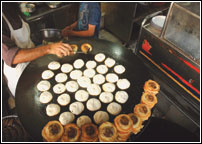 The other is hawked off push carts, holes in the wall and anywhere else big enough for a stove, a bench and two or three chairs. Interestingly, though other proletarian foods such as biryani and haleem have been given the franchise treatment and are now sold out of air-conditioned outlets featuring uniformed staffers, no one has thought of giving bun kebabs the same makeover. They remain part of the thelay-wallah’s domain.
Short-listing ace bun kebab-wallahs in the city of Karachi is a well-nigh impossible task as they are all mostly pretty decent. However, though the line is quite fine, many bun kebab vendors – perhaps due to an inferiority complex – tend to label their delicious delights as burgers, or burgurs, if one is to transliterate. This confounds me. Why the complex? Stand up and be counted for what you are, I say.
Anyhow, there are certain spots where I, in my many adventures across this city, have had quality bun kebabs and despite the dodgy standards of hygiene have lived to tell the tale. There is a spot opposite the Abbasi Shaheed Hospital in Nazimabad where the bun kebab-wallah’s bun of choice is the hot dog style bun, as opposed to the round burger buns that are perhaps more common. Served up with tangy chutney in little trays that look like they came from an airline’s galley, the secret is to dip the bun in the chutney for maximum enjoyment.
Another joint, opposite a famous kebab paratha/nehari-wallah off Burnes Road, serves up his bun kebabs quite differently. Here, a kebab (though it is called that, there is hardly any meat in the stuff) enveloped by a fried egg is served to the customer with a slightly toasted bun by the side, so that one may consume the stuff in not too different a manner than eating curry with naan. The kebab is accompanied by a tamarind-flavoured chutney and smothered with raw onions and coriander.
There is another stall, located next to a popular DVD store in the upmarket Boating Basin area that makes a truly tantalizing bun kebab. I’ve tried the chicken burger served at this place – though methinks it is erroneously named as it is closer to the genus bun kebab – and can safely say it is simply delicious. And considering the area it’s in, the bun kebab is quite reasonably priced.
This is a brief recollection of the bun kebabs that have satisfied me in times of great hunger and very little in my wallet. For between Rs20-30 (depending on the filling that is to go in between the buns, i.e. a potato, beef or chicken patty) one can be satisfactorily satiated till a proper meal is had.
However, I have also experienced a bun kebab horror story or two. The most recent one was when I ventured into a joint run by an elderly gent smack opposite the Merewether Tower. Now I had tried a few of the dishes from this place and they weren’t half bad (in retrospect … they weren’t half good either). Too lazy to go to Saddar and face the monstrous traffic and with the pangs of hunger getting ever stronger, I decided to give it a whirl.
Suffice to say, it was a most unpalatable experience. The bun kebab just wouldn’t go down my throat, while the ketchup, coleslaw and fries definitely looked like they had seen better days. It was quite a painful experience to part with a fifty rupee note that day.



























