0
0

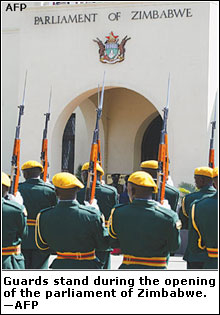 HARARE: Zimbabwe President Robert Mugabe’s 28-year grip on power was dealt a further blow by ballot with the opposition’s clinching of a key parliamentary post, analysts said.
The main Movement for Democratic Change (MDC) faction won the speaker of parliament post on Monday in what was the first meeting of the assembly five months after Mugabe’s ZANU-PF lost majority control of the chamber in national elections.
The election of the MDC’s Lovemore Moyo, who becomes the first opposition speaker of parliament since independence from Britain, was a display of widening divisions within ZANU-PF, analysts said.
Moyo won 110 votes out of 208 ballots cast in the secret vote, likely picking up the support of nearly a dozen ZANU-PF lawmakers. The MDC holds 100 seats in the parliament.
Mugabe’s ZANU-PF party did not put up a candidate despite holding 99 seats in the 210-member house, with most voting instead for Paul Themba Nyathi of the MDC splinter group led by Arthur Mutambara, which has 10 seats.
“This vote somehow exposes divisions that have been slowly creeping up within the ruling party,” said Olmo Von Meijenfeldt, an analyst from the Institute for Democracy in South Africa.
ZANU-PF’s not putting up a candidate could also have been a “strategic move” by Mugabe toward Mutambara who is in a pivotal position to swing power to either main bloc, said Laurence Caromba of the Centre for International Political Studies in South Africa.
“Relations between Mutambara and Mugabe have been good lately ... It’s not inconceivable that the two agreed to work together in an attempt to retain control of parliament,” Caromba said.
Monday’s ceremony was the first meeting of Zimbabwe’s parliament since March elections in which the MDC broke ZANU-PF’s majority control.
The March elections set off months of political unrest after Tsvangirai claimed that Mugabe, 84, fixed the presidential election result and later pulled out a runoff vote in June because of allegations of violence.
The MDC attended Monday’s swearing-in even though Tsvangirai has said it could jeopardise power-sharing talks with Mugabe which were suspended two weeks ago over failure to negotiate divisions of power.
The party later alleged that the detention of two of its MPs as they entered parliament was an attempt to influence the election that would harm the talks. One was released in time to attend the vote.
While it is doubtful that parliamentary control will exert much influence on government policy, the ruling party had been “clearly desperate” to prevent a MDC victory, Caromba said.
“The fact that the MDC won despite these tactics is certainly an important psychological victory for them and a big blow for Mugabe.” Political analyst Chris Maroleng agreed that the result was a victory for MDC-Tsvangirai.
“The new speaker will now determine when the parliament will be convened. As for the talks on power-sharing, Mugabe will now negotiate from a relative position of weakness, his party not being in control of the parliament,” Maroleng said.
“However it remains to be seen how the ZANU-PF parliamentarians are going to respond to being led by the opposition,” said Institute for Democracy in South Africa’s Von Meijenfeldt.
Earlier there was concern that Mugabe’s intention to go ahead with the opening of the parliament without a power-sharing agreement would further undermine the talks.
ZANU-PF retained control of the presidency of the Senate on Monday.
ZANU-PF controls 30 seats in the Senate, while the MDC has 24 and the Mutambara faction six. The chamber has no significant power.
Thirty-three Mugabe appointees – traditional chiefs, provincial governors, women, disabled groups and other interested parties – take the senate numbers up to 93 members.
Zimbabwe’s political unrest has worsened an economic crisis which has seen widespread unemployment and inflation now officially at more than 11.2 million per cent – while experts say it is even higher.—AFP