



 0
0

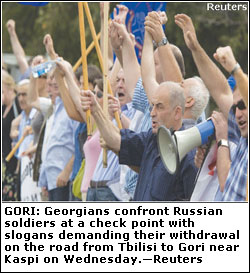 MOSCOW, Aug 20: Russia moved on Wednesday towards recognising Georgian separatist regions as independent, raising tensions after blocking a UN demand that it withdraw forces from Georgia.
Russian troops remained entrenched in the rebel provinces of Abkhazia and South Ossetia, although President Dmitry Medvedev said the bulk of the forces would be out by the weekend.
A senior Russian commander accused Georgian forces of “regrouping” in spite of agreeing to pull back under a French-brokered ceasefire agreement and said the Tbilisi government still had “aggressive” intentions toward Russia.
The deputy speaker of the Russian parliament’s upper house said the body, the Federation Council, would meet in emergency session on Monday to debate requests from Abkhazia and South Ossetia for recognition as independent states.
That announcement came moments after a senior Abkhaz lawmaker announced that the province would renew its appeal for recognition by Russia.
“The Federation Council is ready to recognise the independent status of South Ossetia and Abkhazia if that is what the people of these republics want,” Interfax news agency quoted council speaker Sergei Mironov as saying.
He said this would also require “a corresponding decision by the Russian president.” Medvedev, who was at his Black Sea coastal residence in Sochi has already affirmed that Russia would “unambiguously” back any decision made by the people of Abkhazia and South Ossetia.
The leadership of Georgia, backed by the United States, has said it would accept no change to the status of Abkhazia and South Ossetia as part of the territory of the state of Georgia
Although it has provided support to both regions, Russia has so far not recognised their independence claims. Formal recognition by Moscow would redraw the map of Georgia and change the balance of power in the Caucasus.
In a telephone conversation on Tuesday with French President Nicolas Sarkozy, Medvedev vowed that all but 500 Russian troops needed for “additional security measures” would be pulled out of Georgia by Friday.
But in New York, Russia blocked a draft UN Security Council resolution demanding that its forces pull back to positions they held prior to the outbreak of fighting in Georgia on Aug 7.
Russia’s UN envoy, Vitaly Churkin, said it would be “a waste of time” to vote on the draft, which he said was one-sided because it reflected only two of the six points contained in the ceasefire agreement brokered by Sarkozy.
Over five days Russia’s army expelled Georgian forces from South Ossetia and Abkhazia, and also seized control of several towns and strategic roads deep inside Georgia.
An reporter with Russian forces in South Ossetia saw armour and other military vehicles moving north and south on the main road linking Georgia and Russia, but no concerted pullout.
Russian troops meanwhile remained dug in near Gori, a Georgian town outside South Ossetia.
Georgian interior ministry spokesman Shota Utiashvili said that “there are no major movements or sign of a withdrawal.” Delays in Russia’s withdrawal have stoked increasingly heated rows between Moscow and Western capitals.
Nato foreign ministers said on Tuesday that there could be no more “business as usual” with Russia because of the Georgia conflict. Moscow pulled its navy out of joint exercises with the alliance.
Russia shot back that the US-led alliance was “biased” on the Georgia conflict and was looking for ways to support the “criminal regime” of Georgian President Mikheil Saakashvili, a close US ally.
Russia has said it will gauge its pullout in correspondence with Georgia’s adherence to the ceasefire agreement, which called on Georgian forces to return to their permanent bases.
The ceasefire deal specifies that combat troops must pull out but an unspecified number of Russian soldiers can remain as “peacekeepers.” There is little clarity on their mandate or their scope of operations.
The other major question remains whether Georgia will regain control over its rebel territories, which first broke away during fighting in the early 1990s.
Authorities in South Ossetia meanwhile said that 1,492 residents had been killed in the fighting. Georgian authorities say the death toll there was far lower.—AFP



























