0
0

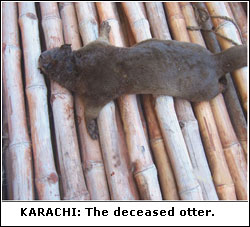 KARACHI, Aug 10: A male otter, referred to as vulnerable in the IUCN red data list and protected under the CITES Appendix 2 and Sindh Wildlife Ordinance 1972, has recently been found dead on the National Highway near Sunda village, Keenjhar Lake. It’s the first time ever that a species of otter has been recorded at the lake, according to the World Wide Fund for Nature (WWF).
The animal, a smooth-coated otter (Lutrogale perspicillata), was reportedly run over and killed on the road at night. Its body, spotted by a villager, is now in the custody of the WWF, which plans to hand it over to the Sindh Wildlife Department for stuffing and preserving the prototype for museum exhibition.
Talking to Dawn, Jehangir Durrani, the WWF’s natural resource management officer at Keenjhar Lake, said: “The otter has become endangered in Pakistan because of high market demand, habitat degradation due to pollution and loss of wetlands and killing by fishermen. The fur of this species is smoother than that of other otters and is used in making various accessories, whereas its different organs are used in making medicines. To fishermen it’s an enemy, as it takes away their catch.” He claimed that there was no record of the species at Keenjhar Lake earlier, even with the Zoological Survey of Pakistan that conducts a yearly survey. “Though local people have many otter stories to share, there was no scientific documentation of the animal at the lake. In a survey conducted in 2000, Sindh Wildlife Department (SWD) had shown its presence at the Haleji Lake,” he said, adding that Nara Canal and Chotiari Dam site, also famous for endangered gavial, were other hotspots for otters.
“I have done two surveys here, but I could never catch its glimpse. I believe that the animal has become nocturnal to avoid disturbance and hunting. Wildlife expert T.J. Roberts has recorded the species along riverbeds in parts of the country.” The discovery of an endangered species, he observed, would enhance the conservation value of Keenjhar Lake, home to endangered crocodiles, Dalmatian pelicans and rare ducks.
Saeed Baloch, deputy conservator wildlife, Hyderabad division, said that there was no data on the otter population in Pakistan and it had been found that the animal was facing the problem of inbreeding due to its scattered numbers. “This is another major reason of their decreasing numbers. Native to Nepal, Bangladesh, India and China, otters are also caught for their liver and sexual organs, from which various medicines are made. China has a big otters’ fur market.”