



 0
0

Rain, no longer cherished
 Tuesday’s rain brought back many memories, along with of course the usual reports of chaos, injuries and traffic jams. Excitement at the prospect of heavy grey clouds and showers of rain is a rare sentiment in the city since the past few years.
As soon as monsoon season arrives, people start getting more pessimistic about life in general. Complaints about drainage, disease, roads and rubbish start rising and defeated sighs punctuate conversations about the rain.
I don’t remember it always being like this though. What I do remember, however, is piling up in the car with cousins, aunts, uncles and anyone else who could fit in and going for long drives in the rain. I also remember parking at street corners and buying a bag full of samosas. I lived in a low-lying area during my school days and even though the street was a brown coloured swimming pool, we learnt how to make the most of it.
An excited chatter could always be heard between neighbours strolling on their rooftops and balconies. Cricket on the streets didn’t stop; instead, it was followed by other ‘games’ such as racing paper boats made to float in the rain-water!
Security issues already force a lot of people to remain indoors as much as possible, and now the rain will be another excuse for us to remain locked up inside. Those with chirpy reactions to the rain may continue the tradition of frying pakoras at home and sitting by the windows, but a large group will probably postpone plans and errands, and complain about how the rain makes daily life so hard. Sudden rainfall is obviously a hassle for the millions of commuters in the city, but looking past that, it is also a break from the heat and humidity we bear everyday.
A little bit of rain is often welcome – any escape from the heat is – but a downpour, what horror! It is no surprise though, as load-shedding becomes even worse during the rainy season and the dug up streets become complete road-blocks. Such obstacles and inconveniences are not going anywhere for the time being, but a slight shift in our mindsets could allow us to give these showers a warmer welcome.
Maybe the excitement was only meant to last during our school days anyway. Flooded roads meant a day-off and a slight drizzle caused an instant stir during lectures. Gone are the days? Perhaps. After all, the family gets together for Eid anyway, so why would anyone get together just for the sake of enjoying the weather? Still, I am sure there remain a few who must be anxiously awaiting the next rainfall with the pakora batter ready!—Shyema Sajjad
Complimentary service
 The annual monsoon has the habit of taking a late start in some places. In Karachi it seldom makes its appearance in June. This year, merely two days before the month of August began the heavens opened up.
We (meaning me and my better half, or shall we say much better half) were heading towards North Nazimabad when the flooded streets forced us to return from Soldier Bazaar to our apartment in Seaview township. The flow of traffic was such that we were forced to drive through Shahrah-i-Quaideen, where from its beginning to the end there were four long flooded strips.
My old jalopy huffed and puffed and its engine went dead on three occasions. Every time pedestrians, wading in the water, came to our rescue and pushed it to a spot where there was no accumulated water.
On the first two occasions the engine woke up when I turned the ignition key after short pauses but on the third time it simply refused to respond. The lady sitting next to me boosted my morale, which she does unfailingly in such situations, and I decided to rough it out. But how I didn’t know. Suddenly a mini-van stopped in front of the car and out came a decently dressed person. He may have been a mechanic heading home.
“Open the bonnet and give me a cloth,” he said. “I don’t have one,” I said sheepishly. “Not to worry,” he assured me and brought one from his van. He dried the distributor and the coil and asked me to apply grease on them the following morning. “Now just turn the ignition key and I’ll do the needful.” He surely did that and the engine went into action with a vengeance. Both of us were drenched to the skin.
“Don’t remove your foot from the accelerator for at least one minute,” he said and closed the bonnet.
I took out a hundred rupee note from my pocket fearing that in emergency conditions, he would demand more. But the man said “Next time. This time my service is complimentary.”
“I hope there won’t be a next time,” I said. He merely smiled, waved his cloth and was soon out of sight.
It’s heartening to note that in times like these you run into people who go out of their way to help you. Who says we are inconsiderate people?
Lest we forget, we should give full marks to the Defence Housing Authority for the drainage system that they have built and are in the process of completing in other places has worked very well. Last year many streets were flooded and remained so for days. This time the water drained out once the downpour turned into a drizzle.
The city government has done an equally fine job in places like Bath Island and the main Clifton Road, but there are many spots like Shahrah-i-Quaideen, which need to be tackled before the next monsoon arrives.
—Asif Noorani
A cut and a shave
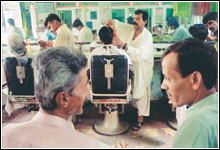
It might be safe to say that barber-shops in this country are better known as centres of neighbourhood gossip and heated political discussion rather than all matters hairy. At least in this writer’s limited experience on earth, this has proved largely true. And the barber-shops of Karachi are no different.
Here a clarification is in order: when I talk about barber-shops, I mean the traditional kind where a cut and a shave won’t cost you an arm and a leg. Not the foppish, outrageously expensive kind (they are growing exponentially in Karachi) where you’ll have to shell out a Rs500 note just to trim the old beard. There are joints in this city that resemble airport waiting lounges instead of the glorified hajjam outlets they are. But to each his own, I guess.
As for the analysis of neighbourhood barber-shops, I feel there are two basic varieties in Karachi. The first is the more traditional kind, where the older gentry gathers and discusses the matters of the day, whether it is cricket, galloping inflation or the all too familiar bumblings and fumblings of our glorious democrats. These joints usually have a news channel constantly blaring out the latest stuff that passes for headlines, while the neighbourhood’s fathers, uncles and grandfathers scour the newspapers for the latest political controversy.
The second type of Karachi barber-shop is a bit of a confused hybrid between the traditional desi neighbourhood joint and the flashier salons. This is the poor little go-getter who couldn’t quite make it.
The defining characteristic of this place is that it is run by younger men and generally attracts younger men, or at least those who want to be young. Instead of the news channel, the TV at this place plays hosts to the latest Bollywood sludge, item numbers and all. Outside are posters of ageing Bollywood heroes – steroid-induced muscles a-flexin’.
I try to avoid the latter like the plague. Firstly, the atmosphere at the barber-shops trying to attract the younger lot is not exactly gentlemanly. Apart from regular youngsters, these places become hives for the local toughs, goondas and other rabble. Also, the loud Bollywood music is a certain turn-off.
Back in the day, a cut and a shave was the most people expected out of a barber-shop. But today, in this age of vanity, there are creams, moisturizers, mud-masks and a huge number of other (useless in my book) options at barber-shops. I see more and more regular chaps opting for facials, waxing and threading nowadays, as if they were as conscious about the softness of their skin as a bride to be. I’m no raving male chauvinist, but please … the line has to be drawn somewhere.
My barber recently offered to give me a ‘face wash,’ and as he began pulling out sickly looking creams, I told him that I had already washed my face – thank you very much – and that I was dead against having suspicious looking glop plastered across my face. He seemed to get the message and didn’t offer me anymore face washes.—QAM
Compiled by Syed Hassan Ali
karachian@dawn.com
Landhi plots
 Sir,
Sir,
Cottage industry plots in Landhi were allotted by balloting to unemployed graduates by the Karachi Metropolitan Corporation. This scheme was announced in 1993 by the then prime minister. The KMC has taken all the money of the plots given by the allottees. Allotment orders were issued but to date, 15 years have passed and physical possession has still not been given.
We request the prime minister to look into the matter of Landhi plots and save the money of poor people.
SHAHID BHUTTO
Akhtar Colony
High-handedness
Sir,
For some time now the Defence Housing Authority Karachi has been preventing fishermen from anchoring their boats along the seashore in areas under its control. As reported on local television channels, even some boats marooned on the open sea have not been allowed to approach the coast along DHA-controlled land.
As a result of this high-handedness, the entire coastal belt along the DHA has become no-man’s land for the poor fishermen – the original inhabitants of Karachi – whose only source of income is their catch from the sea.
The Board of Revenue Sindh has leased out land to the DHA and not the rights of encroaching upon the sea.
I request the chief minister of Sindh to intervene and order the DHA to halt their intimidating activities forthwith and not impede the fishermen from using the sea.
MANSOOR UL HAQUE SOLANGI
Clifton
Extra charges
Sir,
It is surprising to note that electricity bills not only contain charges for electricity consumed, but also charges for income tax, general sales tax and bank charges. Thereby, the unit consumed is being charged at Rs10 per unit.
In our opinion, they should flatly charge the full amount of the unit consumed instead of diversifying the bills. It would be fair if the Karachi Electric Supply Company charges Rs10 per unit straight instead of charging Rs8.30 per unit plus the other charges.
FOZIA SULEMAN
DHA
Good work done
Sir,
Citizens living in Defence and Clifton would recall the problems faced during heavy monsoon rains in 2007. Subsequently, all residents’ associations joined hands in Sept 2007 to form the ADR (Association of Defence Residents) to work in liaison with the DHA and CBC and address the two burning issues of the day: (1) Provision of storm-water drains before the next monsoon and (2) Giving representation to residents at the Clifton Cantonment Board in order to provide a forum for proposals and redress of complaints.
While civil society is quick to criticize, we must also learn to appreciate when work is done. To their credit, the corps commander and administrator DHA decided to construct storm-water drains on a war-footing at a cost of Rs2 billion to make up for the deficiencies of the past. Being a fully inhabited area it is a very complex undertaking, due to which inconvenience is being faced by residents.
The DHA set up a special cell and hired a consultant to design a water drainage system primarily based on natural gradients available. Residents inhabiting areas where excavation and laying of drains is being done have suffered, but they must keep in mind that this is being done for their ultimate benefit.
DHA, CBC RESIDENTS
Karachi
Shershah culprits
Sir,
This is with reference to the report ‘No action against culprits – Shershah bridge reconstruction contract okayed,’ which appeared in Dawn on July 25. Shockingly, despite the completion of the inquiry into this gory incident, in which over half a dozen innocent lives were lost, no action has been taken against those who were found responsible for the collapse of the bridge.
May I ask the authorities what was the crime of those families whose dear ones were brutally crushed under the debris and why those whose were found responsible for building such a highly sub-substandard structure have been let off so conveniently?
Do they think that just because they are the favourites of those in power here, they would also be let off in the hereafter?
RAFIQUE AHMED SIDDIQUI
Karachi
Ibn-i-Safi
Sir,
With reference to the article written by Mr Rauf Parekh (Dawn, 22-07-2008) regarding Ibn-i-Safi, I agree with him that Ibn-i-Safi is one of the most important fiction writers who popularized Urdu among the young generation of the fifties, sixties, seventies and eighties.
Ibn-i-Safi lived in his isolated world and with his great imagination produced the best fiction in Urdu literature. He is definitely the ‘Imam’ of Urdu detective fiction. His characters are still living in many people who waited hours for his books at Regal bus stop in Karachi every month.
Ibn-i-Safi was a writer who worked hard to popularize Urdu in the subcontinent and it is time that we celebrate his success and the impact of his writing on our literature.
DR SHERSHAH SYED
Karachi
Redundant sign
Sir,
A diversion sign was put up on Khayaban-i-Roomi just before the Chaudhry Khaliq-uz-Zaman Road signal when it was closed on account of the KPT underpass’s construction work almost two years ago. However, the authorities concerned seem to have forgotten to remove the sign, which still wrongly advises motorists that the road ahead is closed.
I request the authorities concerned to remove this redundant road sign immediately.
AAMIR MALIK
DHA Phase VII
city@dawn.com



























