0
0

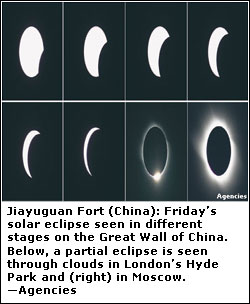 JIAYUGUAN FORT (China), Aug 1: Darkness fell on Friday over the last outpost of the Great Wall of China, where a rare total solar eclipse delighted sky watchers a week before the Olympics open in Beijing.
The dramatic spectacle — when the moon passes between the sun and the Earth — began in Canada, tracked across Greenland and crept into Siberia, before ending at sunset in China.
In north-western China, cheers went up from the Jiayuguan Fort as excited tourists welcomed the eclipse.
“It’s really doubly special, because I’m standing here on the Great Wall and watching it,” said Feng Lei, a backpacker from the south-western province of Sichuan, who was making his way to Beijing for the Olympics.
Eclipses were considered dark omens by ancient astronomers.
But many Chinese view this one as particularly fortunate, since it comes just before the torch is lit in Beijing for the Games, designed to restore China’s pride and showcase its achievements.
 “I have a really deep feeling, especially because it’s exactly eight days before the Olympics,” said Chuai Rui, a college student from Xi’an. Chinese consider eight a lucky number.
In Russia, thousands had flocked from around the world to Novosibirsk, awe mixed with excitement as day turned into night.
They gazed in wonder as an eerie silence descended on the Siberian city and gusts of unusually strong wind tore through the crowd. Birds stopped chirping and the temperature suddenly dropped.
“It’s very dramatic and awe-inspiring when the darkness suddenly comes,” said Jay Pasachoff, a professor at Williams College who led a team to Novosibirsk for his 47th eclipse.
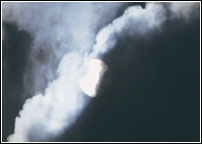
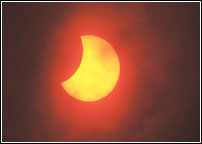 In northern Europe, a partial eclipse also drew thousands.
“There’s a strange light now,” said Norwegian astronomer and popular author Knut Jorgen Roed Odegaard as the midday light in Oslo grew slightly dimmer with a silvery sharpness. Families crowded into a park to watch images transmitted from an air force plane in the Arctic.
“You just feel part of nature ... This is so rare,” said Lev, a software specialist in St Petersburg.
In Pakistan and other Asian countries a partial eclipse was witnessed.
A NEW ERA: The Chinese hope the Olympics will usher in a new era where China is once more as modern, wealthy and important as it was more than 10 centuries ago, when imperial astronomers were among the world’s best scientists.
Chinese astronomers in the state of Lu, the present-day Shandong, carefully recorded solar eclipses that can be dated as far back as 720 BC.
Superstitious Chinese courtiers and peasants once banged drums to scare away the dragon they thought was eating the sun.
Eclipses were sometimes linked then to the death of emperors, said F. Richard Stephenson, who studies ancient eclipses.—Reuters