0
0

ISLAMABAD, July 30: The government on Wednesday reduced customs and deemed duties on petroleum products by 25 per cent and capped dealer commission and marketing companies’ profit margin, but decided to use the average Rs4.30 per litre saving thus achieved for budget financing, instead of passing on the benefit to consumers.
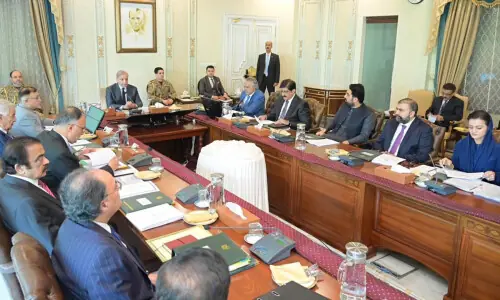
The decision was taken by the Economic Coordination Committee (ECC) of the cabinet at a meeting presided over by Finance Minister Syed Naveed Qamar.
The measures will be effective from August 1 and consumer prices will remain unchanged.
Mr Qamar told journalists after the meeting that the entire oil pricing formula had been changed in a way that all stakeholders of the oil chain would share the burden of higher international oil prices and contribute to efforts to contain budget deficit.
He said the deemed duty on locally refined products and customs duty on imported products had been reduced from 10 per cent to 7.5 per cent and dealer commission and oil marketing companies’ profit margin had been capped at the $100 per barrel level.
The minister admitted that oil marketing firms and dealers were making windfall gains because of a rise in international prices.
He said that oil companies’ margin should have been cut further, but since they were carrying the liability of petroleum differential claims they were facing some financial problems.
Mr Qamar said that main supply depots of oil companies had been reduced from 29 to 13 to cut the inland freight equalisation margin. He said the price gap between diesel and kerosene would be bridged to address the issue of diesel adulteration because a lower kerosene price provided an incentive for mixing kerosene with diesel.
He said the inland freight margin, which was currently being fixed by oil marketing companies to meet transportation costs, would now be determined by the Oil and Gas Regulatory Authority (Ogra). All these measures would provide an annual saving of Rs15 to 20 billion and it would be used for reducing fiscal deficit. He expressed the hope that a declining trend in international oil prices would help reduce the subsidy element and burden on the federal budget.
In reply to a question about the State Bank’s criticism of heavy bank borrowings by the government, Mr Qamar said the SBP governor should have told the truth and informed the nation which government had borrowed so much money.
He said the last government had borrowed Rs165 billion to pay petroleum differential claims to oil companies and did not show it in its accounts by parking this money on the books of oil companies. This had created a circular debt problem for public companies and resulted in higher inflation, he said, adding that the previous government had been meeting its financial needs by printing currency notes.
He said that former finance minister Ishaq Dar had told the nation soon after assuming office that about Rs500 billion actual debts had not been shown in the federal government’s account.
Mr Qamar said the present government would take stringent measures to control inflation. Had the central bank governor taken such strict measures during the previous government’s tenure, borrowing and fiscal deficit would not have reached such limits, he added.
The minister said the government would formally launch the Benazir Income Support Programme on August 14. Under the Rs34 billion programme, about 3.7 million families will be helped and each of them will get Rs1,000 per month.