0
0

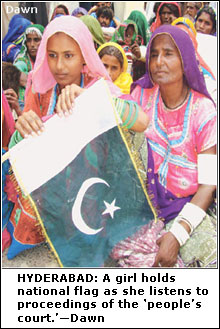 HYDERABAD, July 27: A ‘people’s court’ held by peasants outside the press club on Sunday found Abdul Rehman Marri, a powerful landlord of Sanghar district, guilty of kidnapping family members of Mannu Bheel, a liberated hari, who had been struggling for the release of his relatives for over a decade.
In an extraordinary show of support for Mannu, a large number of liberated haris held a rally followed by the ‘people’s court’ under the banner of Hari Himmat Welfare Society (HHWS) and People’s Development Foundation organised.
Raising slogans in support of Mannu, they called upon the PPP government to prove its commitment to people’s rights by abolishing feudal system.
The court heard Mannu’s case in detail in which the haris who testified against Rehman. He has again been cited as an accused in a case by Jhol police for keeping haris in bondage.
The Jhol case, they said, indicated that Rehamn planned to let loose a reign of terror against poor haris who had been in wrongful confinement at his lands, mostly in Sanghar and Mirpurkhas districts.
Comrade Ghulam Hussaini Malookani of HHWS alleged that Rehman was still holding Mannu’s family members in bondage.
“Private jails still exist in Marri’s village,” he said, taking note of the fact that whenever a bold and honest police officer tried to lay hands on him the official was transferred. “And this is happening again,” he said.
He referred to a raid conducted by Jhol police on July 15 under directives of Hyderabad Regional Police Officer (RPO) Fayyaz Leghari on the lands of Ali Ghulam Marri, Rehman’s nephew, in which police found 61 bonded labourers.
The footage of the raid had been shown on TV channels, he said.
Malookani said that haris had pinned high hopes on the government that it would get them liberated but nothing happened. The scope of the protest would be widened and rallies would be held in every district, he said.
He urged the government to prove its commitment to human rights by abolishing feudal system and called for the appointment of Hyderabad DIG Sanaullah Abbasi as inquiry officer of Mannu’s case. “Rehman had admitted that his relatives were involved in kidnapping of Mannu’s family,” he said.
He said that around 45 cases had been lodged against Rehman and his relatives but all of them were later cancelled. The cases should be reopened, he urged.
He accused Rehman of establishing a private check-post in his area. “In a district bordering with India Rehman’s men were armed with sophisticated weapons.
The government should, therefore, take notice lest it might have to face a situation similar to areas bordering with Afghanistan,” he feared.
Peasants Soomar Khaskheli and Naan Jee recorded their statements at the court and said they would not rest at peace unless the hostages were recovered.
“Rehman will again be hand-cuffed,” Naan Jee believed.
The Centre for People’s Empowerment and Equality chairperson Nasreen Shakeel Pathan, widow of Shakeel Pathan, who first raised voice for bonded labourers, said: “The government should ensure recovery of hostages.”
She referred to a report of Asian Development Bank which put number of bonded haris in Pakistan at 1.7 million.
Mannu reiterated the resolve in his statement before the court that his family members would be recovered provided the government took action against Rehman, who had been recently granted bail by Sindh High Court’s Hyderabad circuit bench on health grounds.