0
0

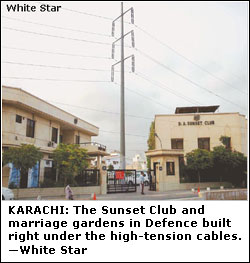 KARACHI, July 27: Hundreds of people visiting the Sunset Club and the adjacent marriage gardens in the Defence Housing Authority for recreation or attending ceremonies remain under the threat of electrocution as the vicinity has high-tension electricity cables passing overhead.
The land controlling authority concerned has set up the club at this site without taking into consideration the risk although the high-tension line may be there or planned to be erected much before the construction of the club. The power lines not only pose health hazards to the club’s visitors but may also cause fatalities in case of snapping of the cables.
According to some electrical technology experts, visitors to these spots are also exposed to the electro magnetic field created by the live current running in the high-tension cables.
The cables supply bulk electricity from the Bin Qasim power plant and other sources, including the Water and Power Development Authority’s (Wapda) national grid, to the city.
The huge towers and other structures holding the high-tension lines make a constant hissing sound affecting the hearing of the people around.
Intermittent sparks also cause panic among the visitors and other people present in the vicinity.
Responding to Dawn’s queries, DHA’s spokesperson Col Rafat Naqvi maintained that these high-tension lines were not passing exactly above the club or the marriage gardens though the were close to these establishments. He argued the cables were more than 50 feet above the ground level and the magnetic field created by the current remained restricted to 20 feet around these cables. As such, he said, the DHA establishments were safe.
Col Naqvi further argued that the club and the marriage gardens had been functioning for the last 15 years without any incident involving the power lines having been reported. “There are many residential areas in the city where such high-tension lines pass overhead and people live in the houses beneath them,” he added.
He said that the Karachi Electric Supply Company (KESC) did not raise any objection when the club and marriage gardens were being constructed.
“The KESC has never taken up this issue with the DHA even after the establishments started functioning. Had there been any objection, the DHA would have responded to it positively,” he said.
A spokesperson for the KESC said that the company had first obtained the right of way from the authority and then laid these high-tension lines some 25 years back. The area did not have much population at that time, he said, adding that the DHA had established the club and marriage gardens after the cables were laid and a few towers were installed within the compounds constructed later.
Referring to the prescribed rules, the spokesman said no residential or recreational facility could be established under these power lines. He said the KESC had sent several letters to the DHA in this regard but the DHA had never given a response, leave alone the relocation of the recreational spots.
A former chief of the Sindh labour department’s Occupational Safety and Health Centre, C.L. Nankani, said that establishing such spots under high-tension lines was very dangerous as the cables posed a serious threat to the lives of those present under the hanging cables.
The chief of the Institute of Engineers Pakistan, Zafar A. Zuberi said that living in or visiting the places located under high-tension wires must be avoided because of certain health hazards and even electrocution risk.
He said that snapping of the cables could cause instant death while the electromagnetic field around these cables and installations could affect the health of those coming close to them.