



 0
0

‘Salt mines can be exploited to tackle energy crisis’
 KARACHI: One of the major factors that have contributed tremendously towards making Pakistan economically weak is the failure of successive governments to explore mineral wealth and indigenous means for power generation.
Though the food and energy crises prevail throughout the world as oil prices continue to soar, developing countries like Pakistan are worst hit solely due to lack of proper planning and management on part of the authorities concerned.
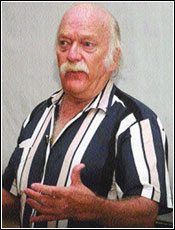
Dr Philip C. Goodell, an expert in geological sciences and an associate professor at the University of Texas, El Paso, who spoke to Dawn during his recent visit to Karachi, believes that Pakistan has a strong potential for mineral development. A number of options, both short and long-term, are available here to tackle the energy crisis as the country possesses renewable and non-renewable energy resources in abundance, he adds.
“Pakistan has great mineral wealth. But, there is nothing much happening here. I believe that maybe the laws are too restrictive to explore mining resources,” he observes.
With his interests in geo-chemistry, especially in the areas of semi-metal and sulfosalt, economic geology and mineralogy, Dr Goodell has been to several developing countries, including Egypt, Peru, China, Argentina and Mexico, and has worked on various projects. Sharing his observations, he discloses that all these countries wanted to develop their mineral resources and have succeeded in doing so after introducing certain amendments to their respective mining laws.
“Besides solar energy, you also have the option of setting up solar ponds and generating electricity from them. The huge salt reserves in Pakistan can be used for generating electricity, which can be transported to different places, including Karachi. The technology of generating electricity from salt ponds is proven and the infrastructure can easily be set up near a salt mine.”
Along with his colleagues, the expert researched on these lines and set up a plant that ran for 20 years. However, he says, money for the project dried up ultimately because of the lower oil prices in those days and no further investigation could be carried out.
He points out that the method of salinity gradient solar ponds is not only efficient for power generation but also helps desalinate water and produces medium-grade industrial heat.
Weighing the different short and long-term options to tackle the energy crisis in Pakistan, he says the country also has sustainable uranium and coal reserves that can be used for power generation, though construction of the required infrastructure may take many years.
“Electricity from uranium is cheaper than oil and coal, but its infrastructure incurs a lot of cost, mainly due to the requirement of safe disposal of waste. A power generating coal plant takes five years for completion while a uranium plant requires almost 10 years. The salt plant, however, completes in one year,” he stresses.About the reliability of a nuclear plant and the safe disposal of nuclear waste, he says, “A nuclear plant never explodes. There is a danger of radioactive contamination and the disposal of nuclear waste, which is not actually waste since 90 per cent of the energy is still there. After much debate and seeing what France has done, the US is also setting up three nuclear reprocessing plants,” the expert points out, suggesting that instead of opting for an independent reprocessing plant, two or three countries can jointly set up a reprocessing plant to save costs.
However, he makes it clear that there are different types of uranium and only one type can be turned into energy.
He says another option for electricity generation can be thorium – an alternative nuclear fuel to uranium. “The only country that successfully produces electricity from thorium is India. Considering the fact that the geological conditions in both countries are similar, Pakistan can also look for thorium reserves on its land.”
Describing the idea of using crops for making gasoline as ‘terrible,’ he says this will only lead to acute hunger and poverty. “Yes, oil is decreasing, but still there are enough energy resources in the world for every one of us,” he says.
“The important thing is how do we plan and use natural wealth,” he says, while laying emphasis on sensible use of natural resources, use of eco-friendly methods for exploration, measures to stop contamination and focus on recycling.
This approach can only develop if policy-makers are aware of the importance of geo-science and students are motivated to explore the world around them.
“Except wood and food, everything is produced by geologists who can educate about the sustainable use of resources. The science has been much neglected throughout the world, but it’s time that we make a beginning and change the approach,” he adds.
Load-shedding
Sir,
 The Karachi Electric (mis)Supply Company has been playing havoc with some portions of Nazimabad No 2, where presses are in abundance. They shut the lights the whole night on Sunday and resume supply only at 11am.
Then again the lights are shut at 2.30pm and restored at about 5pm. This is definitely not load-shedding but some sort of mischief on the part of the person in charge of the respective area. Every night for the last many days the lights go off late at night, after midnight, thus depriving the residents of their sleep. Excessive bills are sent and yet paid on time.
Can anybody at the top explain the point of load-shedding late at night? Why do they not fix a particular time, apart from the night, for all areas so that people can prepare themselves mentally and physically?
Recently I have been to Myanmar, which is one of the most backward and poorest countries in the world. They have got enormous power problems. Yet even they have set a routine timetable for load-shedding. People are mentally prepared and do their work accordingly. There is no unannounced load-shedding at all.
KASSIM YOUSUF
Via e-mail
Thank you PTCL
Sir,
My phone number (402-8559) has been dead for several weeks and only once have I been successful in getting my complaint tended to after registering it on the automated number, with complaint no 207 dated May 21. Since then all attempts have been in vain.
I expect the PTCL shall be fair enough to waive all due charges in lieu of the monthly bill inclusive of the ‘Pakistan Package,’ which I did not avail due to the faulty number, and shall look into the immediate repair of the fault!
GULZAR A. SHAIKH
Karachi
Development work
Sir,
Gulshan-i-Jamal, under the supervision of the Cantonment Board Faisal (CBF), is still in need of much awaited development work as promised by the CBF. Particularly, the entrance of Block C near a water depot is the worst affected area. With no proper entrance and exit for the residents, all efforts for development will be fruitless at the end of the day.
On top of this, the CBF has failed to notice the area opposite a mall that has been handed over for parking. To our knowledge, this area has been sold to the mall and an apartment complex for parking, causing much agony to the residents living just opposite the plot.
I request the authority concerned to take immediate action and provide proper link roads for Gulshan-i-Jamal, particularly Block C, and to abolish all such agreements to use the area opposite Block A as a parking space for malls.
MAHEEN KAMRAN Gulshan-i-Jamal
Drinking water
Sir,
We, the residents of Lal Quarters (District Council Housing Society), Model Colony, Malir Town, Karachi, are getting drinking water for 40 minutes on alternate days instead of a daily basis.
The drinking water is supplied with a bad smell and is mixed with sewage. The matter was reported to all those who are at the helm of affairs, including the town health officer, but so far nothing tangible has been done by the authorities concerned to alleviate our continuous suffering.
Can somebody save us from the impending disaster?
M.A. RAHMAN Karachi
Mangroves
Sir,
This is with reference to a report published in the Metropolitan section titled ‘Karachi being rapidly stripped of mangrove cover,’ (July 13, 2008).
The correspondent in the subject report has mentioned that the mangrove forests falling in the Korangi Creek system are under the jurisdiction and administrative control of the Defence Housing Authority, which is not correct.
No mangrove forests fall under the jurisdiction of the DHA.
SYED RAFAT HUSSAIN NAQVI
PRO, DHA Karachi
Over-speeding
in DHA
Sir,
This refers to the letter published in Dawn on Friday, May 30, 2008 titled ‘Speed thrills but kills.’
Being a parent, neighbour and a resident of the DHA, I don’t have words to express my grief with the family.
Unfortunately, it’s a usual occurrence on the streets of the DHA, especially on weekends and late hours, where reckless, intoxicated drivers roam around as if they are lords of the jungle. Over-speeding and drag-racing in narrow streets is a common feature.
However, one has to say that there has been no police action. Is there any FIR pending against anyone or the persons involved in the accident? Do the drivers of both vehicles involved possess driving licences? Who was on the wrong side? Who was over-speeding at the time of the accident? Have any medical tests for intoxicants or blood alcohol levels of the drivers involved been conducted?
Whatever action is taken the deceased will not come back, but at least we can learn from such a tragic event.
NAME WITHHELD Phase-V, DHA
Telephone tower
Sir,
We are residents of Block 15, Federal B Area, and this letter has been written to bring to your attention the placement of a large telephone tower at a house in Block 15.
The house where the tower is being installed has a very narrow street where not even two cars can be parked simultaneously. Moreover, the installation of this tower has also brought with it a large industrial-size generator, which emits toxic fumes and makes an awful noise.
The residents of the street are really frustrated and now look to the elected town nazim to solve this problem.
RESIDENTS
Block 15, FB Area
city@dawn.com
Civil disobedience
 Especially in the last century, civil disobedience has been used as an effective non-violent weapon to communicate to the powers that be a nation’s or group’s disagreement with a certain policy or point of view. The key to the whole game is remaining peaceful even in the face of possible repression and not resorting to violence and thus giving the state or other powerful actors a license to retaliate.
But in our society, destruction seems to top the agenda of most protesters and people tend to forget that for the successful use of civil disobedience, the presence of civic sense in a society is a must. Various ugly events in the city over the past few days amply illustrated that civic sense is a commodity that runs in rather short supply in the city of Karachi.
One of the most disturbing – speaking as an ordinary Joe with little interest in judges, juries, or their restoration – was the way in which protesters decided to vent their anger against a certain bank. Now I’m not here to take sides, as facts have probably been fudged on both sides, but very briefly, the protesters took to the streets protesting what they claimed were massive layoffs and cuts in the benefits plan by the bank, while the bank claimed the whole protest was being orchestrated by ‘outsiders’ and bank employees had nothing to do with it.
To cut a long story short, the protesters decided to lay siege to as many of the bank’s branches across the city as possible last Monday, and perhaps the biggest demonstration was organised outside the bank’s Karachi headquarters on I.I. Chundrigar Road. What resulted apart from smashed flower pots and ugly graffiti painted on the walls of the bank’s branches, was that several of the bank’s automated teller machines (ATMs) were disabled city-wide.
Who ultimately suffered? Was it the corporate captains of industry running the bank’s affairs sitting in comfortable boardrooms, who the protesters hold responsible for their grievances? Or was it normal people who could not conduct their routine business with the bank that day and for many days to come as several ATMs remained out of order for quite a few days? Was the mission of the protesters accomplished, or did this stunt generate them mostly bad press? The protesters need to ask themselves these tough questions.
Chairman Mao Zedong is reported to have said that justice flows from the barrel of a gun. In Karachi, it seems order and good sense only prevails after receiving the wrong end of a danda. Perhaps that is the sad reality of our times.—QAM
New life discovered underground
As people living in various parts of the DHA are aware, they recently uncovered the storm-drains – the ones built last year – for cleaning in case it rained.
That got rid of one nuisance – kids playing cricket. They kept losing their balls in the drains before they could bat them into your house and then ring your bell like madmen, asking for the ball back.
But now a new nuisance has arrived on the scene.
Walking at night, one sees shadows rising out of the centre of the street. It is dark and the things, whatever they are, don’t move like humans (poor fellows must be cramped from staying in there).
It is very spooky and one does not care if these creatures coming out of the ground are drug addicts, rag pickers or the Incredible Hulk. One just moves quickly in the opposite direction, no hello/hi.
Would the DHA please close off the drains again, so that people may stop living in them? Kids playing cricket and asking for their ball is little price to pay rather than being confronted by dark zombies who lurk under your street given the slightest chance.—Shahzad Hasan
City pets
Karachi, like everywhere else in the world, has its fair share of pet lovers who keep a wide variety of animals ranging from felines, canines, herbivores and in same cases carnivores also.
The most common form of pet is of course the kitten/cat and puppy/dog. There are at least one or two dog shows a year displaying the finest breed of canines in the city.
Children also keep rabbits, kittens and puppies as pets for which they care a lot, which is a good thing as it teaches them affection and compassion for all creatures great and small.
Then there are some people who keep aquariums or fish ponds and have swans and ducks in their spacious gardens.
Yet others have aviaries with rare and exotic birds while elderly folks are content with parrots and Persian cats.
The affluent class among Karachians can afford to cater to their whims and many maintain large menageries within their palatial bungalows, housing all sorts of animals like monkeys, chimpanzees, reindeer and even wild cats.
Speaking of wild cats and chimpanzees, I distinctly recall that many years ago, a certain well-to-do gentleman residing in the Clifton area decided to have two huge lions in a large cage inside his palatial bungalow, but in full view of the general public as the cages were on the outside wall.
People from every corner of the city would visit the house to gape at the king and queen of the jungle sitting imperially in their cages. It was only when a few conscientious citizens raised a shrill hue and cry about the inherent dangers of keeping such ferocious animals inside the city that the lions were donated to the zoo.
Lo and behold, it seems some people never learn and only last week someone more daring than the Cliftonian of yore was reported to have not two but five lions as pets inside his house and somehow one of the carnivorous man-eaters escaped and roamed the streets of the PECHS area.
It seems the animal had been well fed and was only on a sightseeing tour of the area, where it eventually ended up in a car showroom and perched itself in the owner’s office.
The panic-stricken gentleman left the premises in haste but had the good sense to trap the lion by pulling down the shop shutters before fleeing.
Game-keepers or zoo officials eventually managed to snare the beast and return it to the owner who has (believe it or not) a valid licence to keep his ferocious pets.
In yet another incident two chimpanzees escaped from the owner’s house and wreaked havoc near the Bahadurabad area causing traffic jams and damaging property.
The female of the species was caught but the male chimp had to be killed.
With animals already dying in the Karachi Zoo, what can one say? I guess I better check on my pet anaconda to ensure it has swallowed up a few of the neighbourhood cows.—Shahbaz Ali
KU crunch
It is indeed a poor and sad reflection of the state of our economic affairs that Karachi’s highest institute of learning, the University of Karachi, has fallen on bad times.
Although I cannot profess that the KU is my alma mater, nevertheless, being a Karachian I feel a certain affinity with the institution and feel obligated to speak up for the cause of higher education.
According to a recent news report, the KU is deep in the red as the federal government has withheld the grant of the last tranche of Rs8 billion to the Higher Education Commission, as a result of which the HEC will not be able to disburse funds to the KU.
There are about 20,000 students and 700 teaching staff who will have to directly bear the brunt of this fiscal deficit.
What is beyond my comprehension is that how can the powers that be give education – the most important issue of the times, along with health-care – less priority? Do they not realize that in doing so they are depriving the youths of their birthright? Without proper education, a nation can only regress.
The country is facing insurmountable problems from the price hike, power outages, crime, unemployment etc and sacrifices must be made and austerity measures adopted. But not at the risk of undermining education in the country.
The KU must initiate a self-generation scheme for funds and approach philanthropists and multinational companies for generous donations for when the cause is just, any sacrifice is justified. After all, education is the panacea for all ills plaguing this land and without it, well, may providence have mercy on us.—Syed Ali Anwer
Compiled by Syed Hassan Ali
karachian@dawn.com



























