0
0

 HYDERABAD, July 16: Abdul Rehman Marri who has become notorious for his alleged involvement in the disappearance of Mannu Bheel’s family and Mannu’s consistent struggle for their recovery since 1998, is out to resume the nasty business of bonded labour, according to recently liberated peasants.
More than hundred bonded peasants liberated by police in two successive raids on July 10 and Tuesday from the private jails of Ali Ghulam Marri, Rehman’s nephew, in 5-Dim village in Jhol of Sanghar district, alleged that Rehman had threatened to make them another example like Mannu.
On the basis of their statements, Jhol police had included Rehman’s name as one of the accused in the FIR lodged against Ali Ghulam Marri, Hakim, Gullo Khaskheli and Damo Bheel under sections 341, 342, 344 PPC and 11 of Bonded Labour System (Abolition) Act 1992, said SHO of Jhol police station Ahmed Bhatti.
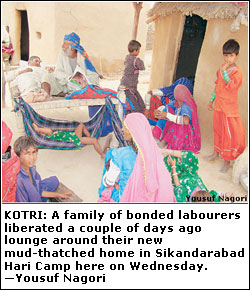
Police brought the liberated peasants to Sikandarbad hari camp with their belongings and household items. The camp has been set up on a vacant revenue land in Kotri taluka of Jamshoro district where haris, rescued from time to time by Special Task Force of Human Rights Commission of Pakistan (HRCP), are provided accommodation.
“When he visited his lands recently after release from jail he threatened me that Rano Bheel is becoming another Manu after submitting an application against him, lest his family should also go missing,” said Parbho, brother of Rano, who had submitted an application to Regional Police Officer (RPO) Hyderabad to secure release of his 58 community fellows.
“The zamindar and his armed henchmen including Munshi never gave us proper food or clothing. They subjected us to forced labour at the lands which we have been tilling for the past 25 years,” said Rano.
He said that their collective share in the annual produce, which stood at 3,500 maunds of wheat, and livestock were still in the possession of the landlord who never settled their accounts to determine their share in the crops.
Rano had approached Pakistan International Human Rights Organisation on July 12 and then he accompanied by Soomar met with RPO to seek assistance from police, which was provided on Tuesday.
At first the police officials were reluctant to raid Marris’ lands but they did it eventually. “It was only after Rehman’s release from jail that his gunmen chained us so that we should not flee,” said Rano.
During raids, police found six haris Khamiso, Sawan, Parbho, Jalloo, Amlok and Chanoo in chains. Parbho was chained to a fodder-chopping machine where was made to work.
According to him it was a long chain that allowed him to move within the room’s boundary. Others were chained to around 20 kg weight.
Rano said that he and his family were shifted to Achro Thar (an area located near Khipro in Sanghar) by the landlord following Rehman’s arrest and he was brought back to Jhol when emergency was imposed in the country in November last.
He denied stumbling on any clue to the missing members of Mannu’s family during his stay in Achro Thar.
Soomri, a liberated peasant woman, said wailing that her husband died during bondage when he was denied treatment of abdominal pain by the landlord’s men. “My husband kept imploring the landlord’s men but they didn’t believe him and forced him to resume work,” she said dejectedly.
Rehman was granted bail on health grounds on June 4 in the kidnapping case of Mannu’s family members by the Hyderabad circuit bench of the Sindh High Court.
He was on pre-arrest bail granted on Sept 27, 2004 by Mirpurkhas sessions judge before the now deposed Chief Justice Iftikhar Mohammad took suo motu notice and cancelled his bail on April 20, 2006.