



 0
0

Un-Islamic elements in Islamic mysticism
 In the introduction to his The Mystics of Islam, Reynold A. Nicholson, while referring to Sufism (or Islamic mysticism), says that it is “a subject so vast and many-sided that several large volumes would be required to do it anything like justice. Here I can only sketch in broad outline certain principles, methods and characteristic features of the inner life as it has been lived by Moslems of every class and condition from the eighth century of our era to the present day.”
How, therefore, can I rush where a scholar like Nicholson fears to tread? But it would be appropriate, perhaps, to quote from the same book a few more sentences so that readers may at least get a feel for what Sufism or mysticism is. In Nicholson’s words: “The whole of Sufism rests on the belief that when the individual self is lost, the Universal Self is found, or, in the religious language, that ecstasy affords the only means by which the soul can directly communicate and become united with God. Asceticism, purification, love, gnosis, saint-ship – all the leading ideas of Sufism – are developed from this cardinal principle.”
But let me quote from Aziz Ahmed’s book Studies in Islamic Culture in the Indian Environment (Oxford), too, where he criticises orientalists like Browne for their misleading theories of the ‘Aryan’ origin of mysticism and Goldziher, and others, for over-emphasizing “on the basis of analogy and conjecture and fragmentary evidence, the Hindu-Buddhist heritage of Sufism.”
 Aziz Ahmed, while appreciating Nicholson’s point of view that Sufism cannot be traced back to a single definite root and it was definitely not a product of Indian or Persian philosophy, quotes Arberry who says mysticism is “a constant and unvarying phenomenon of the universal yearning of the human spirit for personal communion with God.”
But one cannot help feel that even Nicholson has a tendency of drawing parallels between Christian anchorites and Muslim Sufis, between Christian Gnosticism and Islamic Sufism. He tries to trace the influence Neo-Platonism and Buddhism exerted in India and Persia. The existence of Greek, Hindu, Buddhist and Christian mysticism cannot be denied but the words ‘Sufism’ and ‘mysticism’ are not synonymous.
The word ‘Sufi,’ as Nicholson himself admits, has a religious connotation and is used in the context of Islamic doctrines. Sufism, as asserted by many scholars, basically has its roots and origin in Islam and Sufism’s metaphysical terminology has largely been derived from the Quran. Its many practices, too, have been derived from Islamic sources and not from Christian or Indo-Buddhist ones, as suggested by some.
Comparing Sufism with Hindu mysticism, or asceticism or quietism of any other religion for that matter, is therefore unjustified. Though in the latter part of the first millennium some theosophical rather than theological concepts infiltrated into Islamic Sufism through some Sufis who stressed the love of God and cognition of the Divine realities as an end in themselves, the origin of Islamic mysticism was Quranic in essence and thought.
Now raises the question of un-Islamic elements and practices of what is seemingly Sufism or Islamic mysticism. Many have expressed their views on the topic, which at times becomes too hot to handle as it involves answering some tough questions and some soul-searching.
Professor Yousuf Saleem Chishtie (1895-1984) was a person capable of handling the issue with emotional detachment as he was not only a learned person but also an authority on philosophy, Islamic history, Iqbal, mysticism and comparative study of religions. Tareekh-i-Tasawwuf, or the history of mysticism, is his book that thrashed the subject of mysticism and its origin with erudition and authentic references. When published in 1976 by the government’s Auqaf department, the book excluded a chapter ‘The intermingling of un-Islamic ideologies in Islamic mysticism,’ as it was bound to raise many heckles.
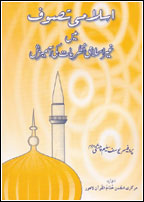
The proscribed chapter was separately published under the title Islami Tasawwuf Main Ghair Islami Nazariyat Ki Amezish but had since been out of print. When reprinted some years ago, it became immensely popular and subsequent printings had to be carried out. The present printing – the seventh – confirms its popularity as Urdu books rarely see the second printing or revised editions.
As mentioned by Maulana Ameen Ahsan Islahi in his preface to the book, the un-Islamic elements in Sufism bother a lot of educated people but it is generally construed in a different way and the blame is put on Sufism itself. The banned chapter published in book form makes one realise that if the book is any standard to go by, it is some other elements that are to be blamed.
The book is written with a specific point of view and presents one side of the argument with which many may or may not agree with. Though the author in his own opinion has tried to be objective and has based his arguments on historical facts, it, however, may be difficult for some to agree with the author. Proceed with caution.
Why do SHOs get shunted around
 Postings and transfers of station house officers (SHOs) do not seem to follow any rules. Their movement from one station to another is often beyond the understanding of ordinary people. Yet no change is made whimsically. There is always a reason. It may be political, punitive or pecuniary. During the last five months nine station house officers of the capital city were either removed, transferred or suspended from their posts.
A good enough reason for the transfer of one was his inability to curb crime in his area, while another was suspended for illegally detaining two persons at the police station. The reason for the removal and transfer of the other seven is not known since their performance was good in their respective areas. Such changes are often presumed to be of a political nature which was expected as new governments always bring in their blue-eyed boys.
The power to remove, transfer or suspend an SHO of his area lies with the senior superintendent of police (SSP) but he has to produce some reason to justify the change. And certainly this becomes quite problematic when there is political figure exerting influence to move some unwanted SHO for a favourite and the SSP for his own good cannot spill the beans. In Islamabad other than inefficiency in curbing crimes an often cited reason is failure to produce satisfactory results in investigations of pending cases. Complaints from the public which the press has played up also result in transfers but that is mostly an eyewash.
The SHOs are regarded as the kings of their area and can utilise their powers in their own personal interest. Some SHOs have their side businesses, including property dealership, which they run more successfully than ordinary dealers owing to their powers as administrators of law in their station areas. For this reason SHOs often seek postings at their choice stations.
Last March the then SHO of the Secretariat Police Station, Inspector Khursheed Khan was removed from the post. The reason was not known as his performance was satisfactory. He was replaced by Inspector Mohammad Nawaz Bhatti. On April 17, the then SHO of the Sabzi Mandi, Inspector Khalid Masood was removed from his post and transferred to Anti-Car Lifting Cell due to his failure to curb crime in his area. His removal took place following adviser to the prime minister, Mr Rahman Malik’s stern warning against SHOs’ failure to curb street crimes. It was interesting that the Cell was given in the charge of someone who had failed to curb similar crimes in his jurisdiction.
Then there is the case of Inspector Mohammad Safdar who was appointed as SHO of the Sihala police station on June 16, replacing Inspector Qasim Niazi, was sent to Police Line Headquarters, though he had performed well. Unfortunately this officer lost his life on July 6, in a suicide attack near the Aabpara police station while performing duty at the outer cordon.
The Secretariat police station SHO was suspended on account of an incident on June 20, in which an unidentified man broke into the suite of an MQM member of the National Assembly in the Parliament Lodges and scrawled abuses on the walls against his leader Altaf Hussain. Mohammad Nawaz Bhatti’s fault was that he had failed to promptly inform senior officers about the incident. Diplomatic Protection Department is responsible for security arrangements in and around the Parliament Lodges. Inspector Altaf Aziz Khattak replaced him.
The Aabpara police station SHO, Inspector Abdul Rasheed Niazi, was suspended from the post on the night of July 5, when the PM’s adviser on interior found two persons in illegal detention at the police station. The adviser also ordered to register a case against him along with two other police officials. The police was detaining them to trace their accomplices in a case of theft. In another case of detention for over a week no notice of the act was taken because the detainees were involved in a VIPs security matter that the said adviser’s family had reported on June 19. The family of the adviser, including his son, had gone to the Super Market for shopping where they spotted five persons acting suspiciously. They alerted the security men escorting them who called police and got the them arrested. They remained in policy custody illegally for a week and were released after verification of their identities.
Similarly another nine persons were arrested by the local police on the orders of adviser Rehman Malik for manhandling a journalist on July 5. The accused were put behind bars and a criminal case under sections PPC 147 (punishment for rioting) and PPC 149 (unlawful assembly), PPC 500 (punishment for defamation) and PPC 506 (punishment for criminal intimidation) was registered against them. They were released on bail against Rs20,000 bonds from the court of law.
The SHO, Kural police station, Inspector Mohammad Hussain Lasi, was transferred to the Secretariat police station investigation wing on July 7. In his place Inspector Arshad Mehmood has been transferred from the wing to the Kural police station as SHO.
On the same day, Inspector Liaquat Ali Langa was appointed SHO at the Sihala police station. After five days he was transferred to the Tarnol police station to replace Inspector Tanveer Ahmad Abbasi, who was transferred to the investigation wing of the Shahzad Town Circle.
During four months, he arrested outlaws allegedly involved in drugs and arms trafficking and recovered huge quantity of illegal arms and narcotics. Recovery of narcotics and arms in the last four months in his area is estimated to exceed the amount recovered in the last four years in the city.
Inspector Hakeem Abdul Razzaq was appointed as new SHO of the Sihala to replace inspector Langa. He was transferred from Diplomatic Protection Department.



























