0
0

 KARACHI, July 13: Geographically placed at a unique location, Pakistan is home to a wonderful variety of plant life. However, it’s unfortunate that no infrastructure exists at the grass roots level to tap the country’s potential in floriculture.
With the acute shortage of water in the interior of Sindh and rising inflation, farmers are selling land and migrating to urban areas, while at the country’s biggest flower market, located in Karachi, huge stocks of flowers are wasted only because there is no system to make value-added products from them.
This is the gist of the information gathered from different traders and farmers whom this reporter talked to, to discover their problems and explore the potential of floriculture in Sindh. When asked if any flower industry exists in Pakistan, Khalil-ur-Rehman, who has been in the business for three decades, says:
“The little we export is of no economic value while no infrastructure exists at the grass roots level to boost the local market. The result is huge losses and market instability; not only do farmers fail in getting the right price and consumers remain at the losing end, but flowers in large numbers are wasted while they are being transported and sold in urban markets.”
Successfully running three outlets in the posh areas of Karachi, Rehman today is a content man. But, unfortunately, this is not the case for many others engaged in the same trade, as they daily have to face new challenges at the Teen Hatti market, considered Pakistan’s biggest flower market.
“Today, the market has opened a little late because transporters were stopped from unloading flowers on the road by town officials.
The matter was resolved after some ‘agreement’ was reached between the two parties,” Hanif, a flower-seller at the market, tells this reporter.
“This is not a proper market. The land is not on lease,” he adds, “The flower market was initially set up in Jodia Bazaar’s Jinnah Market. Then it went to Jubilee Market from where people shifted their businesses here in Jamshed Town when some quarters were demolished to make way for a road about four decades ago. The land was soon taken over and now there are about 30 to 40 shops at Teen Hatti, most of which are on rent while hundreds of people work as labourers.”
The flower-sellers sitting on the roadside seem to be more perturbed with the situation as they reportedly pay monthly bhatta, or extortion, to the police. “We are not allowed to do business on the road. But what option do we have if the city government does not set up a proper flower market?” says one vendor.
Tuberoses wasted
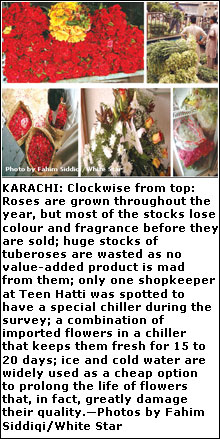
As dozens of workers unload consignments of roses, tuberoses, marigolds, statice, gladiolus and cut-flowers, the market comes alive with fragrance, adding a touch of freshness to the otherwise polluted air, heavily laden with the smell of diesel. The riot of colours is indeed eye-catching. What is ironic, however, is to see countless rose petals and tuberoses being trampled upon during the process of unloading and shifting.
The loss of tuberoses is high since the stocks are plentiful these days.
“June and July is the peak season of tuberoses, which come in large numbers from the interior of Sindh. Often tuberoses are just thrown on the road here when they fail to fetch the required price,” says Sohail Akbar Qureishi, a shop owner at Teen Hatti who also exports dry rose petals.
About the loss of tuberoses, he says that unlike other flowers which are transported in baskets or crates, tuberoses are sent in open bunches.
“They sell very cheap in season and are kept only for decoration purposes. No value-added product is made form them. I once tried to export them, but failed. My flowers were rejected because they were not as fresh as Egyptian tuberoses. On the contrary, our larian and kangan of motia are in great demand in Gulf countries. The surplus rose is dried and also sent abroad to different countries,” he says, adding that the export of dry rose petals was not profitable and he had to do it to prevent the wastage of flowers.
The use of ice and cold water as a cheap source to prolong a flower’s life is also common, though it damages the quality. This reporter could spot only one shop with a proper flower chiller at Teen Hatti.
“People who run the business are, by and large, uneducated, who consider the use of a chiller as damaging and are not ready to invest money. In fact, it’s a certain temperature which is important to help flowers keep their freshness,” Khalil-ur-Rehman says.
About the difference between local and imported varieties, he says: “There is no comparison. Imported flowers are stronger, more beautiful and long-lasting. Abroad, they sell a stick and we a bunch. That’s the difference which has been made with investment and research.”
Homes of flowers
According to flower-sellers, Teen Hatti’s market also fetches about 30 to 40 per cent of flowers from Pattoki’s market in the Punjab. About 20 to 25 mini-trucks carrying tons of flowers arrive daily in at the market, which is mainly supplied by the area between Gharo and Thatta and Hatri, a town in Hyderabad district. Hatri is popular for roses, tuberoses, motia and
dehla (local name, a species of jasmine), which is planted as a replacement of motia in its off-season, though some farmers also cultivate marigolds, statice, gladiolus and cut-flowers, depending upon the season.
“Flowers are also grown in Matiari and if we move towards Tando Jam from Hyderabad, about 200 to 250 acres are also under flower cultivation,” says Dr Nadeem Shah, a practicing doctor and farmer in Hyderabad.
The majority of cut-flowers, that comprise only roses, come from Pattoki. These days, marigolds and statice are coming from Quetta and gladiolus from Ughi, Mansehra. A local variety of jasmine – chandni – is grown in Gadap, Malir, Gharo and Thatta.
Many flower shops in posh areas also import flowers. Some imported varieties include lily, rose, chrysanthemum, carnation, gypsophila, orchids, anthurium, zantedeschia, portea, hydrangea, heliconia, birds of paradise and cymbidium, which are grown in Kenya, Malaysia, Thailand and China. Most of the shipments arrive directly.
Talking about the problems in the interior of Sindh, Dr Shah says that flower cultivation is mostly done by farmers with small to medium tracts of land, who, under a contract, are bound to sell their produce at a fixed rate throughout the year, notwithstanding the supply and demand situation.
“City traders make a lot of money by raising prices at their whim, off and on, depending upon occasions. For instance, the sale of roses increases on Shab-i-Barat, and so does its price. But farmers are paid the same price. These days, farmers are being paid Rs2 for a bunch of 24 tuberoses, which are sold for Rs10 in the city.”
He suggests that a wholesale market in the interior of Sindh could end the exploitation. In the absence of any government strategy to strengthen infrastructure, he says, the area under flower cultivation has also reduced over the years.